
PERMISSIONS · FIELD ETHICS
The UK responsible metal detecting code
Put the UK responsible metal detecting code into practice: permission, protected ground, careful recovery, accurate records and prompt reporting.
Get consent for the exact ground and method before switching on.
Stop when a find or its setting needs specialist assessment.
Record and report archaeological material through the correct national route.
What is the responsible detecting code?
The Code of Practice for Responsible Metal Detecting is an agreed standard for hobby detecting in England and Wales. Historic England explicitly expects detecting to follow the current Code as well as landowner permission. It is not a blanket permit, a substitute for statutory consent or a promise that every buried item belongs to its finder.
For a typical permitted field, the code translates into five decisions: where you may search; how you avoid damage; when to stop recovering; how you keep findspot evidence; and whom you tell afterwards. The right decision may be to leave a signal untouched.
Before you go: four checks
- Confirm the authorised person and exact boundary. A tenant, landowner and event organiser can have different rights. Keep a map or written permission that identifies the parcel and agreed digging method. Our permission agreement guide gives a usable checklist.
- Check designations and local rules. A scheduled monument needs statutory consent; walking access, council ownership and a public beach are not automatic detecting permission.
- Ask about the land. Agree crops, livestock, gates, vehicle access, depth limits and whether wet turf should be left alone. A field that is searchable in one season may be unsuitable in another.
- Plan recording and reporting. Know the correct national finds route before a discovery, especially if searching near a county or national border. Keep a phone, location method and simple numbered bags or labels ready.
Recover without erasing context
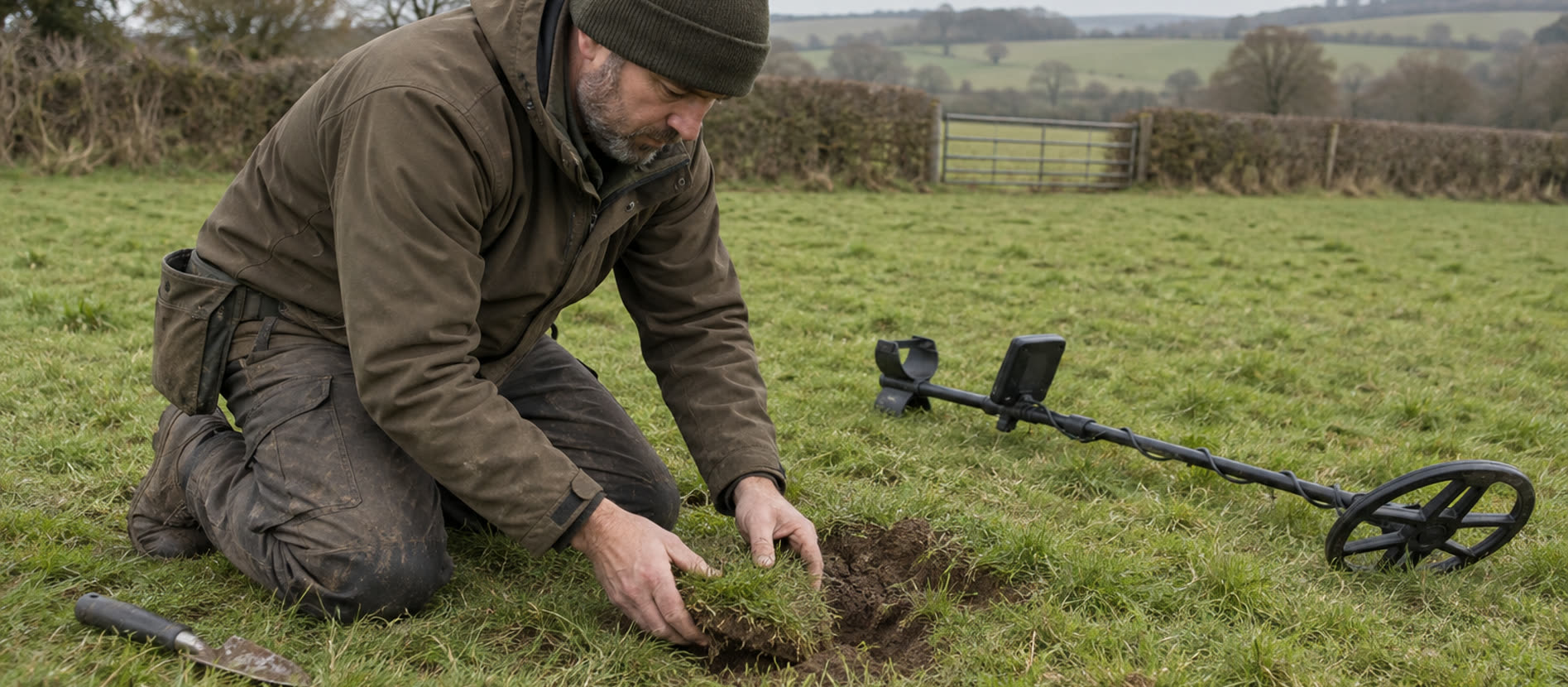
Swing within the agreed area and use repeatable signals to narrow a target before digging. Cut only the plug needed for a permitted recovery, keep spoil close and replace turf so that animals and people are not left with holes. Do not use a spade to force an object from a hard layer or cut through a feature.
An isolated modern object in loose topsoil is different from a vessel, a cluster of coins, human bone or a concentration of material emerging from an intact layer. At that point, stop widening the excavation. Photograph the setting, record a location from a safe position, protect the site from casual disturbance and seek advice. Our grouped-finds guide explains why nearby objects should not be treated as separate lucky signals.
The pouch is for ordinary recoveries on authorised ground. It is not suitable for suspicious ordnance, human remains or an unassessed fragile assemblage. See dangerous finds for the stop-and-leave response.
Record first, identify later
Give each recoverable find a field number linked to a precise position, depth, photographs and the landowner agreement. Keep potentially related objects together in your record while physically separating them for protection. Do not rub away soil or patina simply to make a social-media identification easier. The record-a-find guide provides a field log format and photography sequence.
For archaeological objects in England and Wales, a Finds Liaison Officer can advise on recording through the Portable Antiquities Scheme. Potential Treasure has a separate statutory deadline; the GOV.UK Treasure service is the official starting point. Scotland and Northern Ireland have different rules, so use the country in which the object was found.
Leave the place and the relationship intact
Remove safe surface litter where the permission allows, but never handle an unknown hazardous item to tidy a field. Close gates as agreed, avoid disturbing wildlife or livestock, and tell the landowner what was found and what was reported. A responsible day ends with an accurate log and intact ground, not just a full pouch.
This code is a minimum standard of conduct, not a shortcut around ownership. Our finds ownership guide explains why finding an item and owning it are different questions.
Common questions
Frequently asked questions
Is the responsible detecting code a legal permit?
No. The Code is a good-practice standard. You still need land permission, must check protected-place restrictions and must meet applicable finds-reporting duties.
Does permission from a farmer mean I can dig every signal?
No. Follow the exact recovery terms, avoid damage and stop if you encounter a feature, possible group, hazardous object or protected context.
Should I record ordinary finds as well as valuable ones?
Yes. A field number, accurate position and basic photograph help preserve context. Archaeological finds may also merit PAS or another national reporting route.
Does the Code apply in Scotland and Northern Ireland?
The published Code is a good-practice reference, but country-specific permission, protected-site and reporting laws still apply. Check those rules separately.
Helpful products
Keep ordinary finds separate
A divided field pouch helps keep numbered ordinary finds away from sharp litter; use suitable rigid protection for fragile material.

All-round field pouch
XP Finds Pouch
Best for: Regular field and wet-weather searches where quick debris storage and a separate protected pocket matter.
- Open pocket plus zipped pocket
- Washable with water drainage
- Belt, strap or MOLLE mounting
A washable belt pouch with an open debris compartment, a zipped pocket for better finds, drainage and MOLLE attachment points for a pinpointer holster or lanyard.
Know before buying: The open section is for robust scrap, not fragile objects; use a rigid finds box inside the zipped area for coins and delicate artefacts.