
FINDS CARE · CONTEXT
Recognising grouped metal detecting finds
Spot possible grouped finds, coin concentrations and associated objects; record the context, stop widening a hole and get the right UK reporting advice.
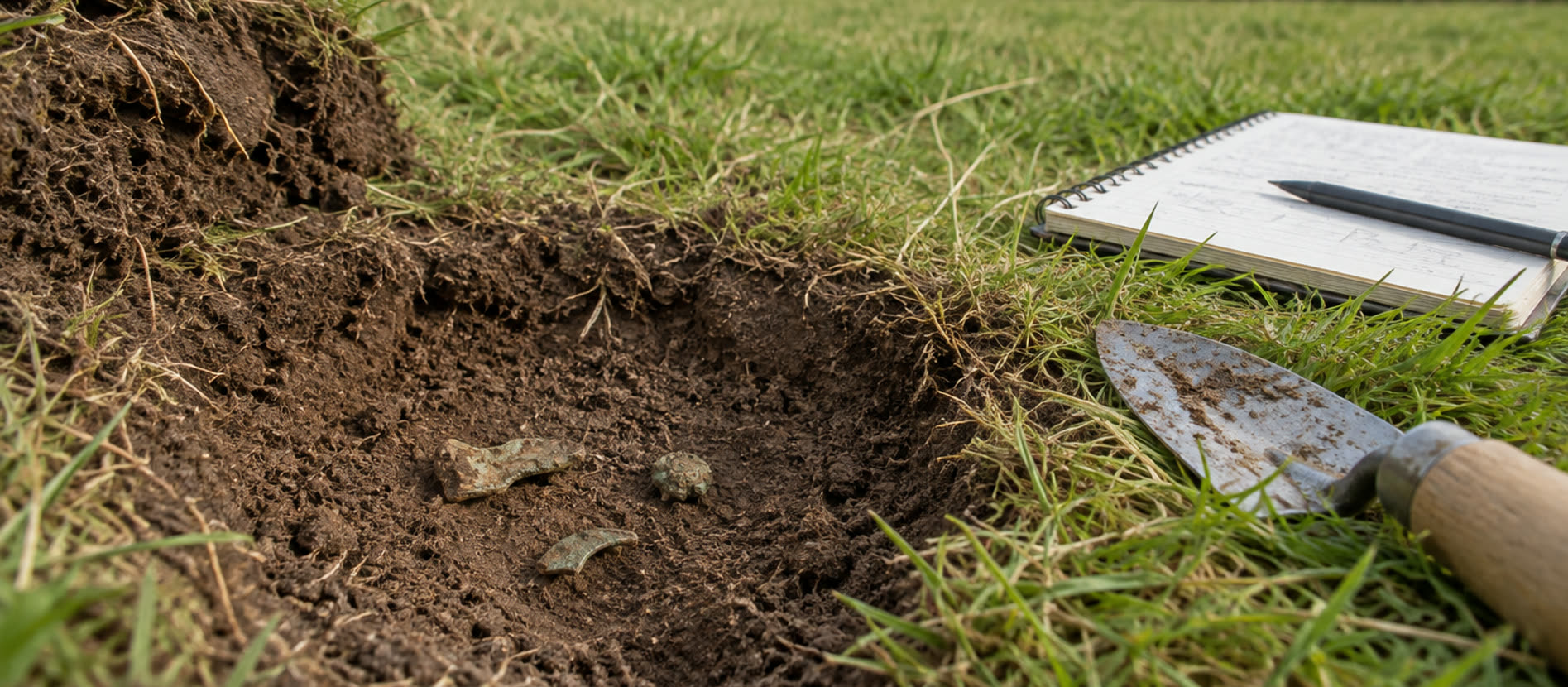
Note each object's position and relationship before moving anything.
A group may change Treasure or other reporting duties.
Do not divide, clean, sell or redistribute an unassessed assemblage.
What counts as a possible group?
Two finds in one hole are not automatically a hoard. They may have reached the soil at different times. But a concentration of coins, several matching fragments, a container, an intact layer, a spread of fittings or objects that physically join should change your behaviour. The critical question is whether their relationship may carry information that further digging would destroy.
Potential group indicators include:
- objects touching or clustered within one plug or small area;
- similar coins or fragments appearing repeatedly in a tight pattern;
- pottery, bone, charcoal, stonework or a vessel with metal;
- a compact layer or feature different from ordinary loose topsoil;
- two pieces that appear to belong to the same item.
None is a field diagnosis. They are reasons to pause. Historic England's portable-antiquities guidance treats context and responsible collection as central to useful archaeology.
The stop-and-record response
Stop widening the hole or chasing adjacent signals. Leave material in place where possible and safe. Photograph the general setting, the exposed objects and their relative positions with a scale. Note a precise position, depth, visible layer and how the objects relate to the original signal. Do not clean an edge to prove that two fragments join.
Inform the landowner or authorised manager and contact the appropriate heritage professional. In England and Wales, your local Finds Liaison Officer is a useful starting point; a possible Treasure find must also follow the statutory reporting route promptly. The legal definition can include associated objects and groups of coins, so do not decide the whole issue by checking whether one piece looks valuable. Use the current GOV.UK service for the official process.
Scotland uses Treasure Trove, while Northern Ireland has its own archaeological-object and Treasure duties. The landowner's permission is not a substitute for those rules.
For routine isolated objects, numbered rigid containers in a field pouch help preserve identity. Do not scoop a possible group into one pocket, or keep searching because the pouch has space. Wait for advice on excavation and packaging.
Why location and association matter
A group can show when a place was used, whether an object broke there, or how material entered the ground. If pieces are cleaned, mixed or separated among people, later specialists may be unable to reconstruct that relationship. Our photographing-finds guide and record-a-find workflow show how to create a numbered photographic and written record without inventing an identification.
Keep any object already recovered with its own field number and container, while linking those numbers as a provisional group in the log. Do not put adhesive on finds or silently reassign their findspots after an expert changes the interpretation. Record what you observed, what you moved and when you stopped.
If the group is dangerous or contains bone
Possible ordnance or human remains change the priority from archaeological documentation to safety. Stop, move away and follow the dangerous-finds guidance. Do not approach to improve a photograph or map. Emergency responders and relevant professionals should direct the next step.
Common questions
Frequently asked questions
Are two objects in one hole automatically Treasure?
No. But their association can matter, so stop and record the positions rather than deciding status by appearance. Seek the correct reporting advice promptly.
Should I keep searching for the rest of a possible hoard?
No. Stop widening the hole, document what is exposed and seek heritage and statutory reporting advice before further recovery.
Can I clean and divide a group with the landowner?
Not before status, ownership and reporting are resolved. Cleaning or splitting can destroy context and complicate a possible Treasure assessment.
What if a group includes possible ordnance or human bone?
Safety takes priority. Leave the material undisturbed, move away and contact police or emergency services as appropriate.
Helpful products
Keep authorised routine finds numbered
Separate containers in a pouch help with ordinary isolated finds. A possible group is a stop-and-seek-advice case, not a reason to fill more compartments.

All-round field pouch
XP Finds Pouch
Best for: Regular field and wet-weather searches where quick debris storage and a separate protected pocket matter.
- Open pocket plus zipped pocket
- Washable with water drainage
- Belt, strap or MOLLE mounting
A washable belt pouch with an open debris compartment, a zipped pocket for better finds, drainage and MOLLE attachment points for a pinpointer holster or lanyard.
Know before buying: The open section is for robust scrap, not fragile objects; use a rigid finds box inside the zipped area for coins and delicate artefacts.