
Places · Beaches
Beach metal detecting in the UK
Plan a lawful UK beach metal detecting trip by checking foreshore ownership, local restrictions, tides, detector suitability and find-reporting duties.
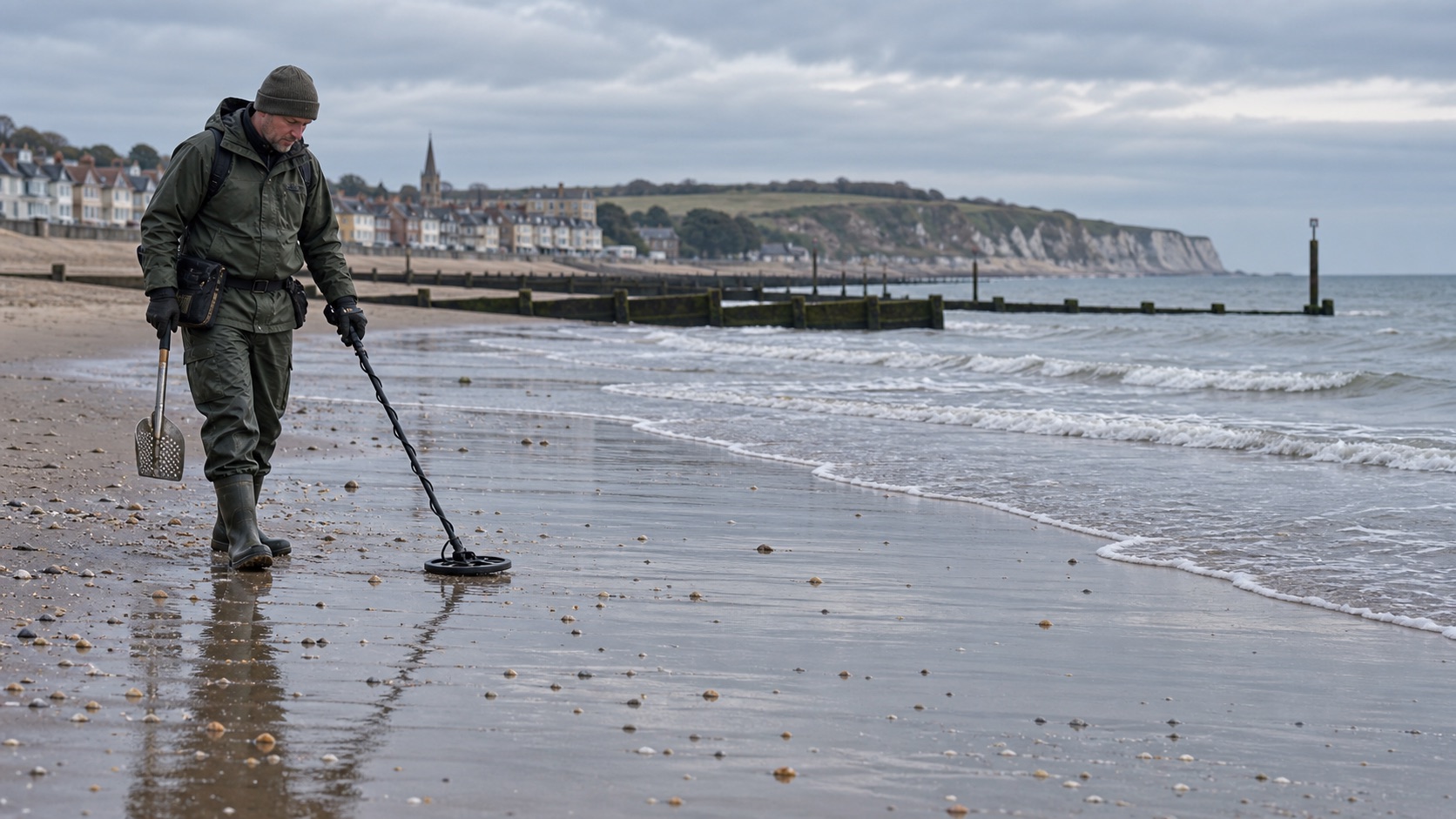
The Crown Estate permissive right applies only to foreshore it owns and is subject to its terms and third-party rights.
Local authorities, leaseholders and protected-site rules can still restrict detecting.
Recovered wreck material must be reported to the Receiver of Wreck within 28 days.
Where beach detecting can be possible
The most useful UK beach locations are not necessarily famous resort names. They are stretches where ownership is clear, detecting is permitted, local restrictions have been checked and the tide leaves a safe working window. A quiet, well-understood local beach is usually a better starting place than a long trip based on an old forum post.
The Crown Estate's metal-detecting guidance says people may search foreshore it owns without applying for formal consent, subject to its terms, third-party rights and other restrictions. Foreshore means the land between mean high water and mean low water. That permission does not extend to the seabed, river beds, the River Thames foreshore or other Crown Estate land.
The Crown Estate owns only part of the foreshore around England, Wales and Northern Ireland. Use its ownership map for the exact area; do not infer ownership from the county or beach name.
Five promising beach types
Managed resort beaches with clear council guidance
Some councils publish a specific metal-detecting policy and identify beaches where individuals may search. These can be practical for modern losses because access, parking and exit routes are clearer. Check whether the beach is leased, whether group events need separate approval and whether seasonal or local byelaws apply.
Crown Estate foreshore without a listed conflict
After checking the ownership map, read the current terms in full. They require shallow, responsible investigation, refilling holes and compliance with reporting rules. Third-party rights, local authority restrictions, Sites of Special Scientific Interest and Marine Conservation Zones can affect the apparent permission.
Private or leased beaches with written consent
Ownership above the mean high-water line can differ from the intertidal strip. A hotel, estate, harbour authority or beach business may manage part of the site. Ask the party with authority to permit detecting and record the agreed area, dates, recovery method and finds arrangement.
Club-organised beach searches
A reputable local club may already understand ownership, access and expected conduct. Confirm that the organiser has the necessary permission and insurance rather than assuming an event notice settles every issue. The participant still remains responsible for safe behaviour and statutory reporting.
Dry-sand practice areas
Dry sand is usually easier for a beginner's first beach session because digging is simple and salt response is reduced. It can also contain dense modern litter. Use a broad-acceptance mode at first, learn how bottle caps and foil sound, and fill every hole so the surface is safe.
How to check a location before travelling
- Identify the exact search strip on a map, including access and the mean high-water boundary.
- Check the Crown Estate foreshore map or contact the known owner or managing authority.
- Search the local council's current beach rules and byelaws; ask if the wording is unclear.
- Check scheduled monuments, protected wrecks and environmental designations.
- Read the current permission terms and record any depth, tool, event or reporting conditions.
- Check local tide times, weather, daylight and the exit route for that day.
This process avoids a misleading “best beaches” list that becomes wrong when leases, byelaws or conservation controls change.
Tide and surf planning
The Met Office's beach and tide guidance warns that tide times and heights change daily, the water does not advance at a constant rate, and an incoming tide can cut off a return route. Its displayed times relate to the nearest tidal station and local conditions can differ. Use local information, observe the water continuously and leave a generous margin.
Never work into a cove or beneath cliffs without a clear escape. Avoid soft mud, unstable cliffs, groynes in heavy surf and isolated tidal flats unless you understand the local risk. If cut off by the tide, call 999 and ask for the coastguard.
Dry sand, wet sand and shallow water
Dry sand is less electrically demanding and can suit many beginner detectors. Wet salt sand is conductive, so single-frequency machines may chatter or lose useful sensitivity. A simultaneous multi-frequency detector with a dedicated beach profile is the strongest general starting point.
For shallow water, choose a genuinely waterproof metal detector and compatible waterproof headphones. A waterproof coil alone does not protect the control box. The best beach detector guide compares suitable models in more detail.
For a mixed dry-sand, wet-sand and shallow-water plan, the X-TERRA ELITE is a relevant step-up example: its complete housing is rated to 5 m and its Multi-IQ system includes separate Beach 1 and Beach 2 profiles. It is more detector than an occasional dry-sand search requires, and its ordinary wireless headphones are not an underwater accessory.
Digging and beach etiquette
Use only the tools permitted by the owner and current terms. Recover shallowly, keep spoil controlled and refill every hole. Stay clear of swimmers, anglers, wildlife, lifeguard operations and other visitors. Remove sharp modern rubbish safely; do not leave it beside a bin where it can injure someone.
The Crown Estate terms do not authorise excavation into hard-packed subsurface. If an object appears embedded, associated with archaeology or beyond the permitted method, stop and seek advice rather than expanding the hole.
Treasure, wreck and other finds
Possible Treasure in England or Wales must be reported through the official Treasure process within 14 days of finding it or realising it may qualify. Wreck material—including parts, cargo or equipment from a vessel found on the seashore or in tidal water—must be reported to the Receiver of Wreck within 28 days of recovery.
Do not assume an unreported object becomes yours. Finds above low water are generally connected to land ownership unless Treasure or another legal regime applies. Record the precise location and condition before cleaning. Our England and Wales guide gives the wider checklist.
A simple first beach plan
Choose a council-documented or clearly mapped stretch, begin on open dry sand, take a charged phone and tell someone your return time. Arrive with enough time to observe the tide and leave before the route narrows. Use a moderate sensitivity, overlap each sweep and recover a mixture of modern rubbish so you learn the beach rather than chase only high IDs.
Pack gloves, a finds pouch with separate sharp-waste space, a suitable scoop or tool and fresh water for rinsing equipment later. The equipment checklist covers the rest of the day bag.
Common questions
Frequently asked questions
Do I need permission to metal detect on a UK beach?
Yes. Ownership and detecting conditions vary by beach, and local bylaws, leases, protected areas or land-manager rules may apply. Check the current permission for the exact stretch before searching.
Is wet sand harder to detect than dry sand?
Usually. Conductive salt can make unsuitable detectors noisy or unstable. A beach mode, careful sensitivity adjustment and suitable multi-frequency or pulse-induction technology can improve wet-sand performance.
What safety checks should I make before a beach search?
Check tide times, weather, access and exit routes, and avoid unstable cliffs, soft mud and isolated sandbanks. Keep clear of wildlife restrictions and never rely on detecting equipment for navigation.