
Technique · METHOD 13
How to swing a metal detector properly
Learn correct metal detector sweep height, speed, overlap and cross-checking for cleaner signals and more complete ground coverage.
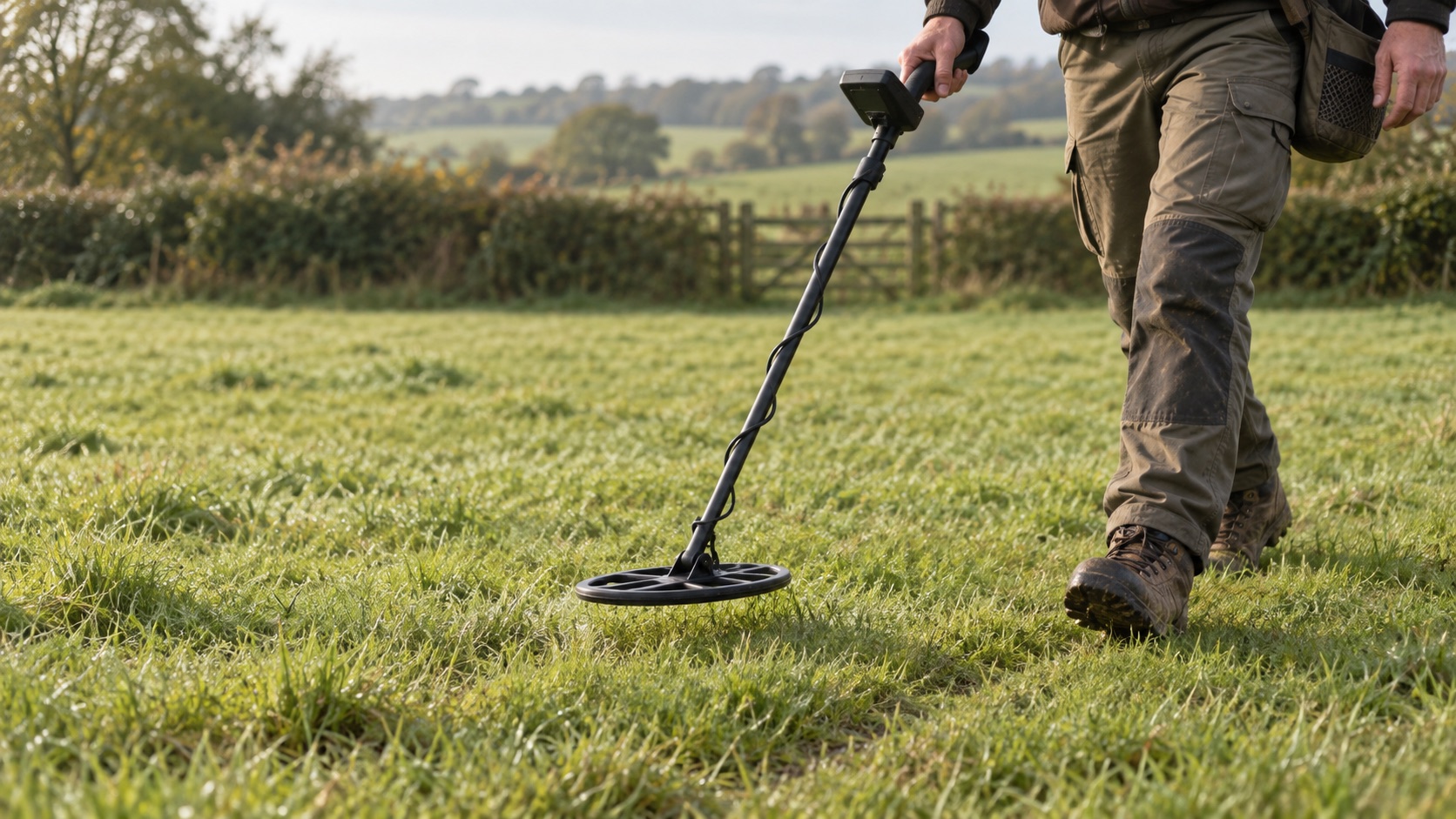
Swing from the shoulder with a relaxed grip; do not steer the coil mainly with the wrist.
Raising the coil at each end loses effective coverage and can create ground-response changes.
The correct speed is the one the detector manual recommends and the target density allows.
Set the detector to your body first
Stand naturally in the footwear you will use. Adjust the shaft until the coil can rest just above the surface 20–30 cm in front of your leading foot while your elbow remains slightly bent. The arm cuff should support the forearm without squeezing, and the grip should not force the wrist sharply up or down.
Too short a shaft makes you stoop and sweeps a tight arc around your feet. Too long a shaft pushes the coil away, increases leverage on the shoulder and encourages a high swing. Adjust straps and cable routing before increasing sensitivity or blaming the detector for an uneven response.
Keep the coil parallel with the ground
The search field is most consistent when the coil follows the surface at a steady height. A common beginner movement resembles a pendulum: the coil is low in the centre and rises at both ends. Those raised edges leave shallow gaps and change the detector's relationship with the ground.
Use a smaller, comfortable arc and guide the coil around the body rather than lifting it. On a slope, follow the contour rather than trying to keep the coil level with the horizon. Over stubble or stones, accept a slightly higher consistent height instead of repeatedly striking the surface.
Choose a sweep speed the machine can process
There is no universal metres-per-second number. Detector recovery processing, the selected mode, coil, target density and ground all affect a useful pace. Start with the manual's recommendation and slow down when responses overlap or become clipped.
A sweep that is too fast can smear closely spaced targets and makes coil height harder to control. Moving extremely slowly is not automatically deeper and may weaken response on motion-based modes. Listen for complete, repeatable sounds rather than chasing a dramatic speed.
Overlap every pass
The coil's advertised diameter is not a promise of equal sensitivity across its full width at depth. Overlap each sweep by roughly a third as a starting habit, then tighten the overlap around a productive patch or dense iron. Advance a small step only after completing the arc.
Use tramlines, furrows, mowing lines or two visible markers to hold a straight search lane. Searching a smaller area completely is more informative than wandering a whole field with wide gaps.
Cross-sweep a possible target
When a signal catches your attention, stop advancing. Make short passes centred over it, then turn approximately 90 degrees and repeat. A stable target may give a compact response from both directions; elongated iron often changes position, becomes one-way or produces mixed edges. These are clues, not rules.
Reduce the sweep length as you narrow the centre. If the detector has a pinpoint mode, use it after the motion-mode cross-check rather than replacing the cross-check. Mark the likely centre with a shoe or recovery tool without scraping the ground.
Read the complete response
Target ID is affected by depth, orientation, corrosion, ground and nearby objects. Listen to the beginning and end of the tone, whether it repeats in the same place and whether an iron response appears beside it. Dig enough uncertain signals on a new permission to learn its particular rubbish.
Do not increase discrimination and sweep speed together after the first patch becomes noisy. That combination can hide the relationship between good and unwanted signals. Change one control at a time.
Adjust for beaches, pasture and stubble
On flat sand, use parallel lanes and watch the coil shadow or scrape marks to judge overlap, without grinding the coil cover into abrasive sand. Wet salt may require a slower, steadier sweep and lower sensitivity for stability. The beach detector guide explains why frequency approach matters there.
On pasture, float the coil above grass rather than pressing it down and flattening vegetation. In stubble, shorten the arc and work between rows where possible. A smaller accessory coil can improve access, but technique should be corrected before buying hardware.
Reduce fatigue before it reduces coverage
Use a light grip, keep the elbow near the body and alternate the leading foot. Take short breaks before shoulder fatigue turns the sweep into a lifted pendulum. A lighter, well-balanced detector can help, but shaft length and control remain decisive.
At 1.16 kg, the VANQUISH 360 is one example of a lighter complete machine. Its simple controls let a beginner concentrate on coverage, though its limited adjustments will not suit everyone.
A ten-minute practice drill
Lay out three ordinary metal objects on clean permitted ground, several metres apart. Walk a straight lane and try to centre each without looking down at it. Repeat with a slower sweep, then with tighter overlap. Finally, turn 90 degrees and observe how orientation changes the response.
Remove every object when finished. The exercise teaches coil position and repeatability without digging, and it reveals whether your shaft setup is forcing the coil upward.
What to do after the signal
Good swing technique should lead to a small, controlled recovery. Pinpoint, cut beside the estimated target, keep soil together and restore the ground. Our first-day field plan joins setup, searching and recovery into one sequence.
Common questions
Frequently asked questions
How high should the coil be above the ground?
Keep it as low as conditions safely allow without striking the surface. Maintain the same height across the sweep instead of lifting the coil at each end of the arc.
How fast should I swing a metal detector?
Use a controlled pace that allows the detector to separate and report targets clearly. The best speed varies by model, search mode, ground and target density, so check the manual and practise.
How much should each sweep overlap?
Overlap each pass enough to avoid gaps, commonly around one third to one half of the coil width. Tighten the overlap when targets are small, deep or masked by nearby metal.