
Finds care · FIELD RECORD 39
How to record a metal detecting find
Record a metal detecting find with useful photos, an accurate findspot, measurements and a secure label, then choose the correct UK reporting route.
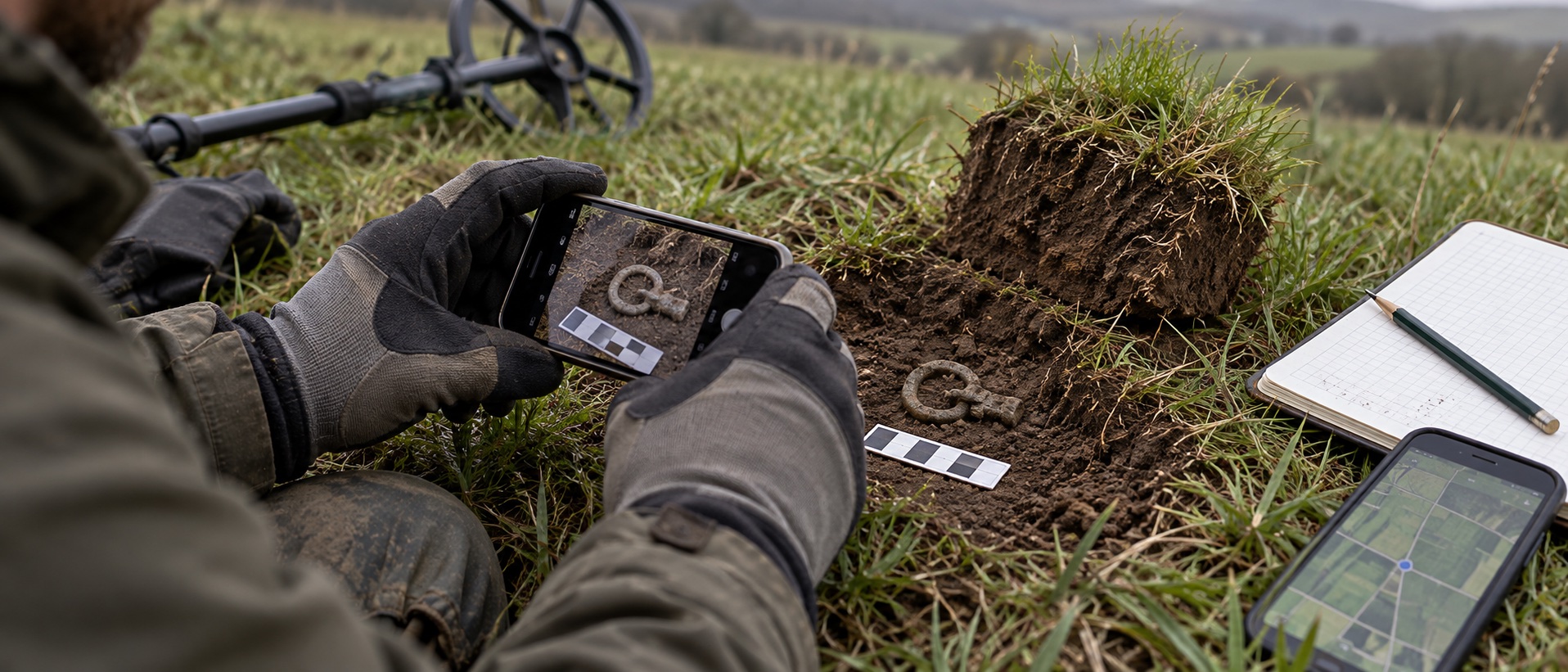
A precise findspot can carry more archaeological value than a polished surface.
Associated objects and concentrations should be recorded as a group before more recovery.
England, Wales, Scotland and Northern Ireland use different finds-reporting systems.
Recording and reporting are different
A field record is the information you create at the moment of discovery: exact place, photographs, depth, condition and associations. Reporting is the act of giving the relevant authority or heritage scheme that information. A good report begins with a good record; neither requires aggressive cleaning.
The Portable Antiquities Scheme records archaeological objects found by the public in England and Wales, while possible Treasure has a legal reporting process. Scotland and Northern Ireland have different systems. Wreck material recovered from tidal water or the seashore follows the Receiver of Wreck route.
Stop before the context disappears
When an object appears older, unusual or associated with other material, stop widening the hole. Leave it in place long enough to photograph its position and the surrounding surface. If a second object appears close by, treat the find as a possible group rather than two unrelated items.
Do not excavate below the recovery depth agreed with the landowner or into a compact archaeological layer. A container, concentration, structural feature, bone or group of coins is a stop-and-seek-advice situation.
Give every find a unique number
Use a simple field code that cannot be confused with another day. For example, NF-01, NF-02 and NF-03 can link photographs, a bag label and notebook entry without trying to identify the object in the field.
Do not use “Roman coin” as the identifier. Early identifications change. The stable fact is that object NF-02 came from a specific position and is shown in specific photographs.
Save the precise findspot
Capture coordinates or a grid reference as close to the hole as your device allows. Also write a human-readable description such as “north pasture, 14 m east of the stone stile”. Digital positions can be copied incorrectly, and field descriptions help reveal an obvious error.
Record which side of a boundary the object came from. A point placed in the correct field but on the wrong side of a parish, estate or foreshore boundary can complicate ownership and archaeological interpretation.
The British Museum explains that PAS records make discoveries available for research, and that local Finds Liaison Officers are the normal contact for recording finds. Accurate locational information is a central part of that record.
Take three kinds of photograph
- Photograph the object in the findspot before cleaning or moving it.
- Take a wider context image showing the hole and recognisable ground around it.
- After safe lifting, photograph both sides beside a scale in diffuse light.
Fill the frame without digital zoom, keep the camera parallel to the object and take more than one exposure if the surface is dark. Include the field number in the photograph sequence without placing ink, adhesive or a label on the object.
Record depth and layer carefully
Measure approximate depth from the current surface and note whether the object came from turf, loose topsoil, ploughsoil, beach shingle or another visible layer. Do not invent precision: “approximately 9 cm in dark topsoil” is more useful than a guessed exact depth.
On ploughed land, note the furrow position and whether the object was on the surface or in loose cultivated soil. On a beach, note dry sand, wet sand, shingle, clay exposure or the wash, along with the tide state.
Describe without cleaning
Record visible facts:
- material or colour as observed;
- length, width, thickness and weight when safe to measure;
- complete, bent, fragmentary, wet, flaking or actively corroding condition;
- visible decoration, holes or edges;
- nearby material and the detector response.
Do not rub soil from lettering or use the detector's target number as a metal identification. Keep the description provisional until a Finds Liaison Officer or suitable specialist assesses it.
Bag and label as one operation
Place the object in an individual bag or rigid container appropriate to its condition. Put the field number, findspot, field name and your contact reference on a separate label. Keep wet, fragile and corroding objects apart from dry robust finds and ask for conservation advice before changing their environment.
A divided finds box inside a zipped pouch protects better than a loose pocket. The XP Finds Pouch provides an open debris section and a separate zipped pocket, which is the right general layout when the rigid box and labels stay in the protected area. Our finds-pouch guide compares that layout with two compact alternatives.
Tell the landowner
Follow the finds agreement made before detecting. Recordable does not mean automatically owned by the finder. Tell the landowner or authorised occupier what was found, where it is held and whether advice or a statutory report is pending.
Do not sell, give away or separate a possible group while ownership or reporting is unresolved. Keep copies of messages and receipts with the field record.
Report archaeological finds in England and Wales
For finds in England, contact the local Finds Liaison Officer through the Portable Antiquities Scheme. In Wales, use PAS Cymru. Send clear photographs and the field record first, then follow the local process for an appointment or object handover. The British Museum specifically advises people not to post archaeological finds to it without prior arrangement.
PAS recording is generally voluntary for non-Treasure archaeological objects, but it can turn a single object into evidence about settlement, trade and land use. An FLO decides whether an object is suitable for the database and may advise on identification, care and Treasure status.
Possible Treasure has a deadline
GOV.UK states that possible Treasure in England or Wales must be reported to the local Finds Liaison Officer within 14 days of discovery or within 14 days of realising it may be Treasure. Use the current official Treasure service and do not wait for a social-media verdict.
The definition is more complex than “gold over 300 years old”. Groups of coins, associated objects, prehistoric metalwork and significance-based categories can apply. Our Treasure reporting guide explains the workflow without replacing the official decision.
Wreck, Scotland and Northern Ireland
Material from a ship, aircraft or hovercraft found in tidal water or on the seashore may be wreck and must be reported to the Receiver of Wreck within 28 days of recovery. This is separate from PAS and Treasure.
Scotland uses Treasure Trove and Northern Ireland has its own archaeological-object and Treasure requirements. Use the authority for the country where the object was found, not where the finder lives.
Keep a durable archive
Store the field log, original photographs, coordinate file, messages, PAS or Treasure reference and final identification together. Back up the digital record in a second location. If an object is returned, sold lawfully or transferred to a museum, add the outcome without deleting the original entry.
A useful record lets another person understand the discovery years later. That is the standard to aim for before the next signal.
Common questions
Frequently asked questions
What details should I record with a metal detecting find?
Save a precise grid reference or coordinates, field or beach description, date, approximate depth, layer, photographs, measurements, condition and any associated objects.
Should I clean a find before photographing it?
No. Photograph an unusual object in the findspot and with soil attached. Rubbing or washing can remove fragile detail and destroy evidence needed for identification.
Is recording a find the same as reporting it?
No. Recording creates the field evidence; reporting sends that information to PAS, a Finds Liaison Officer, the Treasure process or the Receiver of Wreck as appropriate.
Who owns a recorded find?
Recording does not decide ownership. Follow the agreement with the landowner and do not sell or transfer an object while Treasure, wreck or other ownership questions remain unresolved.
Helpful products
Pouches that support a recording system
Use the protected pocket for numbered bags and a rigid finds box. Open compartments are for robust debris, not loose archaeological objects.

All-round field pouch
XP Finds Pouch
Best for: Regular field and wet-weather searches where quick debris storage and a separate protected pocket matter.
- Open pocket plus zipped pocket
- Washable with water drainage
- Belt, strap or MOLLE mounting
A washable belt pouch with an open debris compartment, a zipped pocket for better finds, drainage and MOLLE attachment points for a pinpointer holster or lanyard.
Know before buying: The open section is for robust scrap, not fragile objects; use a rigid finds box inside the zipped area for coins and delicate artefacts.

Compact branded pouch
Minelab Finds Pouch
Best for: Detectorists who prefer a small, uncomplicated pouch and already carry a separate finds box for delicate objects.
- Hip-mounted finds storage
- Lightweight shell construction
- Compact field format
A compact waist pouch intended to keep ordinary finds and small tools at the hip, with a lightweight format that is easy to add to a basic field kit.
Know before buying: The shell pouch is not a substitute for individual bags, labels or a rigid box when precise findspots and fragile surfaces need protecting.