
Buying guide · Beach detector
Best metal detectors for UK beaches
Compare three beach metal detectors for UK dry sand, wet salt sand and shallow water, with current specifications and honest limitations.
Our recommendations
Three beach detectors worth comparing
The shortlist separates dry-sand use from conductive wet salt sand and actual water entry. Each product links to its current Amazon UK listing; availability and price can change. We may earn a commission from qualifying purchases, at no extra cost to you.

Mid-range
Minelab VANQUISH 360
Best for: Parks, fields and beaches for a beginner who wants simple controls and one detector for varied ground.
- Multi-IQ simultaneous multi-frequency
- Whole detector to 5 m (IP68)
- 1.16 kg
Automatic simultaneous multi-frequency operation, a low 1.16 kg weight and full 5 m waterproofing make this the least complicated route into mixed UK ground.
Know before buying: The deliberately simple control set offers less room to tune audio and recovery behaviour than the X-TERRA PRO.

Upper mid-range
Minelab X-TERRA PRO
Best for: A committed inland beginner who wants to learn how frequency, ground balance and audio choices change detector behaviour.
- Selectable 5 / 8 / 10 / 15 kHz
- Whole detector to 5 m (IP68)
- 1.3 kg
Selectable 5, 8, 10 and 15 kHz operation, six search profiles and detailed tone and discrimination controls give a keen beginner more room to progress.
Know before buying: Selectable frequencies are not simultaneous multi-frequency, and the extra controls create a steeper first-week learning curve.

Lower mid-range
Nokta SIMPLEX Lite
Best for: A cost-conscious beginner who wants full waterproofing, vibration and more adjustment than the simplest starter machines.
- 15 kHz single frequency
- Whole detector to 5 m (IP68)
- 1.2 kg
A 15 kHz entry model with four modes, 30 sensitivity levels, automatic or manual ground balance and a fully submersible 5 m build.
Know before buying: It is single-frequency and lacks the ULTRA model's recovery-speed and tone-shaping controls; wet salt sand is not its strongest ground.
| Detector | Frequency approach | Waterproofing | Best beach fit | Main limitation |
|---|---|---|---|---|
| Minelab VANQUISH 360 | Simultaneous Multi-IQ | Whole detector to 5 m | Simple dry and wet-sand use | Limited manual tuning |
| Minelab X-TERRA PRO | Selectable 5 / 8 / 10 / 15 kHz | Whole detector to 5 m | User who wants Beach modes and control | Not simultaneous multi-frequency |
| Nokta SIMPLEX Lite | 15 kHz single frequency | Whole detector to 5 m | Lower-cost dry sand and wading | Wet salt can require compromise |
Choose for wet salt sand, not the word “beach”
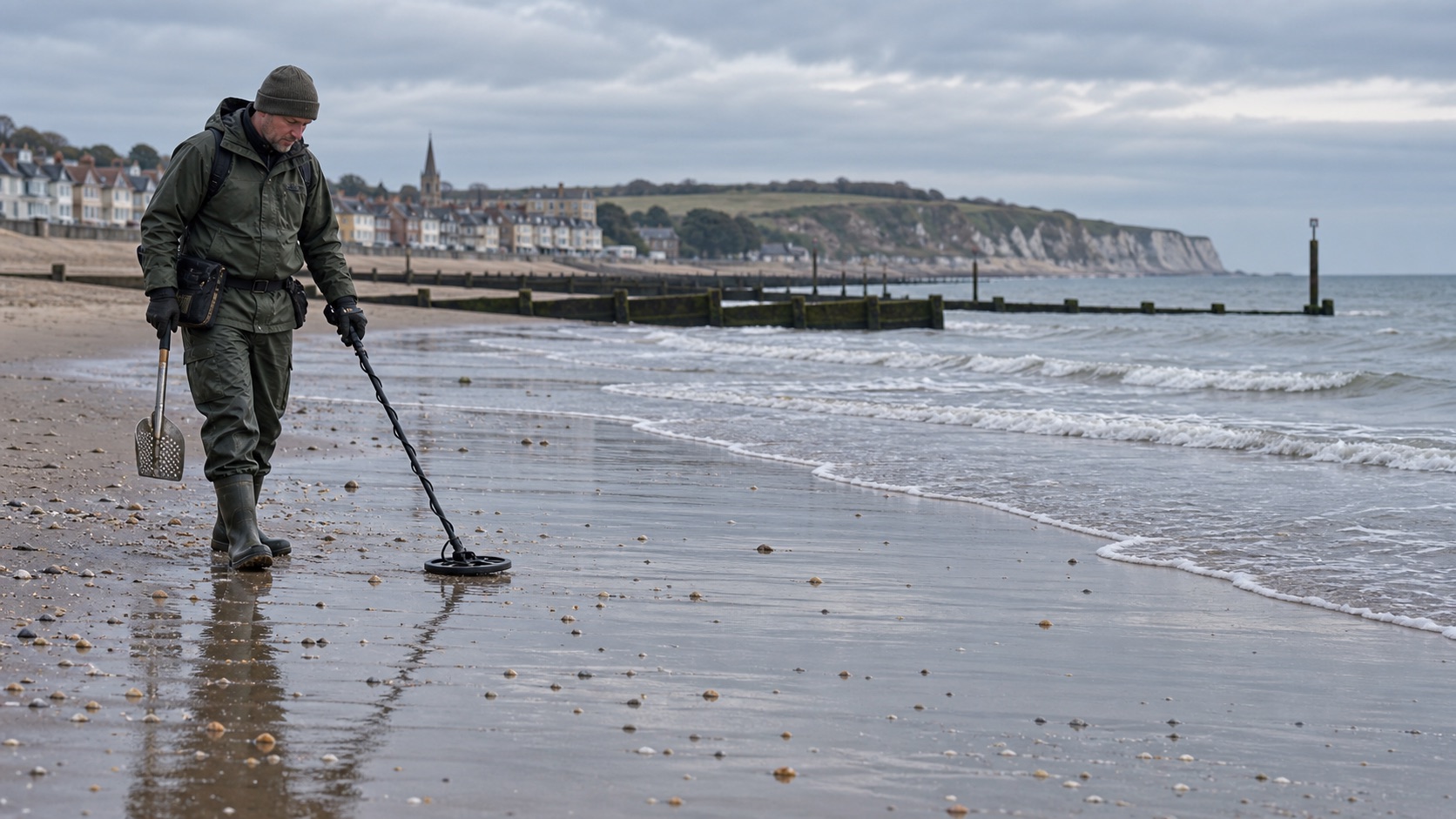
Dry sand behaves much like ordinary inland ground, so most competent detectors can search it. Wet salt sand is different: dissolved salt conducts electricity and can produce background responses that resemble targets. A detector may be waterproof yet unsettled on the tide line. For regular wet-sand searching, ground handling and frequency design matter as much as the depth rating on the box.
The practical question is where your coil will spend its time. If most trips involve dry towel lines, a single-frequency detector can be entirely sensible. If you expect to move between dry sand, saturated sand and shallow surf, simultaneous multi-frequency operation is the safer all-round starting point.
Start with the beach surface you will search
| Your normal ground | Prioritise | Do not assume |
|---|---|---|
| Loose, dry sand | Comfortable weight, a stable basic mode and a recovery tool suited to sand. | A water-depth rating is essential if you will keep the control unit dry. |
| Wet salt sand | Stable salt-ground behaviour; simultaneous multi-frequency is a strong starting point. See our wet-sand detector guide. | A waterproof label means the detector will run quietly on conductive sand. |
| Splash and surf edge | Whole-detector waterproofing, protected connectors and a safe route back. | Ordinary headphones share the detector's water rating. |
| Shallow water | The manual's stated depth limit, suitable waterproof audio and an exit before the tide closes it. | A 5 m rating makes a changing sea safe to enter. |
The RNLI advises checking tide times because rising water can cut off a route back. Our tide-planning guide covers the field decision; the Crown Estate beach guide covers the permission question. Neither waterproofing nor a beach mode replaces those checks.
Best overall for mixed beach ground: Minelab VANQUISH 360
The VANQUISH 360 combines Minelab's automatic Multi-IQ operation with three search modes and a fully waterproof 5 m housing. It does not ask you to choose between operating frequencies as the mineralisation and salt response change. That makes it the easiest recommendation here for someone learning to hear repeatable targets rather than continually adjusting the machine.
Its 1.16 kg weight is useful on open sand, where a long search can expose poor balance and an over-tight grip. The compromise is a deliberately compact control set: six discrimination segments, three tones and wired rather than wireless audio. A more experienced user may eventually want finer recovery and sound adjustments.
Best for learning beach controls: Minelab X-TERRA PRO
The X-TERRA PRO offers Beach 1 and Beach 2 profiles within six search profiles, automatic and manual ground balance, noise cancellation and selectable 5, 8, 10 or 15 kHz operation. That gives a committed beginner more tools for understanding why a detector behaves differently on dry sand, wet sand and submerged ground.
Selectable frequency is not the same as simultaneous multi-frequency: the detector operates on the selected frequency rather than processing several at once. Its richer controls also mean a steeper first few outings. Buy it for adjustability and a progression path, not because more menu choices automatically produce more finds.
Best lower-cost waterproof choice: Nokta SIMPLEX Lite
The SIMPLEX Lite gives you a fully submersible 5 m build, four search modes, 30 sensitivity levels, automatic or manual ground balance and vibration. It can be a lower-cost way into whole-detector waterproofing when its current listing supports that comparison. It is a strong fit for dry sand and freshwater edges.
Its 15 kHz single-frequency platform is the important qualification. The dedicated Beach mode can help, but difficult wet salt sand may still require reduced sensitivity and a calmer sweep, which costs some depth. If the tide line is your main ground rather than an occasional part of the day, the VANQUISH 360 is the more forgiving choice.
Waterproof coil versus waterproof detector
A waterproof coil can be placed in shallow water while the control box must remain dry. A fully waterproof detector protects the control housing to the manufacturer's stated depth, but that is not permission to ignore seals, charging-port covers or freshwater rinsing after salt exposure. Check the current manual before submerging any machine and never exceed its specified depth.
Waterproof headphones are a separate decision. A detector's ordinary wired or wireless headphones may not be submersible even when the detector is. For searches above the waterline, secure headphones that do not block awareness of people, dogs and the sea are often the more practical setup.
Beach settings that produce a cleaner first hour
Start in the manufacturer's beach profile rather than copying an aggressive online programme. Use only enough sensitivity to keep the threshold or background response stable, ground-balance as the manual directs, and test a known coin on the actual sand. Keep the coil level through the end of every swing; lifting it at the edges changes its relationship with the ground and can create false responses.
Investigate signals that repeat from two directions. Bottle caps, ring pulls and corroded fragments can produce convincing numbers, so treat target ID as a clue. A small sand scoop speeds loose-sand recovery, while a waterproof pinpointer can help in a compact wet plug. Fill every hole before moving on.
Before your first beach search
Access on foot does not automatically include permission to detect. Check foreshore ownership, the land manager's rules, local byelaws and any protected status. The Crown Estate permission applies only to foreshore it owns and remains subject to conditions and third-party restrictions. Our permissions and UK law guide explains the starting checks; the UK beach-location guide covers ownership and local restrictions in more detail.
Choose a safe tide window, tell someone where you are going and avoid working beneath unstable cliffs or in cut-off areas. Rinse salt from the coil, shaft, fasteners and recovery tools with fresh water after the session, then let components dry before storage.
Common questions
Frequently asked questions
What detector works best on wet UK beach sand?
Choose a detector with stable wet-salt performance, usually a capable simultaneous multi-frequency or suitable pulse-induction model. Dry-sand ability alone does not prove it will behave well below the tideline.
Does a beach detector need to be fully waterproof?
Full waterproofing is strongly preferable for wading and surf use. For dry sand, a waterproof coil may be sufficient, but the control box still needs protection from rain, spray and accidental drops.
How should I care for a detector after beach use?
Remove loose sand, rinse salt from manufacturer-approved waterproof parts with fresh water and dry everything before storage. Check coil covers and shaft joints because trapped sand can cause wear.