
Places · CULTIVATED GROUND 28
Metal detecting on ploughed fields
Plan a responsible UK ploughed-field search, from permission and stewardship checks to furrow coverage, stable settings and careful find recording.
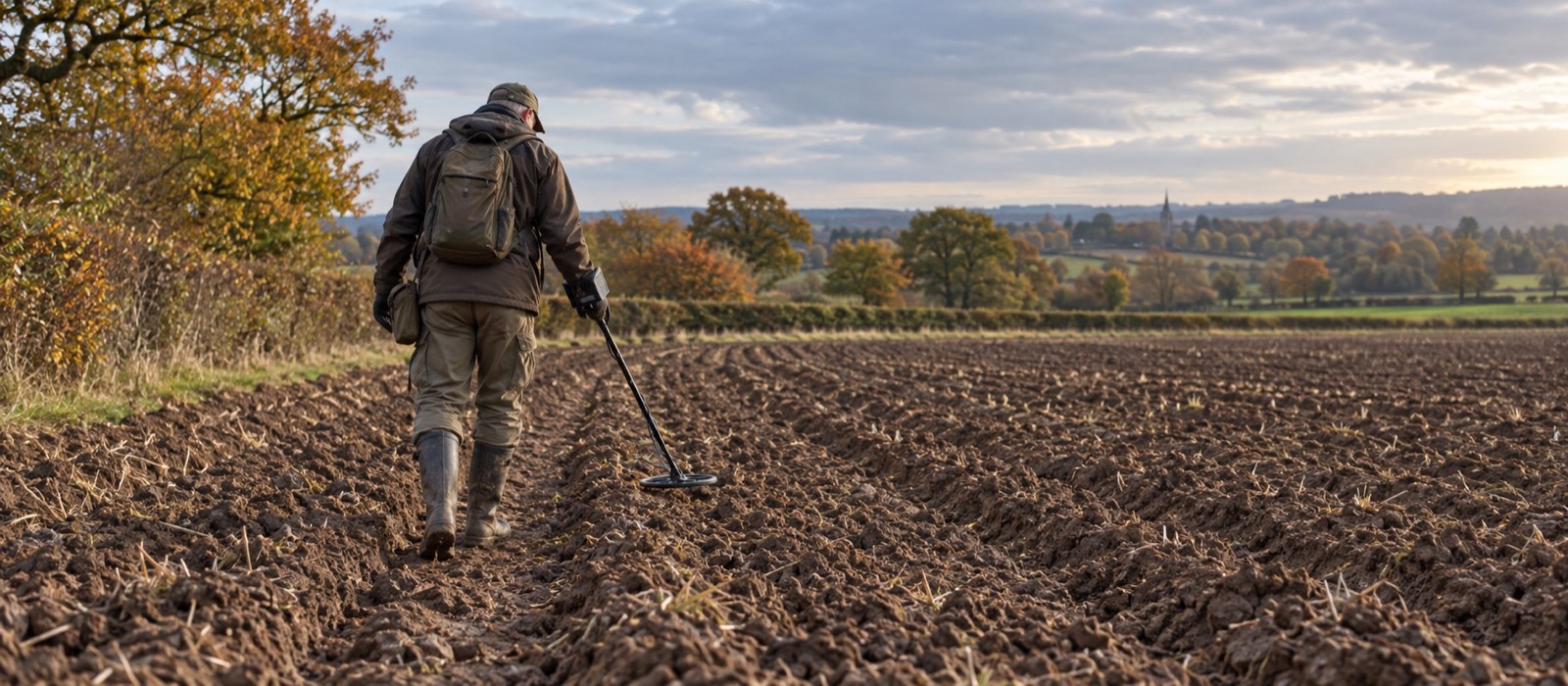
Check scheduled status, known archaeology and stewardship conditions before treating cultivated land as searchable.
Walk with the furrows where possible, keep the coil level and reduce sensitivity until operation is stable.
Record significant finds precisely; a group or concentrated scatter can matter more than an individual object.
Permission must cover this field and this visit
Written permission should identify the land, who may search, when access is allowed, the recovery method and how finds will be handled. A previous invitation to another field or season is not enough. Ask where to park, which gates to use, whether livestock will move and when cultivation, drilling or spraying is scheduled.
Protected status still applies after a field has been ploughed. Historic England states that metal detecting on a scheduled monument requires consent, and its agri-environment guidance explains that known archaeological sites, Sites of Special Scientific Interest and scheme conditions can restrict detecting on agreement land. The agreement holder needs to check the current conditions rather than assuming ordinary cultivation permits recreational searching.
Use our England and Wales permissions checklist before arranging the day.
Why ploughed ground behaves differently
Cultivation breaks the surface into ridges, hollows and loose clods. Targets may have been lifted, turned, shifted sideways or left beneath an air gap. The coil-to-target distance changes from one step to the next, and a tilted coin may sound less consistent than it did in settled soil.
Historic England's guidance on archaeology in arable land notes that ploughing can bring scatters of pottery, metalwork and other evidence to the surface, while repeated or deeper cultivation can damage buried remains. That is why a concentration, unusual material or exposed feature deserves a stop-and-record response rather than faster digging.
Walk the furrows without fighting them
Start with lines that follow the cultivation direction. This is easier on the ankles and helps keep the coil parallel to the local surface. On a later pass, change direction only if the ground is safe to cross and the farmer agrees. Shorten each sweep on high ridges; forcing a wide arc causes the outer edge of the coil to rise.
Use a visual marker at the field edge and overlap each pass. Ploughed ground makes footprints unreliable, especially after wind or rain. Break a large field into small blocks and record which blocks were covered rather than wandering toward every promising landmark.
Stable settings beat maximum sensitivity
Begin with the factory Field or all-terrain profile recommended in the detector manual. Noise cancel if available, ground balance where the model requires it, then raise sensitivity only until the machine remains calm during a normal sweep. A detector that chatters at every clod hides weak repeatable targets.
Keep discrimination modest. Cultivated sites can contain dense iron, coke, foil and machinery fragments, but aggressive rejection can clip a desirable target beside iron. Check uncertain signals from two directions and compare tone shape with the displayed target ID. Our discrimination guide gives a conservative starting method.
Coil choice and physical pace
A standard coil is usually the best first pass. A large coil covers open ground but is harder to keep level over ridges and can combine nearby targets into one response. A smaller coil is slower across open soil but easier around iron concentrations and broken ground.
Reduce the pace before changing hardware. Fatigue makes the coil rise, narrows overlap and encourages careless recovery. A lightweight detector can help over a long permission, but balance and shaft adjustment matter as much as the listed weight.
Recover within the agreed ploughsoil
The farmer should define what recovery is acceptable. Work beside the estimated target, keep loose soil controlled and return the surface as requested. Do not deepen a hole into a compact layer or exposed feature simply because the signal continues. Stop if you see a group of objects, articulated material, building remains, bone or a concentrated scatter.
Where a full-size spade is explicitly permitted, a narrow blade can give more controlled entry than a broad garden spade. The Extended Invader is one field option, but its serrated edge and carbon-steel blade demand careful use and cleaning. On many surfaces a hand tool is more appropriate.
Record before cleaning
Photograph an unusual find with soil still attached, note the exact position and keep associated objects separate from ordinary finds. A series of coins from one area may be a dispersed group rather than unrelated single losses. Follow the old-coin first steps and check the Treasure reporting process when age, material or association raises doubt.
The useful field note includes the field name, date, grid reference, approximate depth, position within the furrow and nearby material. Reporting through the Portable Antiquities Scheme can turn an isolated object into evidence about a wider landscape.
Leave the field ready for work
Remove sharp modern rubbish, shut gates, avoid compacting wet headlands and report damaged fencing, livestock problems or hazards to the farmer. Clean soil from boots and tools before moving between farms where biosecurity is a concern. A good search finishes without delaying machinery or leaving any uncertainty about access.
Common questions
Frequently asked questions
When is the best time to detect a ploughed field?
Search only when the landholder permits access and conditions are safe. Rolled or weathered soil is usually easier to sweep than rough fresh furrows, while crop and scheme restrictions always take priority.
Do I need permission for every visit to a field?
Follow the agreement you made with the landholder. Confirm the permitted fields, access routes, dates, crops and recovery method, and check again whenever conditions or land management change.
Which coil works best on ploughed ground?
A medium or smaller coil is easier to keep level across uneven furrows and can separate targets in iron. A large coil suits open, settled ground but may be tiring and harder to control.