
Places · BEACH ZONES 45
Wet sand vs dry sand for metal detecting
Compare dry and wet beach sand for metal detecting, including salt response, detector settings, target patterns, recovery methods and UK foreshore checks.
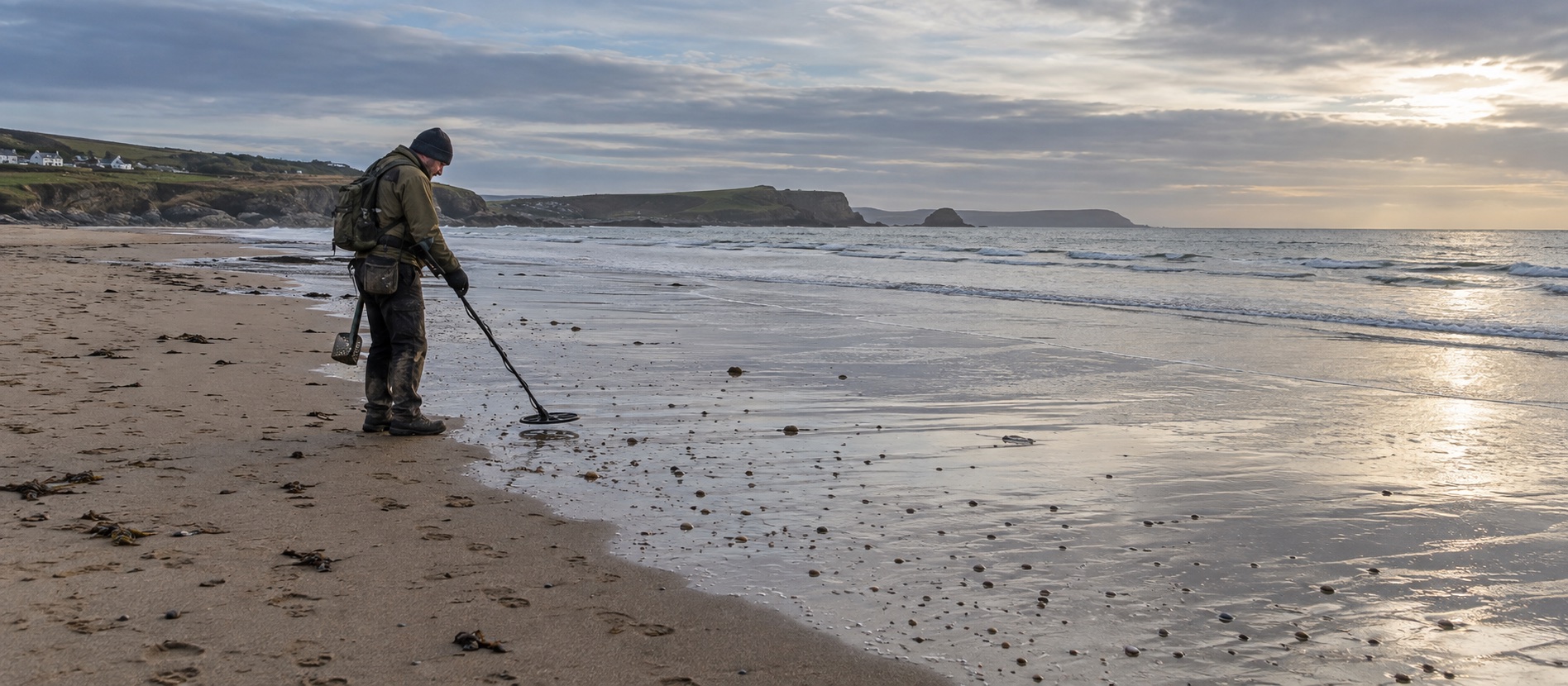
Waterproof construction protects the detector but does not by itself create stable salt performance.
The damp transition and wet slope can concentrate targets, but tide safety controls the search.
Check ownership and local restrictions because the dry beach and tidal foreshore may differ.
The beach is several kinds of ground
A beach can contain loose dry sand above the recent tide, damp compact sand around the high-water line, saturated wet salt sand, shingle, black mineralised streaks and moving shallow water. A detector setting that is calm in one zone may become noisy within a few steps.
Treat each boundary as a new ground condition. Listen to the detector before deciding that every low or broken response is rubbish.
Why dry sand is easier
Dry upper sand contains less connected salt water, so its ground response is usually weaker. Many ordinary VLF detectors can search it in a Park, Field or dry Beach mode with normal sensitivity. Recovery is simple because loose sand can be passed under the coil or removed with a hand scoop.
The upper beach is also where towels, play areas, paths, kiosks and access points concentrate recent losses. That means modern coins, jewellery, tent pegs, foil and sharp aluminium can all be common.
Why wet salt sand is difficult
When salt water fills the spaces between sand grains, the ground becomes electrically conductive. The detector receives a broad response from the sand itself. An unsuitable setup may chatter, give false low tones, display unstable IDs or require sensitivity so low that small targets disappear.
A simultaneous multi-frequency detector with a dedicated salt-beach profile can distinguish more of that ground response from compact metal targets. It is not magic: mineralised black sand, fast water, coil contact and extreme sensitivity can still overwhelm the processing.
Minelab's X-TERRA PRO manual explains that its Beach mode uses specialist salt-noise rejection because dry sand, wet sand, surf and underwater conditions are conductive. Nokta's SIMPLEX manual similarly tells users to change ground balance when moving between wet and dry sand.
The damp transition can be productive
The line where loose dry sand becomes compact and damp often reflects recent high-water movement and heavy foot traffic. Coins and rings can settle where water slows or the sand slope changes. Search parallel to the line first, then use shorter cross passes to test any concentration.
Do not rely on a visible wet line alone. Previous tides, storms, beach cleaning and replenishment move sand. Cuts, shallow channels, exposed clay, gravel patches and changes in pebble size can reveal a more informative layer.
Wet slope and wash
The compact wet slope can be faster to cover because the coil stays close to an even surface. It also exposes the detector to the strongest salt response. Use the manufacturer's wet-sand or Beach profile, run noise cancel where available and reduce sensitivity until the machine is stable during a normal sweep.
At the active wash, keep the coil either consistently submerged or consistently above moving water when possible. Repeatedly entering and leaving water changes the ground load and can create false signals. Never turn your back on incoming waves or let a target pull you below the planned tide route.
Dry-sand starting setup
- Select the detector's dry Beach or general mode recommended by its manual.
- Noise cancel if the model provides it.
- Set sensitivity for a calm threshold or quiet background.
- Sweep low and level without scrubbing.
- Test a known coin and a small foil target before covering a large area.
Use modest discrimination. Beach litter can be dense, but aggressive rejection may remove small jewellery responses that overlap foil.
Wet-sand starting setup
- Select the dedicated salt Beach profile before entering the wet zone.
- Ground balance only as the manual specifies for that mode.
- Lower sensitivity if the detector responds to every sweep or wave.
- Keep sweep speed, height and water contact consistent.
- Check uncertain responses from two directions and with a shorter arc.
The Nokta SCORE is a relatively simple simultaneous multi-frequency option with a dedicated Beach mode and complete 5 m waterproofing. It is a more coherent regular wet-sand choice than buying a waterproof single-frequency detector solely for the depth rating.
Read signal shape before the number
Wet-sand target IDs can vary with depth, angle, salt response and nearby iron. A compact repeatable tone deserves attention even when the number is less stable than it was in an air test. A long broad response that remains strong with the coil raised suggests a large shallow object.
Cross the signal at right angles and use the detector's pinpoint function only after normal search mode confirms it. On a busy beach, recovering sharp modern rubbish is part of leaving the area safer.
Recovery tools by zone
A small hand scoop works in loose dry sand. On compact wet sand, a robust scoop or narrow hand tool may give more control. Mechanical tools and deep excavation may be prohibited, and the Crown Estate terms for its foreshore restrict activity to surface searching without mechanical tools.
Refill every hole, including those below the current waterline. An open hole can trip another beach user or collapse around a foot when the tide returns.
Permission can change at the waterline
The dry upper beach, dunes and promenade may have a different owner from the tidal foreshore. Some Crown Estate foreshore can be searched without formal consent subject to its terms, but not every beach is Crown-owned and third-party restrictions still apply.
Use the Crown Estate beach rules and check the local authority, leaseholder, harbour and on-site signs. Protected wrecks, scheduled sites, nature designations and temporary closures can restrict a particular area.
Record finds by beach zone
For an unusual object, save the exact coordinates and note whether it came from dry sand, the damp transition, wet sand, shingle, clay or active wash. Record the tide state, approximate depth and nearby objects before cleaning.
Possible Treasure, archaeological finds and wreck material have different routes. Wreck recovered from tidal water or the seashore must be reported to the Receiver of Wreck within 28 days. Our record-a-find guide sets out the field details.
Rinse everything after salt exposure
Switch off, keep ports closed and rinse only the parts the manual confirms are waterproof. Use gentle fresh water on the coil, shaft and permitted control housing, then remove trapped sand from the skidplate and shaft joints. Dry fully before opening ports or charging.
Follow the post-beach cleaning guide every time. A detector can perform well on wet salt sand and still be damaged by salt left to dry inside a collar or connector.
Which zone should a beginner search?
Start on dry sand to learn coil height, overlap and repeatable tones without a strong salt response. Move to the damp transition once the detector remains predictable. Search regular wet salt sand only with a suitable mode and stable setup.
The most productive zone changes with people, weather and sand movement. The safest, permitted zone where the detector operates calmly is the right place to build skill.
Common questions
Frequently asked questions
Is wet or dry sand better for metal detecting?
Dry sand is easier for most detectors and often holds recent losses. Wet sand can expose concentrated targets but needs stable salt-beach processing and stricter tide awareness.
Why does my detector false on wet sand?
Connected salt water makes the ground conductive. Use the correct Beach mode, keep coil height and water contact consistent, and lower sensitivity until operation is stable.
Do I need a multi-frequency detector for wet salt sand?
It is not the only possible technology, but a suitable simultaneous multi-frequency Beach mode is usually more stable and versatile than a basic inland single-frequency setup.
Should I change settings between dry and wet sand?
Yes, when the manual provides different dry and salt-beach profiles or ground-balance instructions. Pause at the moisture boundary and confirm stable operation before continuing.
Helpful products
Multi-frequency choices for changing beach ground
These fully waterproof detectors use simultaneous multi-frequency operation and dedicated Beach modes, making them more credible wet-sand options than a basic dry-land detector.

Upper mid-range
Minelab X-TERRA ELITE
Best for: Regular field, park and beach use where stable mixed-ground performance and detailed controls justify a higher budget.
- Multi-IQ; 15 kHz inland option
- Whole detector to 5 m (IP68)
- 1.3 kg
Multi-IQ simultaneous multi-frequency operation, six search profiles and a 5 m waterproof build make this a capable step-up detector for varied UK ground.
Know before buying: Its larger coil and deeper menu demand more concentration than a simple starter model, and wireless audio uses Minelab's compatible low-latency system rather than ordinary Bluetooth.

Mid-range
Nokta SCORE
Best for: Mixed inland and beach use for someone who wants simultaneous frequency operation without a dense advanced-control menu.
- Simultaneous multi-frequency
- Whole detector to 5 m (IP68)
- 1.2 kg
A light, rechargeable simultaneous multi-frequency detector with three search modes, 60 target IDs and full 5 m waterproofing.
Know before buying: The simplified SCORE has fewer adjustment options than Nokta's DOUBLE and TRIPLE SCORE models, so keen tinkerers may outgrow its control set.

Mid-range
Minelab VANQUISH 360
Best for: Parks, fields and beaches for a beginner who wants simple controls and one detector for varied ground.
- Multi-IQ simultaneous multi-frequency
- Whole detector to 5 m (IP68)
- 1.16 kg
Automatic simultaneous multi-frequency operation, a low 1.16 kg weight and full 5 m waterproofing make this the least complicated route into mixed UK ground.
Know before buying: The deliberately simple control set offers less room to tune audio and recovery behaviour than the X-TERRA PRO.