
COMMUNITY · ORGANISED DIGS
Metal detecting rallies and organised digs in the UK
Assess organised metal detecting digs for permission, protected land, finds recording, insurance, ownership, facilities and responsible field practice.
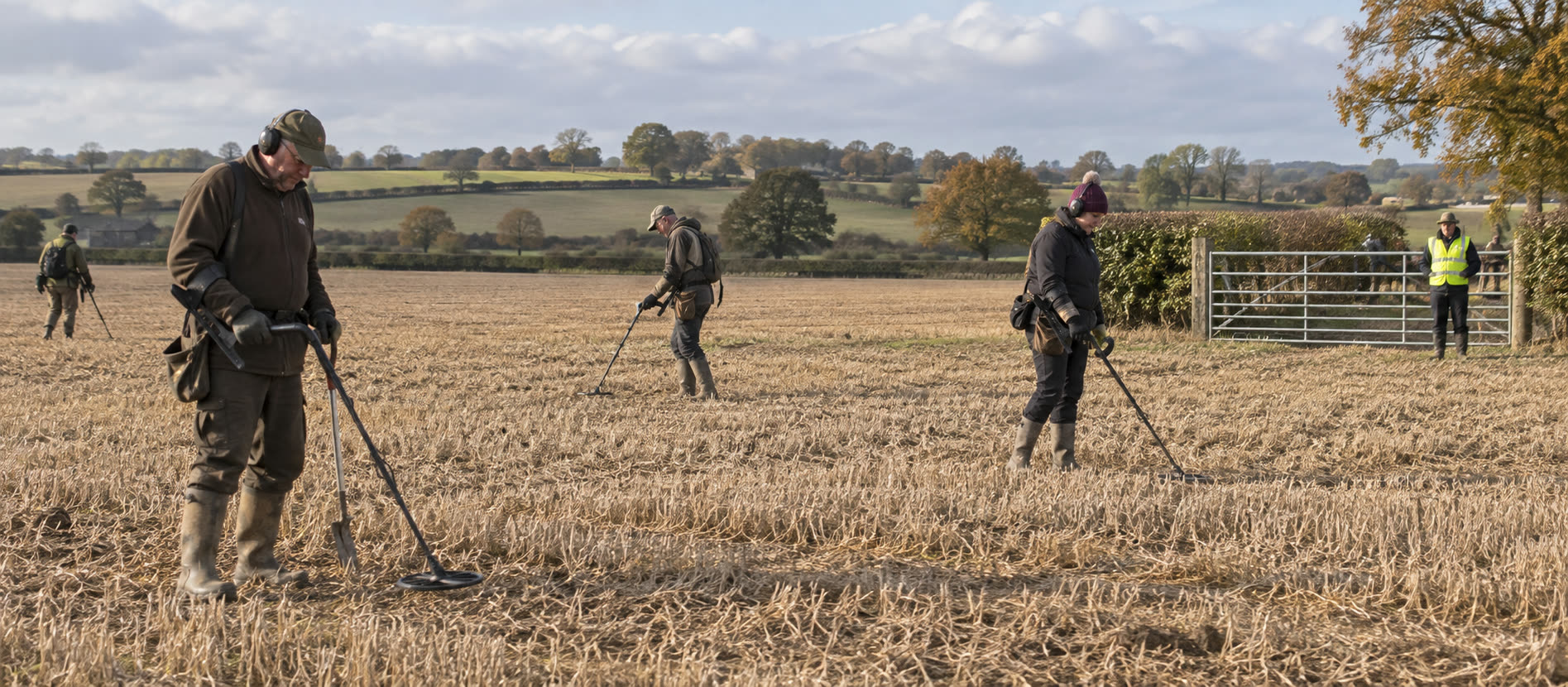
Ask who authorises the exact fields and checks protected areas.
Confirm findspot, ownership and reporting arrangements in writing.
Know what insurance, facilities and safety plans actually cover.
A club dig, a paid rally and a research survey are not the same
Small club outings may offer a structured briefing and a known landowner relationship. A large paid rally can involve many people and a broad area. A formal archaeological survey has its own research design and supervision. Size alone does not tell you whether an event is responsible; ask how permission, protected ground, recovery and finds recording work in practice. Finding a club is one route to smaller supervised days, but membership does not replace land or heritage consent.
The Suffolk Archaeological Service's rally guidance warns that large rallies are not ideal circumstances for FLOs to record finds in the field and can lose archaeological information. It asks organisers to consult the service, provide maps, record attendees and findspots, photograph finds and support later recording. Treat “an FLO might be there” as a bonus, not the whole recording plan.
Questions worth asking before paying
| Ask the organiser | A useful answer |
|---|---|
| Who gave permission? | The authorised owner and, where relevant, occupier/tenant for identified fields and dates |
| Which areas are excluded? | A map and briefing covering protected monuments, sensitive areas, crops, livestock and access routes |
| How are finds recorded? | Individual finder IDs, precise positions, photographs, and a route to the local recording service |
| What are the finds terms? | Written ordinary-find ownership, landowner notifications and possible-Treasure process |
| What does insurance cover? | The named organiser's and attendee's actual arrangements, exclusions and activity scope |
| What if conditions change? | A weather/cancellation policy, safety contact, toilets, parking and clear start/finish |
Landowner consent does not override a scheduled monument or other protected-site restriction. Agri-environment agreement land may carry additional conditions. Check the country-specific rules in UK permissions and the scheduled-monuments guide. Do not accept a vague assurance that “it is all legal” in place of an exact boundary and named responsibility.
Findspot recording at scale
A rally's greatest avoidable loss is the find that travels home without a position. Record your own private location and field number as soon as an object is safely recovered, even when an organiser collects a separate tally. Mark which event, field and finder it belongs to. The organiser should be able to explain how significant finds and potential groups reach the relevant FLO or archaeological service, rather than relying on a shared photo album. Our field log gives a lightweight template.
If you expose a possible hoard, intact archaeological feature or in-situ deposit, stop digging and follow the event's escalation plan. Do not invite a crowd to extend the hole. Grouped-finds context explains why association matters. Possible Treasure has a separate reporting obligation; event rules cannot waive it.
Its separated debris and keeper pockets are useful in a busy field. Keep each significant find in a labelled rigid container rather than a shared pocket, and never confuse a commercial product with the organiser's recording obligation.
Warning signs and a better alternative
Be wary of undisclosed fields, pressure to keep locations secret from the relevant heritage service, unclear landowner terms, no briefing or a scramble to open more holes around a concentrated find. An event that publicises rare finds but cannot describe a recording method is offering excitement without the essential context. A smaller club day with clear supervision may be a better first experience. For preparation, see first organised dig and group-dig etiquette.
Common questions
Frequently asked questions
Does a paid rally ticket give me legal permission to detect?
The organiser should have permission for the exact fields, but a ticket does not waive protected-site restrictions or reporting obligations. Ask for boundaries and written finds terms.
Will an FLO record every rally find on the day?
Do not assume so. Large rallies can overwhelm field recording; keep your own precise positions and follow the organiser's and local service's retrospective process.
Does organiser insurance cover me personally?
Coverage varies by policy and activity. Ask what the policy covers and whether you need your own membership or insurance.
What if I find several objects together at a rally?
Stop extending the hole, record what is visible and tell the organiser and appropriate archaeological contact. A group may preserve important context or require statutory reporting.
Helpful products
Arrive able to separate finds and rubbish
A field pouch with a protected pocket can support an event's recording rules, provided every meaningful find receives its own number and position.

All-round field pouch
XP Finds Pouch
Best for: Regular field and wet-weather searches where quick debris storage and a separate protected pocket matter.
- Open pocket plus zipped pocket
- Washable with water drainage
- Belt, strap or MOLLE mounting
A washable belt pouch with an open debris compartment, a zipped pocket for better finds, drainage and MOLLE attachment points for a pinpointer holster or lanyard.
Know before buying: The open section is for robust scrap, not fragile objects; use a rigid finds box inside the zipped area for coins and delicate artefacts.