
COMMUNITY · FINDS RECORDING
Working with a Finds Liaison Officer
Prepare photos, precise private findspots and custody details for a Finds Liaison Officer, and follow the recording process without losing context.
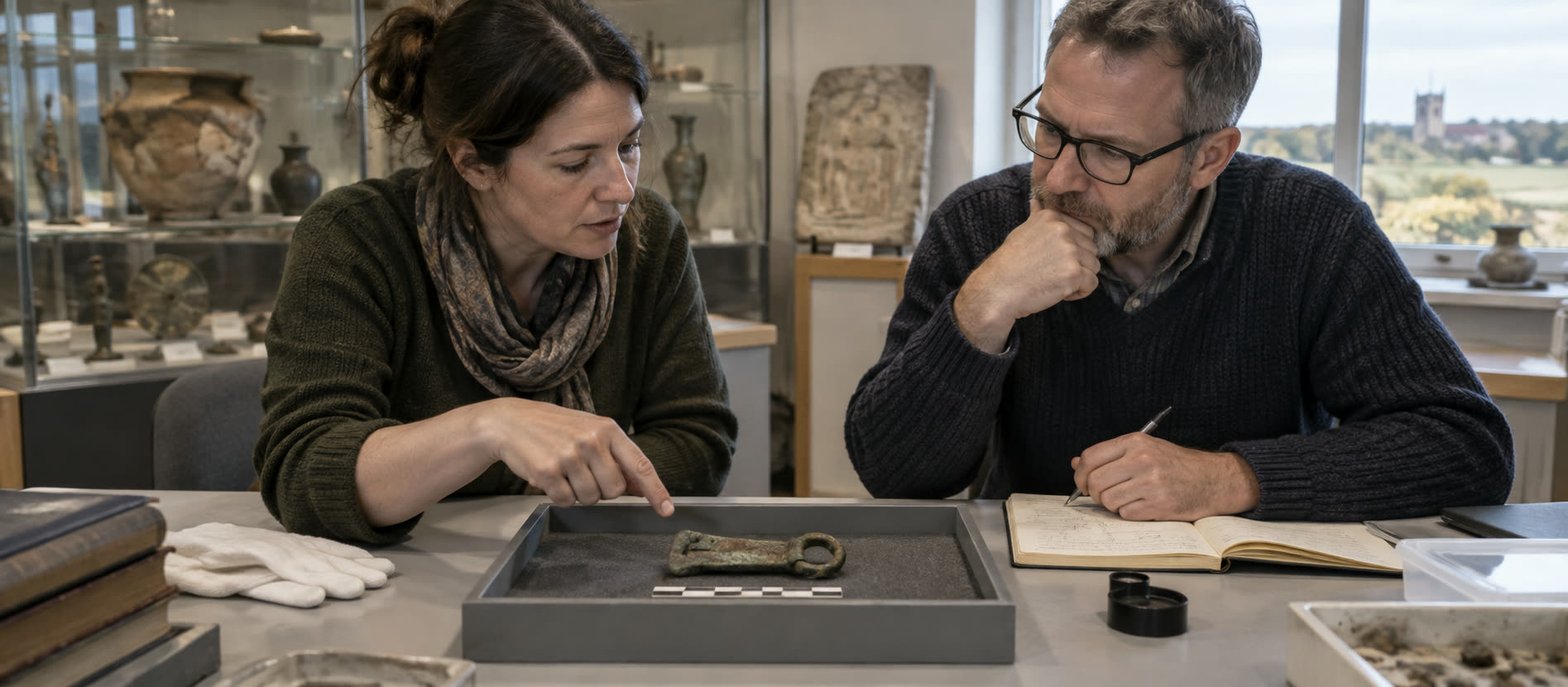
Contact the right local FLO; do not send an object uninvited.
Keep the object, find number, photos and location linked.
Record custody, receipts and any subsequent PAS reference.
What an FLO does—and what to ask first
In England and Wales the Portable Antiquities Scheme records archaeological finds made by the public. A Finds Liaison Officer (FLO) can advise on suitable finds for recording, identify objects and arrange a record using location and context. The service is not a universal appraisal or instant identification desk. Capacity, appointment arrangements and acceptance criteria can vary locally. Find your local contact via the PAS contacts directory and ask how they prefer initial enquiries; Welsh arrangements are through PAS Cymru.
If an object might be Treasure, the statutory Treasure reporting process is separate and time-sensitive. Do not wait for a routine appointment to ask what to do. Scotland and Northern Ireland use different systems; the PAS/FLO workflow here does not replace their national rules.
Prepare the first message
Write a short description without announcing a definite date: material as observed, dimensions, any distinctive marks and the object's condition. Attach clear front, back, edge and scale photographs, plus an in-situ view if available. Provide the find number and approximate discovery date. Say whether other objects were found in the same context, whether it is still in the ground, and whether it is damp, fragmenting or hazardous. Never bring suspected ordnance to an appointment; use the dangerous-finds response.
An FLO needs an accurate findspot for a useful archaeological record. Keep the exact coordinate, field map, parish and permission details ready to share privately in the form requested. A social-media map pin or “somewhere in Suffolk” is not equivalent. If you are uncertain about your phone position, say so. The record-a-find guide lists the minimum metadata and photographing finds helps produce diagnostic images.
Arrange a handover, not an assumption
Do not post or deliver an object uninvited. Ask whether the FLO wants to see it in person, review images first or direct you to a local recording event. Confirm whether the object should be kept dry as found, packed separately or left in place. The British Museum's PAS overview explicitly directs finders to contact their local service rather than sending unsolicited finds.
At a physical handover, note the find ID, person or office receiving it, date, current condition and what was handed over. Request or retain the receipt/process reference offered by the service. Clarify how and when you can expect a return or an update, without assuming a guaranteed timeline. Ownership and custody are not the same thing; check your written landowner finds terms before making promises about disposal.
A divided case can make travel with multiple ordinary stable items less chaotic, provided each has a field number. It is not a specialist storage solution for wet or unstable archaeology. Follow instructions from the recording professional where they differ from your normal kit routine.
During and after recording
Be ready to explain what was observed versus inferred: whether two fragments actually touched in the ground, whether a position came from GPS or memory, and whether the object was cleaned. If a tentative ID changes, keep your original field record and add the new conclusion rather than overwriting the discovery note. Ask for the PAS record identifier once assigned and link it in your collection catalogue. A public PAS record may generalise location to protect a site; that does not mean you should delete your precise private data.
If no reply comes quickly, keep the object safe and follow the local contact route courteously. A recording backlog is not a reason to polish a find, publicise its exact location or leave a possible Treasure deadline unattended. Your best contribution is clear evidence, honest uncertainty and a record that survives beyond the conversation.
Common questions
Frequently asked questions
Do I need an appointment to see an FLO?
Contact the relevant local service first and follow its instructions. Availability, booking and initial photo-review arrangements vary.
What information should I send with a find?
Send a cautious description, measurements, clear scaled photos, field number, precise private findspot and any contextual or ownership details requested.
Can I post a find directly to the British Museum?
Do not send objects uninvited. Contact the local FLO or relevant recording service to agree the process first.
Does an FLO appointment replace reporting possible Treasure?
No. Possible Treasure has a separate legal reporting process and deadline. Seek prompt guidance rather than waiting for a routine appointment.
Helpful products
Travel with a labelled, separate find
A small rigid field case can keep an ordinary stable object from mixing with scrap on an arranged visit; specialist instructions take precedence for fragile or damp finds.

Compact compartment case
Detecting Innovations Mini Finds Box
Best for: Short sessions where separation matters more than generous padding or capacity.
- Ten lidded compartments
- 95 × 70 × 32 mm claimed closed size
- Lightweight folding plastic
A small folding plastic case with ten separate lidded compartments for keeping several ordinary field finds apart.
Know before buying: The small compartments do not replace individual field numbers and may not suit fragile, damp or larger archaeological objects.