
FINDS CARE · PHOTO RECORD
How to photograph metal detecting finds
Make metal detecting find photos useful for identification and reporting with in-situ, scale, front, back and edge views linked to an exact field record.
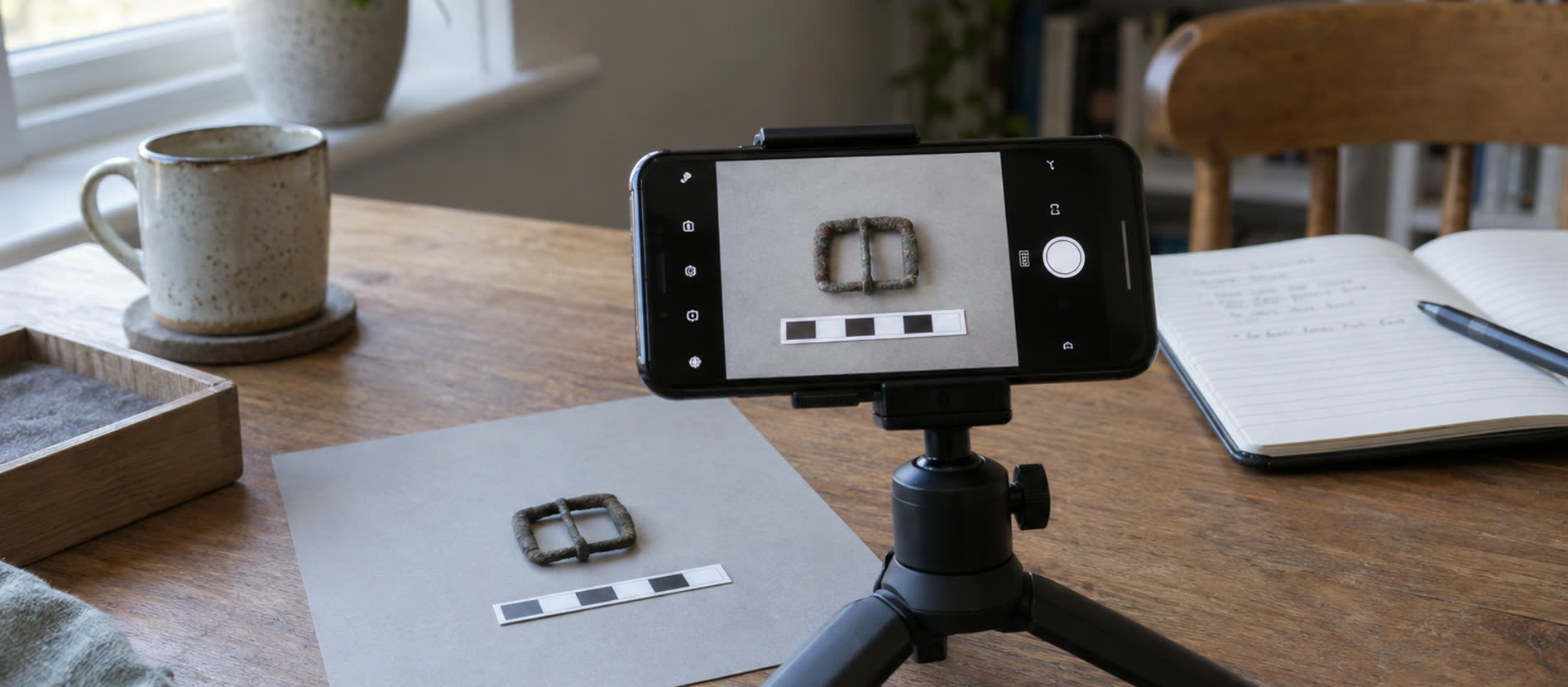
Take the setting and object-in-place views before moving it.
Photograph both faces and edge with a scale after safe recovery.
Preserve original files and keep exact coordinates out of public posts.
The four-photo minimum
For an ordinary object safe to recover, take four kinds of images:
- Context: a wider view of the permission and the specific hole or surface position, without exposing private location details in a public post.
- In situ: the object where it appeared, before cleaning or rearranging soil. Show nearby material if there is any.
- Object faces: front and back on a plain, non-reflective background, with a metric scale in the same plane.
- Edge and detail: thickness, attachment, inscription or break, plus a ruler or scale where useful.
Do not move a possible dangerous object closer to the camera. For suspected ordnance, human remains or hazardous waste, follow the dangerous-finds stop rule instead.
Make a phone camera work well
Use daylight in open shade or diffuse light from a window. Flash reflections can hide corrosion and small stamps. Tap to focus on the object, keep the lens parallel to a flat coin, fill the frame without excessive digital zoom and hold the phone steady. Include a scale and a neutral colour card if available, but never put adhesive labels on the object. Take more than one exposure when a surface is dark or glossy.
For a coin, capture the entire circle and edge; for a buckle or fitting, show where parts join or have broken. Do not let the ruler obscure the most diagnostic feature. Old coin first steps explains why the object should not be scrubbed to improve the image.
Tie photographs to a field number
Give the find a unique number at the moment of recovery, such as CG-2026-014. Photograph the number on a separate card beside the container or at the start of the sequence, then record the same number in your log. Link it to the exact findspot, approximate depth, layer and permission. Never rely on a phone's automatic location metadata as the only record; it can be imprecise, missing or stripped when sharing.
If two objects were found together, record their positions relative to each other before separating them. The grouped-finds guide covers the point at which you should stop searching and seek archaeological advice.
A zipped pouch can carry individually labelled rigid containers back from an authorised field. It does not replace the field log or prevent an unnumbered coin being confused with another find. Keep the photo number visible in the record, not written on the object.
Share usefully, not recklessly
When asking an FLO for advice, send original-resolution files and the private location details through the route they specify. The Portable Antiquities Scheme needs a findspot for meaningful recording. For a public forum, omit exact coordinates and landowner-identifying landmarks unless you have permission. Keep unedited originals alongside cropped copies; a crop is useful for display but should not be the only archive.
Back up photographs and the find log together. An immaculate close-up without a number or place is a picture; a linked sequence is evidence.
Common questions
Frequently asked questions
Which photos does an FLO need?
A useful starting set shows the find in context, both faces, an edge or diagnostic detail and a metric scale, all linked to a precise field record.
Should I clean a find so the photograph looks clearer?
No. Use better light and focus first. Cleaning may remove surface evidence; ask for advice before treating an unfamiliar archaeological object.
Can I publish the exact GPS location with a find photo?
Avoid public exact coordinates or identifying a private permission without consent. Share precise findspots privately with the relevant recording professional.
Is phone location metadata enough for a find record?
No. It may be inaccurate or stripped when files are shared. Write a separate location and field number in the log.
Helpful products
Keep the photographed object identifiable
A labelled rigid container carried in a zipped pouch helps prevent later mix-ups between the find and its photo sequence.

Compact branded pouch
Minelab Finds Pouch
Best for: Detectorists who prefer a small, uncomplicated pouch and already carry a separate finds box for delicate objects.
- Hip-mounted finds storage
- Lightweight shell construction
- Compact field format
A compact waist pouch intended to keep ordinary finds and small tools at the hip, with a lightweight format that is easy to add to a basic field kit.
Know before buying: The shell pouch is not a substitute for individual bags, labels or a rigid box when precise findspots and fragile surfaces need protecting.