
Finds care · FLO GUIDE 44
What a Finds Liaison Officer does
Learn when to contact a Finds Liaison Officer, what details and photos to provide, how PAS recording works and how possible Treasure is handled.
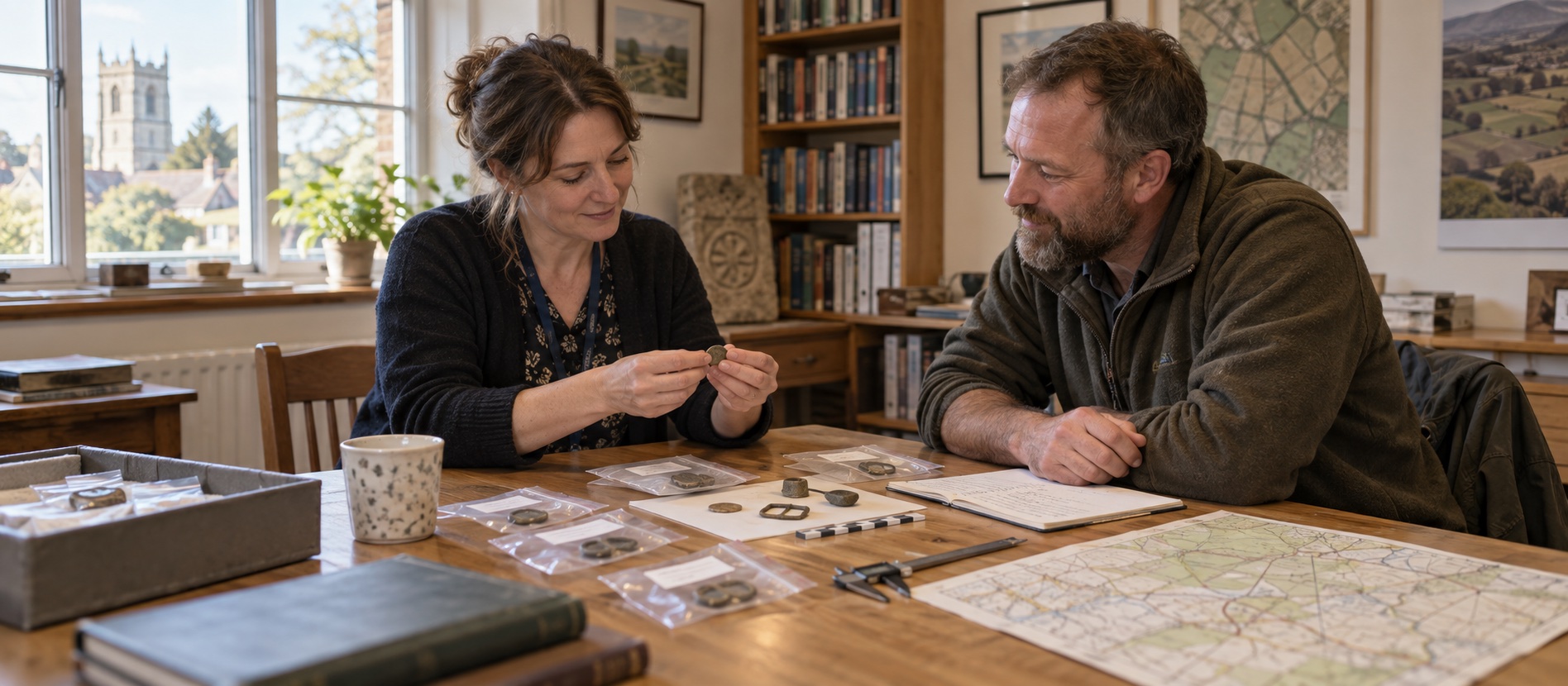
PAS recording and the statutory Treasure process are related but not the same.
A precise location, photographs and landowner details are more useful than a cleaned object.
England and Wales have PAS networks; Scotland and Northern Ireland use different systems.
What is a Finds Liaison Officer?
A Finds Liaison Officer, usually shortened to FLO, is a locally based archaeologist working with the Portable Antiquities Scheme. FLOs identify and record suitable archaeological objects found by members of the public, explain their significance and advise finders about reporting and care.
The British Museum's PAS overview describes a network of locally based officers delivered with national and local partners. Records are added to the public PAS database and can contribute to research, local Historic Environment Records and understanding of past settlement and activity.
When should a detectorist contact an FLO?
Contact the appropriate FLO when you find an object that may be archaeological, cannot be safely identified, appears part of a group or may meet the legal definition of Treasure. Copper-alloy brooches, medieval buckles, tokens, weights, worked lead, unusual coin groups and prehistoric objects can all be archaeologically useful even when they are not financially valuable.
Do not wait for a social-media consensus if the object may be Treasure. GOV.UK requires possible Treasure in England or Wales to be reported within 14 days of finding it or within 14 days of realising it might qualify.
What an FLO does not do
An FLO is not a free valuation service, commercial authenticator or buyer. The PAS records archaeological information; it does not transfer ownership to the finder or automatically place every object in a museum.
The officer decides which finds are suitable for recording under local and national priorities. Modern objects, common recent coins and material with no reliable findspot may not be accepted. That is not a judgment that the object has no personal interest.
Find the officer for the discovery area
In England, use the current PAS contacts directory and choose the FLO covering the county where the find was made. In Wales, use PAS Cymru and follow the regional museum process.
Contact the discovery area's officer rather than the one closest to your home. Local knowledge and the area's archaeological record are part of the value. If the findspot lies near a county boundary, provide the coordinates and ask which team should handle it.
What to include in the first message
Send a concise description with:
- date and circumstances of discovery;
- precise grid reference or coordinates;
- parish, field or beach description;
- clear photographs of both sides with a scale;
- length, width, thickness and weight if safe to measure;
- the landowner and finder details required by the local process;
- whether nearby or associated objects were found;
- why you think it may be Treasure or otherwise urgent.
Do not clean the object to improve the photographs. Diffuse light, a plain background and several sharp angles are more useful than polished metal. Our record-a-find guide gives a complete field record.
Do not post a find without arrangements
The British Museum tells finders not to send archaeological finds directly through the post. Contact the FLO first. Local services may use appointments, finds days, secure drop-off points or initial assessment by email.
If the FLO asks to retain an object for identification or recording, get a receipt and keep your field number with the record. Pack each object separately so labels and associations cannot be mixed.
What happens during recording
The officer may identify the object, measure and photograph it, record material and condition, assign a date range and describe the findspot. A suitable record is published on the PAS database, with sensitive location detail normally restricted to protect the site and landowner.
The object is usually returned after recording unless the finder and owner arrange a donation, a museum seeks to acquire it, or a statutory Treasure process requires it to be held. Agree ownership and reward expectations with the landowner before detecting, not after an important find.
FLOs and Treasure
The FLO can advise whether an object may be Treasure and helps create the archaeological report used in the process. The officer does not personally decide the final legal status or set a reward. Coroner, museum and valuation stages are governed by the Treasure framework.
The official GOV.UK service says a finder is contacted by an FLO or museum curator after reporting and receives a receipt. Keep the object secure, do not separate a group and follow the case instructions. See our Treasure reporting guide for the sequence.
Recording a group or scatter
Tell the FLO if several coins or related fragments came from the same small area, even when found on different visits. Provide every coordinate and the order of discovery. A dispersed group can carry a different interpretation and legal status from isolated losses.
Do not return to expand the recovery after recognising a concentration unless the landowner and relevant archaeological authority agree a method. Marking the boundary and preserving the remaining context may be the most valuable action.
Protect the object while waiting
Keep each find in its own labelled bag or rigid container. Avoid rubbing, washing, oils, waxes, acids and electrolysis. If an object is wet, flaking, powdering or unusually fragile, tell the FLO and ask for conservation advice before forcing it to dry.
A multi-compartment pouch can protect the rigid box during the search. The XP Finds Pouch has a zipped keeper pocket separate from its open debris section, but the archaeological object should still be individually contained and numbered.
What about Scotland and Northern Ireland?
The Portable Antiquities Scheme and FLO network described here cover England and Wales. Scotland uses the Treasure Trove system, where archaeological objects can be claimable by the Crown. Northern Ireland has separate legal requirements for archaeological objects and Treasure.
Use the rules for the country where the object was found. Moving it across a border or contacting an English FLO does not replace the correct national report.
Make the relationship easy to maintain
FLO teams handle large caseloads and local arrangements vary. Send organised information, keep appointments, label every object and use one clear subject line or field reference. Ask which categories the local team prioritises and whether self-recording support is available.
The aim is not simply to receive a name for a find. It is to preserve enough evidence that the object can contribute to the archaeological story of its place.
Common questions
Frequently asked questions
What finds does a Finds Liaison Officer record?
FLOs record suitable archaeological objects found by the public. Local priorities vary, and modern items or objects without a reliable findspot may not be accepted.
Can a Finds Liaison Officer value a find?
An FLO identifies and records archaeological objects and advises on reporting; the service is not a commercial valuation or authentication business. Treasure valuation follows a separate process.
Can I post a find directly to the British Museum?
No. Contact the local FLO first and follow the arrangements they provide for photographs, appointments, delivery or secure handover.
Which Finds Liaison Officer should I contact?
Contact the officer responsible for the area where the object was found, not necessarily the one nearest your home. Provide coordinates if the findspot is near a county boundary.
Helpful products
Keep recordable finds separate in the field
A pouch should carry a rigid finds box, individual bags and labels in a protected compartment. Never mix a possible archaeological object with sharp modern rubbish.

All-round field pouch
XP Finds Pouch
Best for: Regular field and wet-weather searches where quick debris storage and a separate protected pocket matter.
- Open pocket plus zipped pocket
- Washable with water drainage
- Belt, strap or MOLLE mounting
A washable belt pouch with an open debris compartment, a zipped pocket for better finds, drainage and MOLLE attachment points for a pinpointer holster or lanyard.
Know before buying: The open section is for robust scrap, not fragile objects; use a rigid finds box inside the zipped area for coins and delicate artefacts.

Compact branded pouch
Minelab Finds Pouch
Best for: Detectorists who prefer a small, uncomplicated pouch and already carry a separate finds box for delicate objects.
- Hip-mounted finds storage
- Lightweight shell construction
- Compact field format
A compact waist pouch intended to keep ordinary finds and small tools at the hip, with a lightweight format that is easy to add to a basic field kit.
Know before buying: The shell pouch is not a substitute for individual bags, labels or a rigid box when precise findspots and fragile surfaces need protecting.