
STARTING OUT · FIRST SETUP
How to set up a metal detector for your first UK search
Assemble your first metal detector, check the coil and cable, choose a steady mode and sensitivity, then practise a reliable first sweep on UK ground.
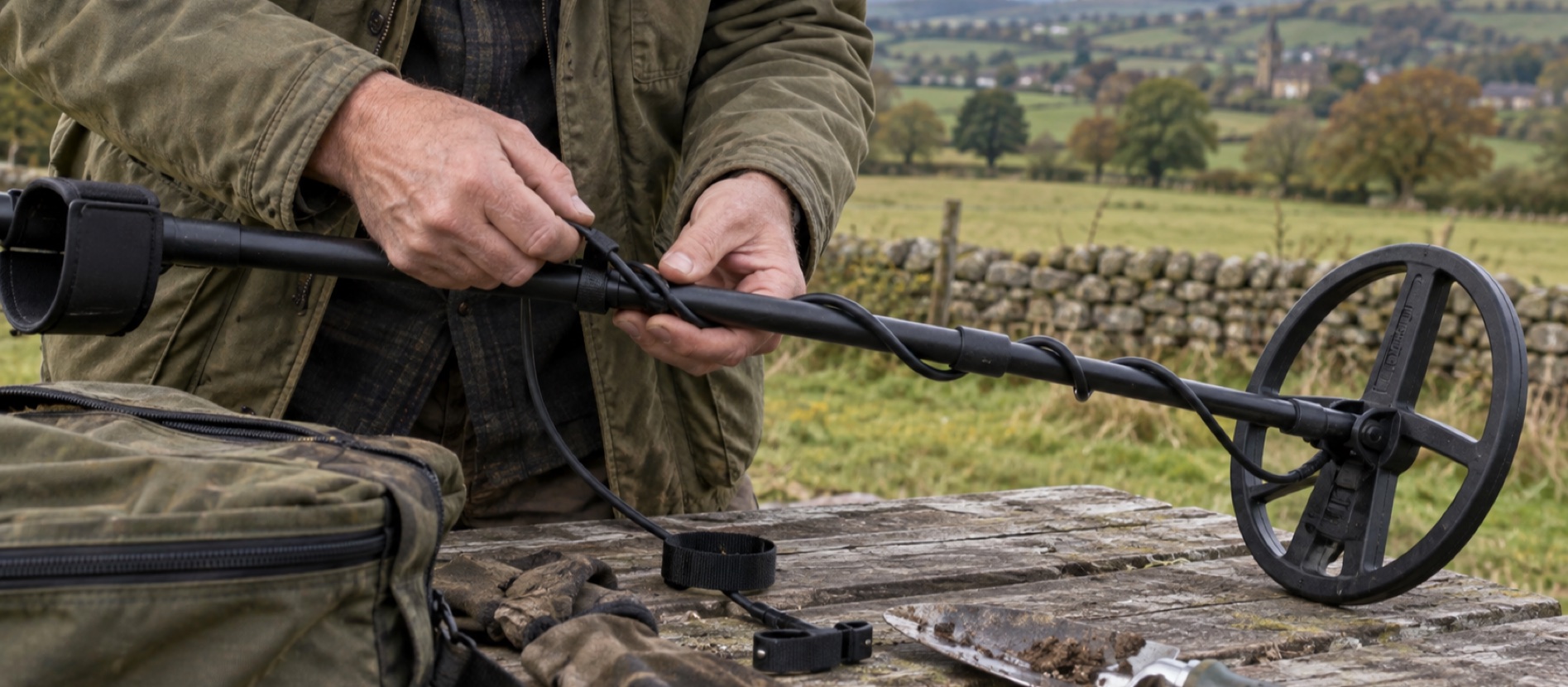
Follow the exact model manual for connectors, battery and waterproof boundaries.
Keep the coil low and level; raise it at neither end of the swing.
Get permission before searching, not after the detector is ready.
Before the field: assemble for your body
Read the exact model's assembly pages first. Fit the coil to the lower shaft using the supplied bolt and washers; tighten it enough to hold its angle without crushing the ears. Set the shaft length so your arm hangs naturally and the coil can travel just above the ground in front of your lead foot. A shaft that is too short makes you stoop; one that is too long makes the coil rise at the end of every swing. Adjust the armrest so you can carry the machine without gripping it fiercely.
Wind the coil cable around the shaft as its maker shows, leaving enough slack at the coil hinge for movement over uneven ground. Secure the remaining length so it cannot slap the shaft. Align the plug rather than twisting or forcing it. A poorly seated connector or moving cable can produce false signals; the cable troubleshooting guide gives a safe check order. Charge the battery or fit fresh cells, then verify that the skid plate, connector cover and any seals required by the manual are in place.
Choose a place you may actually search
Having a detector does not confer permission. Use land where the person authorised to consent has agreed to detecting, and check separate protected-site or beach rules. Confirm where you may dig, how deep, how to reinstate the turf and how finds will be dealt with. Our England and Wales permissions guide explains the UK-specific checks. For a first outing, choose an open, easily accessible patch away from fences, services and obvious sensitive features. Avoid testing beside a parked car: a detector has no chance to give quiet, useful feedback there.
Establish a stable electronic baseline
Switch on with the coil clear of tools, boots and metal fencing. Select a general Park or Field mode recommended by your own manual. Use its default discrimination rather than rejecting every low number. If your detector has automatic noise cancel or a frequency shift, run it before changing other settings. Ground balance when the model requires it or when moving to markedly different soil. Start sensitivity around the middle of its range, then raise it only if the detector stays quiet between genuine targets. Persistent chatter is a reason to reduce sensitivity, not to search faster.
Learn three known responses without pretending they are a depth test
Place a coin, an iron nail and a pull tab or small foil piece well apart on clean ground. Pass the coil across each at the height and speed you would use in the field. Notice the tone, whether the response repeats at the same centre and how the display behaves. Turn and sweep across each at a second angle. Remove every test item when finished. This helps you learn controls and audio; an item held in air or set on the surface does not predict a buried coin's range. See air tests versus ground for why.
Once you start searching, overlap passes and keep the coil parallel to the surface. Do not lift it at the edges of the arc. If a response appears, shorten the sweep and turn around the spot. If it vanishes or moves, consider iron, ground or interference rather than digging immediately. If it repeats from multiple directions, mark the centre and recover within your landowner's rules. The first-signal method is designed for this moment.
Recover neatly and check the hole
Before cutting turf, check that the place is safe and permitted to dig. Keep the plug attached where possible, use a cloth or mat for loose soil if appropriate and place all metal litter in a pouch rather than back in the hole. A pinpointer speeds up finding a small object within the plug or spoil and reduces needless widening. Re-scan the hole and spoil before replacing soil, then leave the surface secure. A pinpointer comparison helps if that accessory is still missing.
If something may be archaeologically important, record its position and context before cleaning or moving it further; use the find-recording guide. Your first successful day is one on which you understand the machine a little better, recover responsibly and can repeat the setup next time.
Common questions
Frequently asked questions
What should I set first on a new metal detector?
Fit the shaft and coil cable correctly, choose the manual's general Park or Field mode, run noise cancel if available, then use a stable sensitivity setting.
Should a beginner use maximum sensitivity?
Only if the detector stays stable. Background chatter can conceal real targets, so a slightly lower setting often gives clearer learning signals.
Do I need to ground balance before every search?
Follow the exact model manual. Some machines manage ground automatically; others benefit from balancing on clean ground, particularly after a significant soil change.
Can I practise in any field once the detector is assembled?
No. You need permission from the person authorised to give it and must check protected-site or location-specific restrictions before searching or digging.
Helpful products
A simple first-session kit
A straightforward detector and a pinpointer can help you learn and recover carefully; you do not need every accessory on day one.

Mid-range
Minelab VANQUISH 360
Best for: Parks, fields and beaches for a beginner who wants simple controls and one detector for varied ground.
- Multi-IQ simultaneous multi-frequency
- Whole detector to 5 m (IP68)
- 1.16 kg
Automatic simultaneous multi-frequency operation, a low 1.16 kg weight and full 5 m waterproofing make this the least complicated route into mixed UK ground.
Know before buying: The deliberately simple control set offers less room to tune audio and recovery behaviour than the X-TERRA PRO.

Premium pinpointer
Garrett PRO-Pointer AT
Best for: Regular inland, beach and shallow-water detecting where simple controls and a robust waterproof body matter.
- 11.5 kHz
- Whole pinpointer to 6 m (IP68)
- 200 g with battery
A highly visible waterproof probe with three sensitivity levels, proportional audio and vibration, fast retune and a 360-degree detection area.
Know before buying: One button handles power, retune, sensitivity and silent mode, so the control sequence takes a little practice. It uses a replaceable 9V battery.