
TECHNIQUE · TEST THE RIGHT THING
Metal detector air tests versus real ground
Understand what metal detector air tests can teach, why buried targets behave differently and how to run fair, useful comparisons on UK ground.
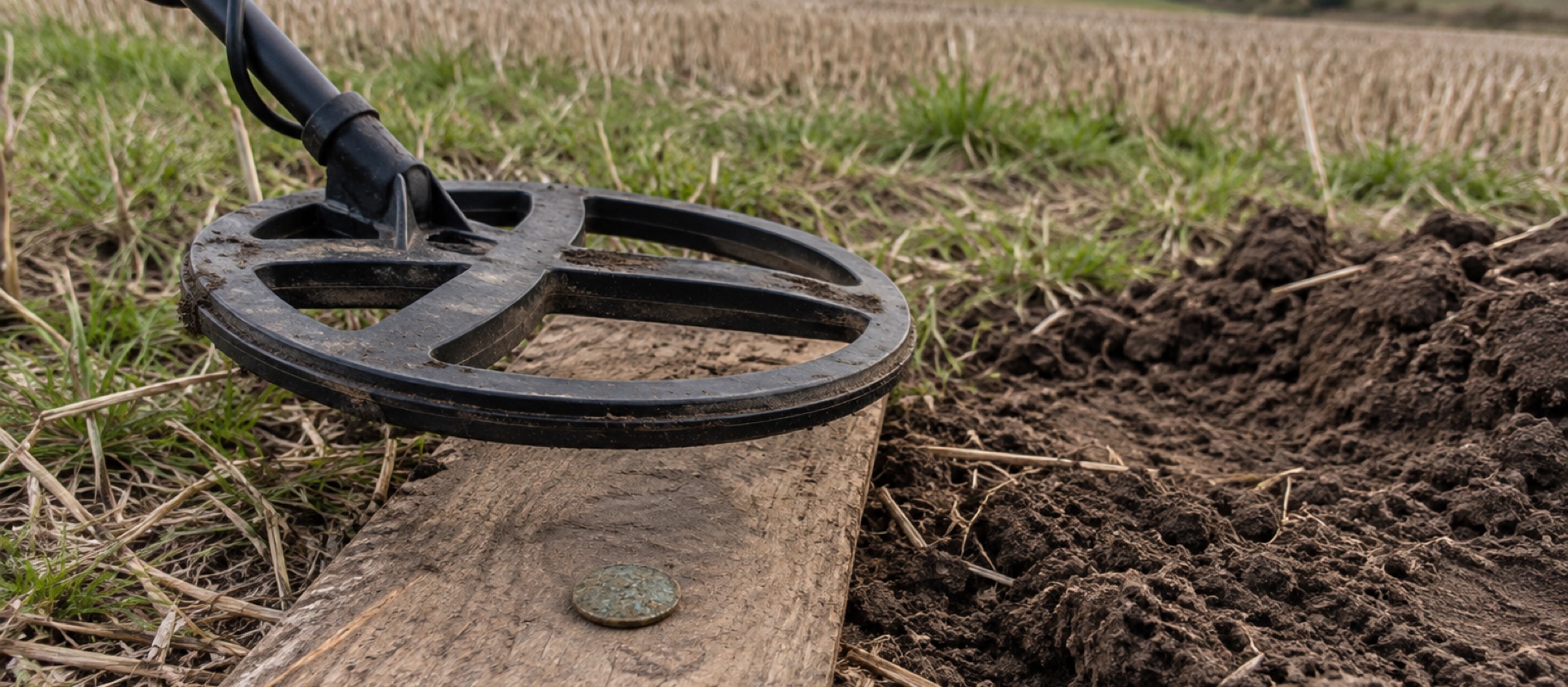
Keep coil, mode, sensitivity, target and pass speed constant when comparing.
Do not publish a single air distance as a guaranteed digging depth.
Test a marked target in the ground without disturbing archaeological context.
What an air test can answer
An air test is a target passed near the coil with no surrounding soil. It can confirm that the detector responds, help you identify the approximate centre of the coil and demonstrate how a setting changes tone or target ID. It is particularly useful when learning a new machine at home: a coin, nail and pull tab held one at a time can teach which controls you have altered. It is also a quick way to spot a grossly faulty connection if a known target receives no response at all.
What it cannot prove is a machine's real maximum depth on a UK pasture or beach. The Minelab detector concepts material describes the role of the target, coil and ground in detection. Air removes much of that ground interaction. A confident beep at a large air gap can become weaker, noisier or less identifiable once the object is in wet, mineralised or iron-littered soil.
Why the same coin changes underground
Soil itself can respond electromagnetically. Mineralised particles can raise ground noise; conductive wet salt sand is a different problem again. Moisture can change the relationship between target and soil, but not in a way that creates one universal depth multiplier. Depth, target orientation and corrosion alter the signal. Nearby iron can mask a good target or distort its ID. A horizontal surface coin held square to a coil is a generous presentation compared with a tilted coin on edge.
The act of burying a fresh coin for a test also changes the soil around it. A freshly dug hole, a settled natural target and a target in a compact undisturbed layer are not equivalent. That is why confident claims such as 'this detector finds every coin at X centimetres' should be treated cautiously. Our depth guide describes the interacting variables without a misleading single number.
Run a useful air comparison
Place the detector away from cars, indoor wiring and other metal. Keep a non-metallic ruler or marked board as a reference, and move one target across the coil at the same speed and orientation each time. Record the mode, sensitivity, ground balance condition, audio response and repeatable distance. Change only one control, then repeat. Test the same target face-on and edge-on, then add a nail nearby to hear masking. Remove test metal afterwards.
This exercise helps compare settings on one detector, not rank two brands absolutely. Coil size, default programmes and measurement technique can bias a brand-to-brand demonstration. A high sensitivity setting that gives an impressive air chirp but constant field chatter is not a useful upgrade.
Ground testing without damaging a site
The best field comparison is a known, already recoverable target on ordinary permitted ground. Mark the centre, check its response from two directions with the same coil height and speed, then change one setting and repeat before digging. Record whether the sound stayed recognisable, not just whether a number flashed. If you recover it, record the object, depth and local soil condition, but do not treat one find as a universal performance curve.
Do not plant test targets in a protected site or disturb an undisturbed archaeological layer to create a demonstration. Where a landowner permits a controlled test garden, use clearly marked modern objects and disclose that the ground has been disturbed. A surface test is safer and still teaches most first-day controls. To understand what an actual signal is telling you, go next to read detector signals and first detector signals.
The practical conclusion
Use air tests to check operation and learn audio. Use repeatable targets in real permitted ground to judge whether a setting helps on your site. Do not buy a detector because one video shows a greater ruler distance. Stable operation, coverage, recoveries and the ground you actually search matter more.
Common questions
Frequently asked questions
Are metal detector air tests accurate for depth?
No. They omit soil response, moisture, natural target position and neighbouring metal. They are useful for learning controls and comparing one setting change, not promising buried depth.
Why does a buried coin sound weaker than an air-tested coin?
Coil distance, soil minerals, target angle, corrosion and iron can all reduce or distort the response. A surface coin held square to a coil is an unusually clean target.
How can I compare two settings fairly?
Keep target, coil, pass speed, orientation and ground constant, then change one setting. Compare whether the response remains repeatable and identifiable, not just the largest single chirp.
Should I bury a coin to test a detector?
Only on ground where you have permission and without disturbing heritage context. Freshly disturbed soil differs from settled ground, so a controlled test garden is still not a universal depth standard.
Helpful products
A detector to learn with
Any properly functioning detector can show the air-versus-ground difference; this accessible Multi-IQ model is one relevant first machine.

Mid-range
Minelab VANQUISH 360
Best for: Parks, fields and beaches for a beginner who wants simple controls and one detector for varied ground.
- Multi-IQ simultaneous multi-frequency
- Whole detector to 5 m (IP68)
- 1.16 kg
Automatic simultaneous multi-frequency operation, a low 1.16 kg weight and full 5 m waterproofing make this the least complicated route into mixed UK ground.
Know before buying: The deliberately simple control set offers less room to tune audio and recovery behaviour than the X-TERRA PRO.