
Technique · DETECTION DEPTH
How deep can a metal detector detect?
Understand why metal detector depth changes with target size, coil, soil, settings and sweep technique—and why there is no honest single depth figure for coins.
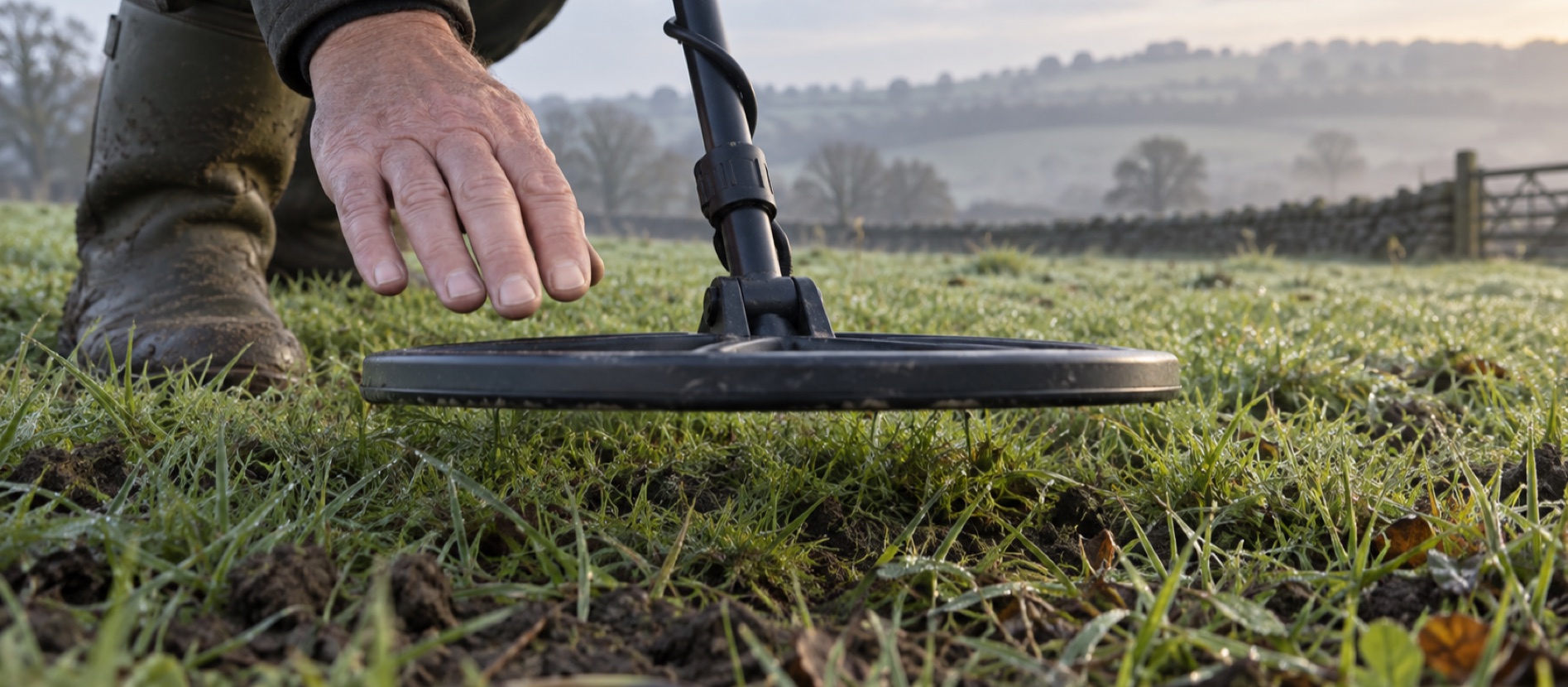
A detector responds to total coil-to-target distance, including grass and air above the soil.
Target size and orientation usually change the answer more than a tiny setting adjustment.
Never dig past the landowner's agreed depth to pursue an uncertain response.
The short answer
No responsible guide can give one depth for “a metal detector”. A coin-sized target might be clearly heard in favourable shallow ground and disappear sooner in mineralised or iron-littered soil. A large metal object can be detected deeper than a small coin, but a detector cannot tell you from its depth indicator exactly how far down the object lies. Minelab's key detecting concepts list target size, shape, orientation, composition and ground mineralisation among the factors that change detection depth.
The first practical question is not “What is its maximum?” but “Can I hear a compact, repeatable response at a depth I am permitted to recover?” The signal-reading guide helps answer that without turning one faint tone into a promise.
Target size, shape and position
A large object presents more metal to the electromagnetic field than a small hammered coin. A flat coin generally presents a different response from the same coin standing on edge. A ring, thin foil fragment, nail and broad plate can all behave differently even when buried at the same measured depth. Conductivity and corrosion add further variation.
Nearby iron may mask a non-ferrous object. A modern coin placed beside a nail can become a broken tone long before the same coin, alone in clean soil, disappears. A depth test that ignores surrounding rubbish tells you little about an old farm gateway. Read detecting around iron for a careful mixed-target method.
Coil size and actual distance from the ground
Larger coils often improve response on some larger, deeper targets in open ground, while smaller coils may find a small target beside iron more clearly. Neither size wins everywhere. The search-coil guide explains why width, weight and target separation belong in the same decision as depth.
The detector responds to the distance from coil to target. If grass, stones, a high swing or a raised coil cover holds the coil several centimetres above the soil, that distance is spent before the signal reaches the buried object. Keep the coil low and level without scraping it. At the ends of a pendulum swing, the coil rises and the effective search depth falls. Correcting that arc can be more useful than buying a larger coil.
Ground can consume a weak signal
Fine iron minerals and conductive salts produce a broad ground response. The detector must separate that background from a small metal signal. In difficult soil, a mode or ground-balance setting that runs quietly may reveal a weak repeatable target better than maximum raw sensitivity. Wet beach sand is a separate conductive challenge, not simply damp inland soil.
Moisture can change coupling and ground response, but “rain always gives more depth” is too simple. The same rain can make recovery damaging or ground unstable. Use the weather and soil guide to judge whether the field is worth searching at all.
Why maximum sensitivity is not maximum useful depth
Sensitivity increases response to weak signals and to interference and ground noise. When the detector chatters, a marginal buried object is harder to distinguish. Begin in the correct search mode, perform noise cancel where offered, balance as required and raise sensitivity only until the ground becomes unstable. Then step back to a quiet setting. The sensitivity guide gives a repeatable method.
The X-TERRA PRO offers a wide sensitivity range and selectable single frequencies, but those controls do not defeat target physics. Its published specification also lists manual, automatic and tracking ground balance. Use the features to obtain stability, not to promise a depth figure.
Air tests and depth indicators have limits
An air test removes soil mineralisation, moisture, iron neighbours and recovery constraints. It can confirm that a detector responds to a known item and compare changes on the same setup, but cannot reproduce a buried target. A freshly buried coin also differs from one that has lain in disturbed and settled ground for years. Keep the same coil, mode, speed and target orientation if you compare settings at all.
Many detector screens show a depth bar calibrated around a coin-like object. A large shallow object can look deeper, and a small target may give a misleading or unstable reading. Pinpoint before digging, then check whether the object is still in the plug, loose soil or undisturbed ground. Do not use the display as permission to dig below the agreed layer.
A modest field check you can actually learn from
On land where you have permission, place several known objects on the surface: a modern coin, a small iron nail and a larger harmless metal item. Compare each from two directions with the normal coil height. Move the coil higher by a small known distance; the weakening response shows why swing height matters. Place the nail near the coin and observe how separation changes. Remove every test object afterwards.
A straightforward detector such as the SIMPLEX Lite is enough to learn this relationship. It has a dedicated Field mode and an 11-inch coil only on the specific SX28 bundle; the standard Lite uses a smaller supplied coil, so check the retailer's exact kit before assuming a size. Choose the machine by the ground you search and the controls you want, not a claimed maximum depth.
Detection depth is not digging depth
Even if a detector hears a large object below the cultivated layer, recovering it may be inappropriate or prohibited. Agree recovery depth and method before searching. If a response appears associated with a compact layer, several objects or structural material, stop and record the context. Record a find and seek appropriate advice rather than turning a technical curiosity into avoidable damage.
Common questions
Frequently asked questions
How deep can a metal detector find a coin?
There is no dependable single figure. Coin size, orientation, soil minerals, nearby iron, coil distance and detector setup all change whether its signal is audible.
Does a bigger coil always detect deeper?
No. It can improve response to some larger or deeper isolated targets, but may be less nimble around iron and less sensitive to certain small targets. Match coil size to the site.
Are air tests a reliable measure of buried depth?
No. They remove soil response and nearby targets. Air tests can compare settings under controlled conditions, but do not predict performance in a real field.
Should I run maximum sensitivity for more depth?
Only if the detector remains stable. Chatter can conceal faint repeatable signals; a quieter setting may give more useful depth in difficult ground.
Helpful products
Start with a stable detector, not a depth claim
These established models give practical field modes and different control levels. Neither has a fixed guaranteed coin depth; ground conditions and technique determine what is audible.

Upper mid-range
Minelab X-TERRA PRO
Best for: A committed inland beginner who wants to learn how frequency, ground balance and audio choices change detector behaviour.
- Selectable 5 / 8 / 10 / 15 kHz
- Whole detector to 5 m (IP68)
- 1.3 kg
Selectable 5, 8, 10 and 15 kHz operation, six search profiles and detailed tone and discrimination controls give a keen beginner more room to progress.
Know before buying: Selectable frequencies are not simultaneous multi-frequency, and the extra controls create a steeper first-week learning curve.

Lower mid-range
Nokta SIMPLEX Lite
Best for: A cost-conscious beginner who wants full waterproofing, vibration and more adjustment than the simplest starter machines.
- 15 kHz single frequency
- Whole detector to 5 m (IP68)
- 1.2 kg
A 15 kHz entry model with four modes, 30 sensitivity levels, automatic or manual ground balance and a fully submersible 5 m build.
Know before buying: It is single-frequency and lacks the ULTRA model's recovery-speed and tone-shaping controls; wet salt sand is not its strongest ground.