
Technique · STABLE SIGNAL
Metal detector sensitivity settings explained
Set metal detector sensitivity for stable UK field and beach searching; learn why maximum can hide targets and how to diagnose chatter step by step.
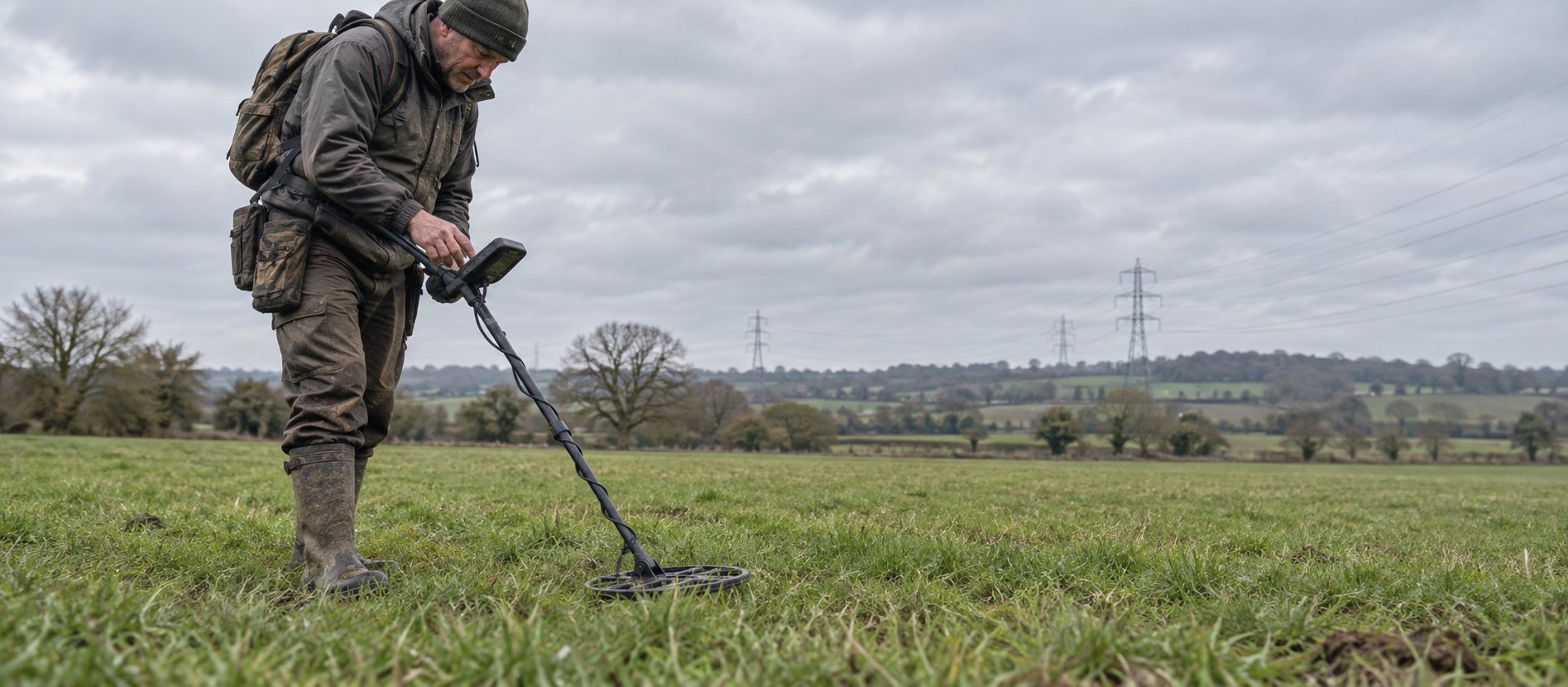
A quiet lower setting can reveal more usable targets than an unstable maximum.
Diagnose interference, ground and coil movement before changing the number.
Test the smallest adjustment over the same target; scales differ by model.
What the control really does
Sensitivity changes how strongly the detector responds to faint signals. Raise it and a marginal target may become clearer. Raise it too far and the machine also reacts to ground minerals, wet salt, electromagnetic interference and nearby metal. The result is a stream of sounds that makes a genuine weak target harder to recognise.
The scale is model-specific. Five levels on a VANQUISH 360 and 1–25 on an X-TERRA PRO do not translate into equivalent percentages. Nor does a displayed maximum mean the detector will reach a stated depth in every soil. Coil size, target size and orientation, frequency processing and sweep technique still shape the response.
Why maximum can make you find less
Imagine listening for a quiet conversation beside a road. Increasing the microphone gain amplifies the voice and traffic together. A stable detector is easier to interpret because a compact repeatable response stands out from the background. Constant chatter can cause fatigue, rushed decisions and missed signals even if the underlying electronic response is technically strong.
Minelab's X-TERRA PRO manual advises reducing sensitivity when black sand continues to produce false responses after ground balancing. That is a good example of a controlled compromise, not a failure of the detector.
Set sensitivity in a repeatable order
Begin in the manufacturer's profile for the actual ground. Keep other detectors several metres away. Run noise cancel if provided, and ground balance on a clean patch where the manual calls for it. Then:
- Start at the factory or moderate sensitivity level.
- Hold the coil still; note whether noise occurs without movement.
- Sweep a known coin or a repeatable target at normal height.
- Increase one step and repeat the same sweep.
- Stop when background noise makes the target harder to pick out; return to the last calm setting.
Do not alter recovery speed, discrimination and tone programme during this test. Otherwise you cannot tell which change mattered.
Diagnose the kind of noise first
Noise with the coil stationary often points to electromagnetic interference from power lines, electric fences, charging equipment, other detectors or a loose connection. Move, run noise cancel and inspect the cable before lowering sensitivity further. Our electrical-interference guide provides a safe sequence.
Noise that follows the ground may mean mineralisation, salt, inconsistent coil height or an unsuitable mode. Ground balance or Beach processing should come before aggressive discrimination.
Noise only when the coil touches grass or the shaft moves suggests a mechanical issue. Check cable wrap, connector and coil cover. Sensitivity reduction can mask the symptom without repairing the cause.
One broad signal from several directions may be a large buried object. Shorten the sweep and map its edges before assuming all noise is environmental.
UK fields and pasture
On mild dry pasture, you may be able to use a higher setting than beside an electric fence, damp clay hollow or concentration of iron. Begin each different zone with a stability check. A soil moisture change can alter the broad ground response without changing your detector or coil. The weather and soil guide explains why rain is not a universal depth boost.
On an iron-littered field, lowering sensitivity slightly can reduce the strength of distant surrounding iron and improve the clarity of nearby compact signals. This is not a substitute for a smaller coil or careful recovery-speed setting, but it can be more useful than forcing the detector to hear every piece of iron at once.
Wet salt sand
Select the dedicated Beach profile before changing sensitivity. Wet salt is conductive and creates a large continuous response. A suitable simultaneous multi-frequency detector can handle it more easily than a basic single-frequency machine, but even a capable model may need a lower setting in surf or black sand.
Sweep at a constant height and avoid repeatedly moving the coil in and out of water during a target check. If the response remains unstable, stop to rebalance or move to a calmer zone. Waterproofing protects electronics; it does not control the salt signal. See metal detectors for wet sand for equipment distinctions.
The VANQUISH 360 offers five sensitivity levels and automatic Multi-IQ operation. Its appeal is a short decision path for someone who wants to learn the sound of stable beach and inland targets without a long control menu.
When to raise it again
Lower sensitivity is not a permanent instruction. After leaving the source of interference or moving to milder ground, repeat the known-target test and raise it cautiously. If a small change produces a clearer response without chatter, keep it. If it only makes the machine busier, return to the calmer setting.
Record the mode, coil, ground, approximate conditions and setting in a field note. Reproducible comparisons beat a copied “best settings” number from another machine or location.
Common questions
Frequently asked questions
Should I run my detector at maximum sensitivity?
Only if it remains stable and real targets are clearly distinguishable. Maximum can amplify ground and electrical noise; one step lower may be more useful.
Does lowering sensitivity always lose depth?
It can reduce response to marginal targets, but a quieter detector can make genuine weak signals easier to hear. Test the smallest change over the same target rather than assuming a fixed depth loss.
Why is my detector noisy even at low sensitivity?
Check power lines, other detectors, ground mode, balance, coil cable and connector. Sensitivity is not a repair for mechanical faults or the wrong Beach profile.
What sensitivity should I use on wet sand?
Start with the manufacturer's Beach profile and normal setting, then reduce only until salt and black-sand responses settle. Scales differ by model, so there is no universal number.
Helpful products
Simple and adjustable sensitivity controls
The VANQUISH keeps the choice short, while the X-TERRA PRO offers a finer scale. Neither should be judged by its highest number alone.

Mid-range
Minelab VANQUISH 360
Best for: Parks, fields and beaches for a beginner who wants simple controls and one detector for varied ground.
- Multi-IQ simultaneous multi-frequency
- Whole detector to 5 m (IP68)
- 1.16 kg
Automatic simultaneous multi-frequency operation, a low 1.16 kg weight and full 5 m waterproofing make this the least complicated route into mixed UK ground.
Know before buying: The deliberately simple control set offers less room to tune audio and recovery behaviour than the X-TERRA PRO.

Upper mid-range
Minelab X-TERRA PRO
Best for: A committed inland beginner who wants to learn how frequency, ground balance and audio choices change detector behaviour.
- Selectable 5 / 8 / 10 / 15 kHz
- Whole detector to 5 m (IP68)
- 1.3 kg
Selectable 5, 8, 10 and 15 kHz operation, six search profiles and detailed tone and discrimination controls give a keen beginner more room to progress.
Know before buying: Selectable frequencies are not simultaneous multi-frequency, and the extra controls create a steeper first-week learning curve.