
Technique · TARGET SEPARATION
Metal detector recovery speed explained
Understand metal detector recovery speed, the separation-versus-depth trade-off and how to test settings on clean pasture and iron-contaminated UK ground.
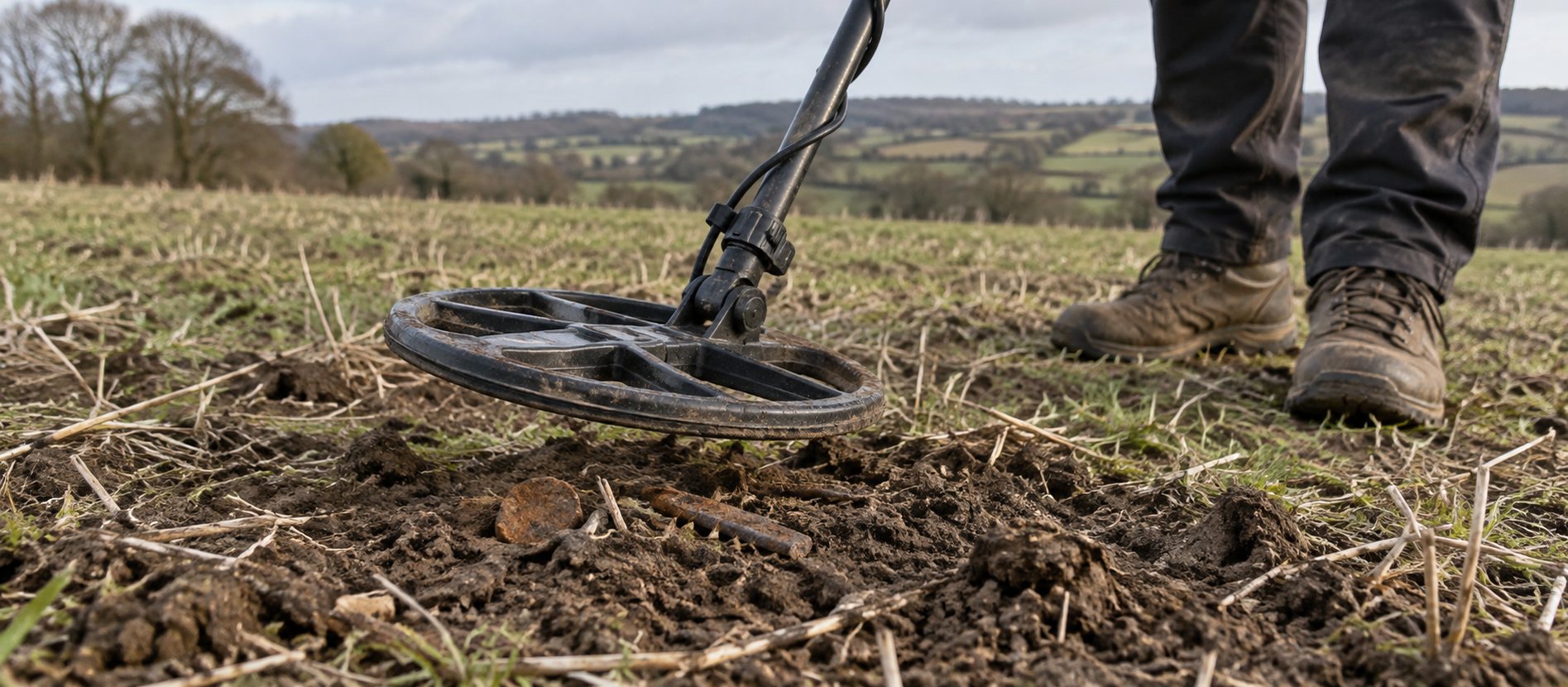
Recovery speed is not the speed at which you should swing the coil.
Fast is useful in dense targets; slow can favour isolated targets on cleaner ground.
Coil footprint, sweep control and iron settings can matter more than one menu step.
A plain-English explanation
When the coil passes a target, the detector processes its response and reports it through sound and display. Recovery speed influences how quickly it can give a distinct response to the next nearby target. If a nail and coin sit close together, a slow response may merge them; a faster response can make two events easier to hear.
That does not make the faster setting a universal upgrade. Shorter processing can make a deep or small target sound weaker or less rounded. Manufacturers use different scales and algorithms, so a setting of “3” on one machine is not equivalent to “3” on another.
Recovery speed is not sweep speed
You still need a controlled, low, overlapping sweep. Whipping the coil across a site can miss ground even when recovery is fast. Moving very slowly does not necessarily recreate a slower electronic recovery setting. The two variables interact, but they are not the same control.
Our sweep guide explains coil height, overlap and pace. Fix those first if signals sound inconsistent at the ends of an arc.
Clean pasture: start on the calmer side
Where targets are sparse and the soil is relatively mild, a lower or default recovery setting may produce a fuller response on an isolated deeper object. Choose the correct Field profile and test a known target before reducing the setting. The gain is not guaranteed: mineralisation, target angle and coil size may determine the real limit.
Do not lower recovery until a target becomes one long smear. A clear sound you can centre and confirm from two directions is more useful than a theoretical depth advantage that makes the field hard to read.
Iron patches: speed can create breathing room
Around old gates, yard margins and cultivated areas with nails, a faster recovery setting may help the detector report a compact non-ferrous response between ferrous signals. Take short passes through the centre of the suspected target and rotate a quarter turn. A smaller coil often improves physical separation because it sees fewer items at once.
Increasing recovery speed cannot unmask every target. A coin directly beneath large iron may still be invisible, and a corroded iron ring can still produce a convincing high tone. Iron bias and discrimination change other parts of the decision; do not change all three at once.
A two-target practice test
On a permitted patch with no buried metal, place a modern coin and an iron nail on the surface. Keep them at least a coil width apart, confirm that each has a separate response, then move them gradually closer. Record the point at which the coin response becomes broken under the factory setting.
Now change only recovery speed by one step and repeat the same approach from two directions. Listen for a separate coin response, not just a higher number. Try a smaller compatible coil if available. Finally restore the factory setting and compare again so you do not mistake familiarity with the test for improvement.
Do not leave test objects in the field or conduct an in-ground test where digging is not permitted.
What current detector menus actually offer
The X-TERRA ELITE specifications list adjustable recovery speed, while the X-TERRA PRO manual lists levels 1–3. Nokta's SIMPLEX Ultra specification also lists the control. The base Nokta SCORE, however, does not provide recovery-speed adjustment; the DOUBLE and TRIPLE SCORE variants do. Check the exact model name before following a settings video.
The X-TERRA ELITE is a useful all-round example: its Field and Park profiles provide different starting behaviour, and recovery speed can be changed after comparing real targets. Its Multi-IQ processing is separate from that setting.
The depth trade-off is conditional
It is reasonable to expect slower recovery to favour a longer, smoother response on some isolated marginal targets and faster recovery to favour separation in dense rubbish. It is not reasonable to promise a fixed centimetre gain. Ground balance, sensitivity, target shape and nearby iron all interact.
If a new faster setting makes every small signal sound clipped, back it off. If a slower setting merges nail and coin into one broad response, move faster electronically or choose a smaller coil. Change only one variable and keep a short field note.
A sensible starting decision
Stay near the factory profile on a new permission. Only alter recovery when the site gives you a clear reason: crowded targets that will not separate, or clean ground where isolated weak responses deserve a fuller check. Judge the result by repeatability and the ability to locate a target, not by how busy the detector sounds.
Common questions
Frequently asked questions
What is recovery speed on a metal detector?
It affects how quickly the machine can report another target after a response. Faster settings can separate close objects, while slower settings may give fuller responses to isolated weak targets.
Is faster recovery speed always better?
No. It is useful where targets are crowded but may shorten marginal deep responses. Test a change over the same coin-and-nail arrangement before keeping it.
Is recovery speed the same as swing speed?
No. Recovery is electronic processing behaviour; swing speed is how fast you move the coil. Keep a controlled, overlapping sweep regardless of the setting.
Can I change recovery speed on the base Nokta SCORE?
No. Nokta's model comparison lists recovery-speed adjustment on DOUBLE and TRIPLE SCORE, not the base SCORE. Check the precise model before following a settings guide.
Helpful products
Detectors with recovery-speed adjustment
These models expose the control for deliberate testing. The simpler VANQUISH 360 and base Nokta SCORE do not offer the same user adjustment.

Upper mid-range
Minelab X-TERRA ELITE
Best for: Regular field, park and beach use where stable mixed-ground performance and detailed controls justify a higher budget.
- Multi-IQ; 15 kHz inland option
- Whole detector to 5 m (IP68)
- 1.3 kg
Multi-IQ simultaneous multi-frequency operation, six search profiles and a 5 m waterproof build make this a capable step-up detector for varied UK ground.
Know before buying: Its larger coil and deeper menu demand more concentration than a simple starter model, and wireless audio uses Minelab's compatible low-latency system rather than ordinary Bluetooth.

Settings-led beginner
Nokta SIMPLEX Ultra
Best for: Inland permissions and freshwater use for a beginner who wants settings to learn rather than automatic multi-frequency operation.
- 15 kHz single frequency
- Whole detector to 5 m (IP68)
- 1.2 kg
A fully waterproof 15 kHz detector with six search modes, manual or automatic ground balance and unusually detailed tone and recovery controls for the price.
Know before buying: Beach mode helps with salt response, but the single 15 kHz platform can still need lower sensitivity and careful ground setup on wet salt sand.