
Community · CLUBS 47
How to find a metal detecting club in the UK
Find and assess a UK metal detecting club, from directories and first contact to permissions, insurance, dig rules, fees and first-meeting questions.
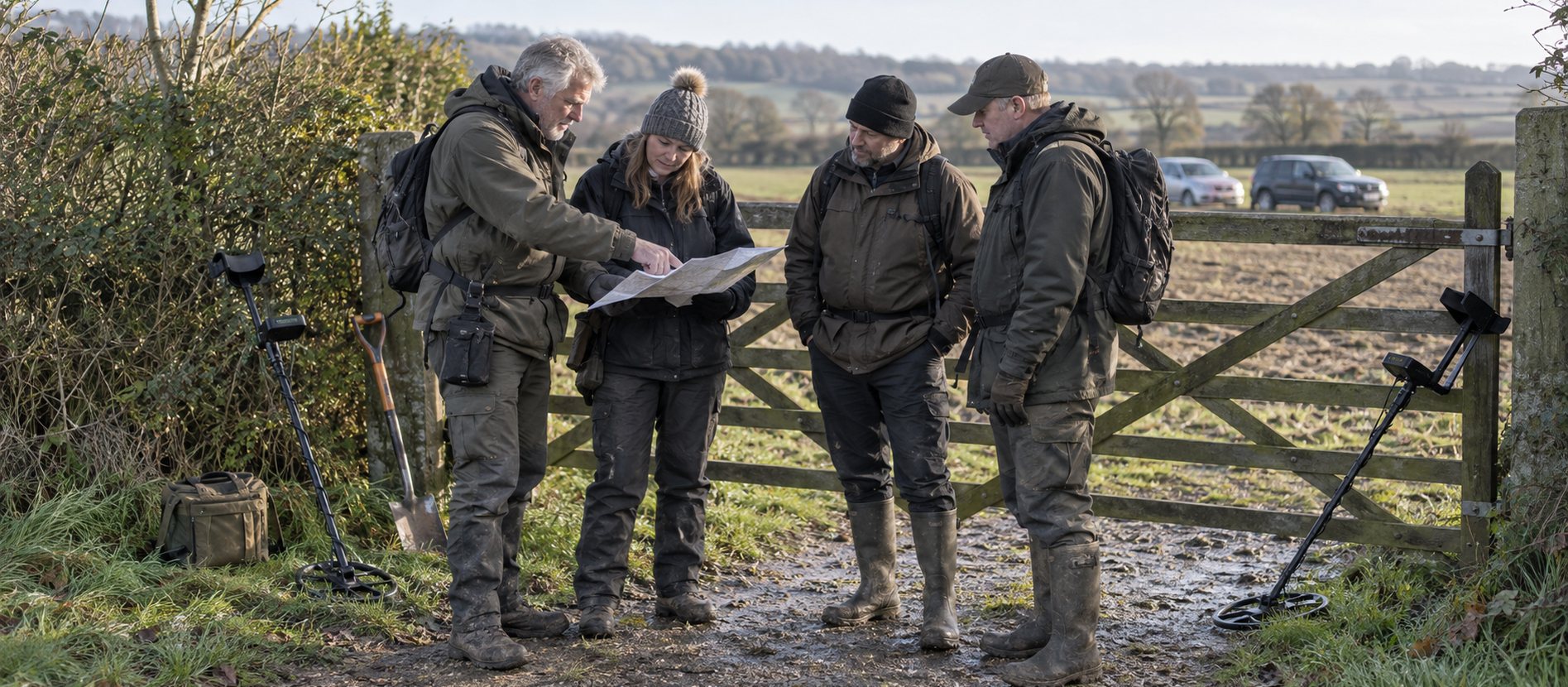
A club and an informal paid-dig group may offer different governance, access and accountability.
Ask about permission, finds agreements, insurance, fees and conduct before paying.
A responsible group welcomes questions about reporting, holes, rubbish and landowner relationships.
Begin with recognised routes
The National Council for Metal Detecting maintains information for clubs and individual members and is a useful starting point for finding established groups. Search its current club information, then look for the club's own website or public page so you can check meeting details directly. Local detector dealers, museums and Finds Liaison Officers may know which groups are active, but they are not endorsements and should not be asked to disclose private contact details.
Use several location phrases when searching: county, nearest city, wider region and “metal detecting club”. A group may meet in one town but organise digs across a much larger area. Check when its website or social feed was last updated; old meeting information can remain visible long after a club becomes inactive.
Do not rely only on a list of names. Confirm the organiser, current contact route and next public meeting before travelling or sending payment.
Club, rally or paid-dig group?
An established club commonly has a committee, constitution, regular meetings, membership rules and organised searches on land for which it has arranged access. A rally is usually a larger one-off event. An informal dig group may organise days through social media and charge per event without offering normal club governance.
None of those labels guarantees good practice. Ask who holds the land agreement, what the agreement permits, whether detecting insurance is required, how finds are divided and who handles a problem on the day. “Members only” is an access rule, not proof of legal permission.
Questions to ask before joining
Send a short introduction explaining your area, experience level and usual transport. Then ask:
- whether new members are currently accepted and if there is a waiting list;
- where and how often meetings take place;
- the annual fee, joining fee and any separate dig charges;
- whether membership of a national body or evidence of insurance is required;
- how land permission and finds ownership are documented;
- what recovery tools, hole sizes or search areas are restricted;
- how possible Treasure and recordable archaeological finds are handled;
- whether guests, under-18s or people with access needs can attend.
A clear answer is more valuable than a promise of “good land”. Productive permissions change with farming, weather and landowner decisions. No responsible club can guarantee valuable finds.
Permission remains specific
Club membership does not let a member detect parks, beaches, footpaths, commons or private fields independently. Permission belongs to the precise land and activity described by the owner or authorised manager. On an organised dig, follow the boundaries, start time, parking route and recovery rules given by the organiser.
Ask how the club records the landowner's finds agreement. That should cover ordinary finds, high-value objects, possible Treasure and anything the owner wants retained. It should also explain whether photographs or exact locations may be shared publicly.
Use the England and Wales permission guide for the underlying checks. Rules and reporting systems differ in Scotland and Northern Ireland, so a UK-wide club should state which process applies to each event.
Insurance is not permission
Public-liability or detecting insurance can protect against specified risks, subject to the policy terms. It does not make an unlawful search lawful, override a protected-site restriction or grant access. Ask whether the club's cover applies to members, guests and every type of event, and whether you need separate individual membership.
Read the current documents rather than repeating a figure from an old forum post. Confirm exclusions, excesses and conduct requirements with the organisation or insurer that issued the cover.
What good club standards look like
A well-run group normally explains its conduct before the first dig. Expect clear boundaries, a safety briefing, a named organiser, a system for emergencies and a requirement to fill holes and remove recovered rubbish. It should discourage detecting on scheduled or prohibited land and provide a route for reporting possible Treasure and recordable finds.
Good practice is visible in small details: gates remain as instructed, vehicles stay on the agreed route, livestock is not disturbed, and finds are not scrubbed or posted with a precise location before they are assessed. Experienced members should be willing to demonstrate coil control and recovery without presenting guesses as identification.
Be cautious if an organiser will not name the permission holder, asks members to conceal the event, discourages recording, promises guaranteed valuables or treats every legal question as unnecessary. Leave if the activity on the day differs materially from what was described.
Your first meeting
A club meeting is a useful low-pressure test. Arrive on time, introduce yourself and listen to how ordinary business is handled. Are landowner updates, reporting and conservation discussed alongside finds? Are rules written down? Does the atmosphere allow a new detectorist to ask basic questions without being pushed into a purchase?
Bring photographs of a detector or find if the club invites them, but do not bring an uncertain fragile object loose in a pocket. Record it first and use the finds-care guidance. A club member may offer an opinion; an FLO or relevant specialist is the better route for an archaeological record.
Prepare for the first group dig
Read the event instructions the evening before. Charge the detector and phone, pack weather layers, water, first aid and only the recovery tools permitted. Label containers before leaving home and carry robust scrap separately from possible finds.
A field pouch with a closed pocket makes that separation easier, while a pinpointer can reduce unnecessary widening once a target has been centred. Neither justifies digging deeper than agreed.
At the briefing, mark the parking place and exit, note the finishing time and identify the organiser. If a target continues into a compact layer or several objects appear together, stop and ask. Record an unusual object before cleaning and follow the club's reporting process without surrendering your own notes.
If no nearby club is accepting members
Do not pay an unknown social-media account simply because established clubs have waiting lists. Attend open talks, learn through recognised organisations and continue seeking your own written permissions respectfully. A small local club may have no polished website, so one courteous message is reasonable; repeated messages after no reply are not.
You can also improve the skills that make you welcome on a future group search: tidy recovery, accurate grid references, conservative finds care and a clear understanding of the Treasure reporting route. The best introduction is evidence that you will protect the landowner relationship rather than only ask what has been found.
Common questions
Frequently asked questions
How do I find a metal detecting club near me?
Start with current information from recognised detecting organisations, then search by county, nearby city and wider region. Confirm the club's own current contact and meeting details before travelling or paying.
Does club membership give me permission to detect?
No. Membership may provide access to specific organised events, but it does not authorise independent detecting on parks, beaches, paths, commons or private fields. Permission remains specific to the land and activity.
What should I ask before joining a club?
Ask about fees, meeting frequency, insurance requirements, how permissions and finds agreements are documented, reporting practice, recovery rules, guests and any separate charges for organised digs.
Is a paid dig group the same as a club?
Not necessarily. A club commonly has a committee, constitution and regular meetings, while a paid-dig group may organise individual events. Judge either by clear permission, conduct, insurance and reporting arrangements.
Helpful products
Useful kit for an organised group dig
A separated finds pouch and dependable pinpointer support tidy recovery and accurate storage, but the club's permission and tool rules decide what can be used.

All-round field pouch
XP Finds Pouch
Best for: Regular field and wet-weather searches where quick debris storage and a separate protected pocket matter.
- Open pocket plus zipped pocket
- Washable with water drainage
- Belt, strap or MOLLE mounting
A washable belt pouch with an open debris compartment, a zipped pocket for better finds, drainage and MOLLE attachment points for a pinpointer holster or lanyard.
Know before buying: The open section is for robust scrap, not fragile objects; use a rigid finds box inside the zipped area for coins and delicate artefacts.

Premium pinpointer
Garrett PRO-Pointer AT
Best for: Regular inland, beach and shallow-water detecting where simple controls and a robust waterproof body matter.
- 11.5 kHz
- Whole pinpointer to 6 m (IP68)
- 200 g with battery
A highly visible waterproof probe with three sensitivity levels, proportional audio and vibration, fast retune and a 360-degree detection area.
Know before buying: One button handles power, retune, sensitivity and silent mode, so the control sequence takes a little practice. It uses a replaceable 9V battery.