
Starting out · FIELD NOTE 09
Your first day metal detecting: a UK field plan
Plan your first metal detecting day in the UK, from permission and setup to sweep technique, careful recovery and what to do with finds.
Confirm the exact search area, exclusions and finds agreement before arriving.
Change only one detector setting at a time; the first day is for learning repeatable signals.
Photograph and record an uncertain or significant find before cleaning or separating associated objects.
The day before: remove avoidable problems
Charge the detector and phone, fit fresh batteries where needed and assemble the shaft to your height. The coil should float just above the ground with your shoulder relaxed and elbow slightly bent. Put each tool in a consistent place so you can return it without setting equipment in long grass.
Reconfirm the permission, parking point, gates, livestock instructions and the time you are expected to leave. Check rain, temperature and daylight as well as field condition. Postpone a pasture visit if waterlogged ground will not close cleanly, and never enter standing crops without an explicit arrangement.
Pack against the equipment checklist, then remove anything without a job. A detector, pinpointer, permitted recovery tool, finds-and-scrap pouch, gloves, water and charged phone are the core.
The first ten minutes on site
Walk the boundary with the landowner or use an agreed marked map. Note excluded areas, overhead or buried-service concerns, active farm work and where recovered rubbish should go. Do not infer permission for an adjoining field because it looks like part of the same holding.
Switch on away from large metal objects and follow the manual's noise-cancel and ground-balance sequence if the detector provides one. Select the relevant factory field, park or beach mode. Set sensitivity high enough for useful response but low enough for stable operation.
Make a five-target listening patch
Place a modern copper-plated coin, another coin, a ring pull, a small iron nail and a piece of foil on clean ground where this is allowed. Sweep each from two directions at normal height. Notice tone shape, repeatability and target ID movement rather than trying to memorise one “correct” number.
Put the objects away afterwards. This quick exercise gives your ears a reference and shows whether the detector is stable before you begin interpreting unknown targets.
Search a small grid
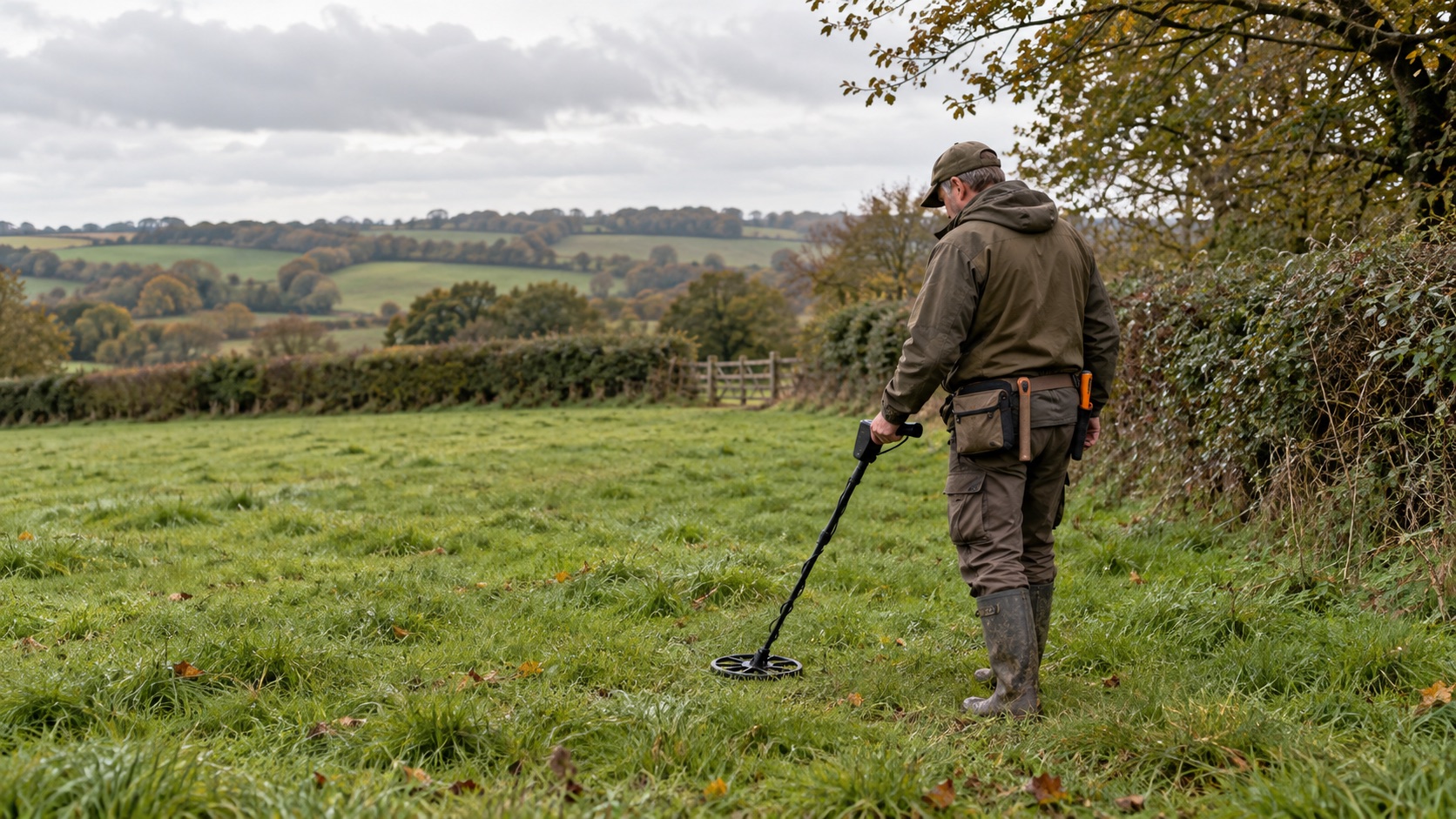
Choose an area that can be searched methodically in the available time. Walk a straight visual line, swing from the shoulder in a comfortable arc and overlap each pass. Keep the coil parallel with the ground through the ends of the swing and advance only a small step at a time.
Large, fast sweeps create gaps and make the detector process changing ground and targets too quickly. Our sweep-technique guide explains coil height, overlap and cross-checking in detail.
Which signals should a beginner dig?
Dig repeatable signals that can be heard from more than one direction, plus some uncertain signals when the surface can be restored. The aim is to connect sound with reality. Perfect-looking target IDs can be modern rubbish; useful finds can sound less tidy because they are deep, tilted or close to iron.
Avoid silencing a broad range of targets simply to make the detector quiet. Begin with the manufacturer's preset discrimination and learn the ordinary rubbish on that site. Keep sharp iron and litter in a separate section of the pouch.
Pinpoint and recover carefully
Use the detector's pinpoint function or short cross-sweeps to estimate the target centre. Cut beside that point to reduce the risk of striking it. Keep the removed soil together and scan both the hole and plug.
A handheld pinpointer makes this stage quicker and can reduce the size of the opening. Retune it against clean soil if the whole sidewall responds, and never use the probe as a lever.
Replace all soil, close the plug and leave the surface stable. If the ground cannot be restored, stop recovering targets there. Responsible fieldcraft is part of detecting skill, not a separate courtesy.
What to record
For an object that may be old or significant, record the location before moving farther. A phone photograph showing the find in context, a precise grid reference where appropriate, depth, orientation and nearby associated objects can matter more than cleaning it immediately.
Do not rub a coin to expose detail in the field. Separate fragile objects from scrap and avoid wetting, oiling or chemically cleaning an uncertain find. The finds-care guide explains safe first steps.
When the find might be Treasure
In England and Wales, an object that might meet the legal definition of Treasure must be reported within 14 days of finding it or realising it may qualify. Scotland and Northern Ireland use different systems. Use current official guidance for the country where the object was found and contact the appropriate reporting service when uncertain.
A sensible first detector setup
If you are using a simple bundle such as the X-TERRA Voyager, start in the mode the manual recommends for the ground and resist changing every discrimination choice. Its included headphones and bag reduce shopping, but only the coil is waterproof and the supplied digger still needs to suit the permission.
Finish before technique collapses
Stop with enough energy to check that every hole is closed, all scrap is removed and no tools remain behind. Note which settings worked, which signals fooled you and any area worth returning to. Thank the landowner and share the agreed information about finds promptly.
The best first day is not the one with the oldest object. It is the one that earns a second invitation and leaves you understanding the machine better than when you arrived.
Common questions
Frequently asked questions
Where should I go on my first metal detecting day?
Choose a manageable site where you have clear permission and understand any conditions. A quiet, recently cut inland permission is usually easier for learning than difficult wet sand or heavy contamination.
Should a beginner dig every signal?
Digging a broad range of repeatable signals is a useful way to learn, provided recovery is allowed. Compare each target with its sound, target ID and depth indication before moving on.
How long should the first detecting session be?
A short, deliberate session is more useful than searching until technique deteriorates. Allow time to adjust the shaft, practise a level sweep and recover targets neatly without rushing.