
Permissions · CROWN FORESHORE 43
Crown Estate beach metal detecting rules
Check Crown Estate foreshore permission, boundaries, local restrictions, recovery rules and finds reporting before detecting on a beach in England or Wales.
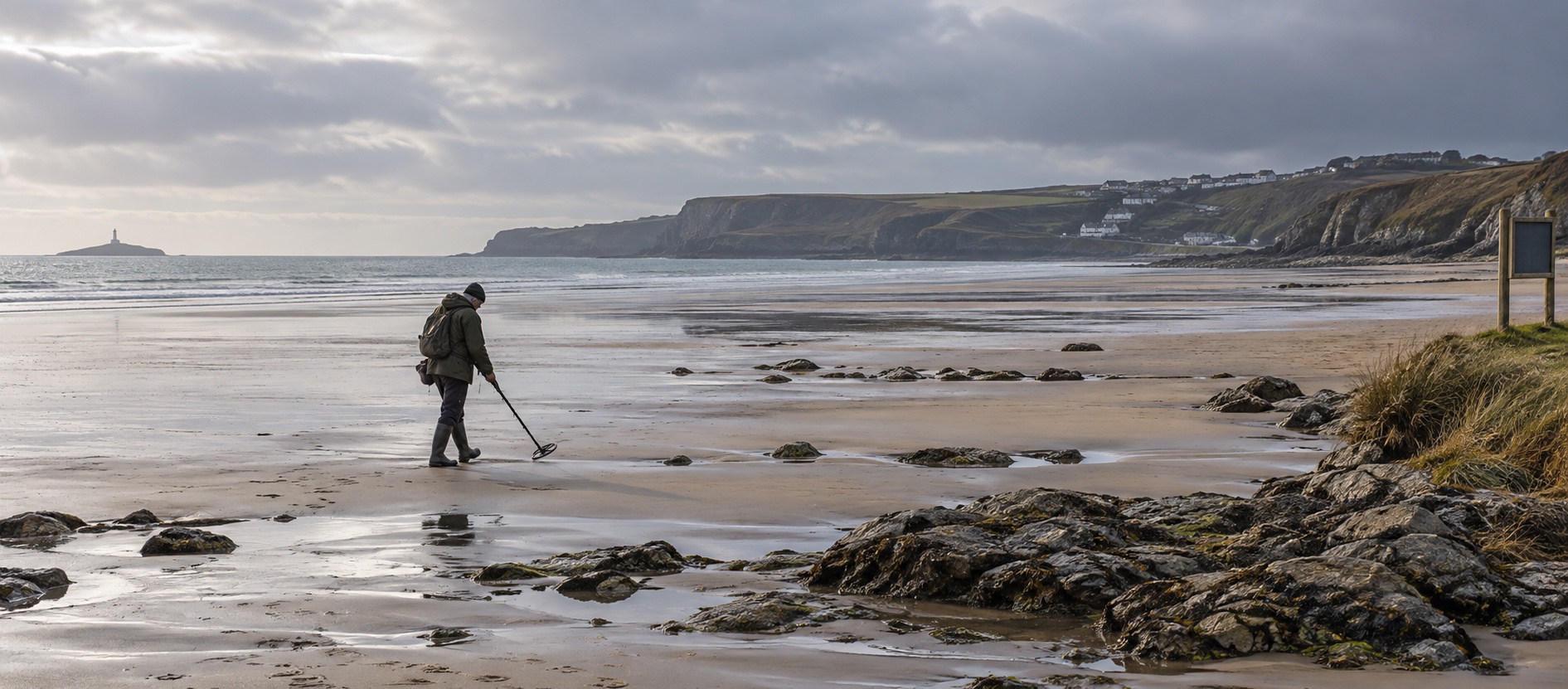
The relevant foreshore is normally between mean high water and mean low water.
Crown Estate permission does not cover every beach, the seabed, riverbeds or the tidal Thames.
Treasure, archaeological finds and wreck material have separate reporting routes.
The short rule
The Crown Estate's metal detecting guidance says a formal consent is not required to detect on foreshore it owns. That permission is conditional. It is subject to published terms, third-party rights and every other restriction applying to the location.
The practical sequence is: confirm ownership, confirm the exact foreshore boundary, check local and protected-site restrictions, read the terms, then plan the tide and recovery method. A general statement about Crown Estate beaches cannot authorise a different owner’s sand.
What counts as Crown Estate foreshore
Foreshore is the tidal band between mean high water and mean low water. The upper dry beach can have a different owner, and the seabed below the low-water line is not included in the ordinary detecting permission.
Use the Crown Estate's ownership map from its official guidance page as a starting point. Map boundaries are not a substitute for on-site restrictions or a leaseholder's instructions. If ownership is unclear, contact the Crown Estate and the local authority or beach manager before visiting.
What the permission does not cover
The Crown Estate states that its general foreshore position does not apply to:
- seabed beyond the foreshore;
- riverbeds or other Crown Estate land;
- foreshore owned by somebody else;
- areas where third-party rights or restrictions prevent detecting;
- the tidal Thames, where the Port of London Authority operates a separate permit system.
Do not extend the permission inland across dunes, sea walls, promenades or private access land. Those areas can have different owners and management rules even when they sit beside Crown foreshore.
Third-party rights can stop a search
Part of the foreshore may be leased or managed by a harbour, local authority, conservation body or commercial operator. Events, construction, military activity, fisheries and access controls can also affect use. The Crown Estate permission remains subject to those rights.
Look for current signs at every entrance, review the beach manager's website and check whether temporary closures apply. If an authorised manager says detecting is not allowed, do not rely on the wider Crown Estate statement to continue.
Protected places remain protected
Scheduled monuments, Sites of Special Scientific Interest, marine conservation measures, protected wreck sites and local byelaws can restrict disturbance or access. The Crown Estate's metal-detecting terms require detectorists to respect these controls and any directions given by authorised bodies.
Beach erosion can expose archaeology without making it free to recover. If structural remains, human bone or a concentrated archaeological layer appears, stop, record the location and contact the relevant heritage authority.
Recovery is limited
The published terms grant a permissive right for detecting on the foreshore, not open-ended excavation. They restrict activity to surface-level searching, prohibit mechanical tools and require holes to be filled. Interpret “surface” conservatively and do not cut into hard-packed layers or archaeological deposits.
Use a hand scoop or small recovery tool suited to loose sand, keep spoil controlled and refill every hole before moving. Deep water, unstable shingle, dunes and sea defences are not places to chase an uncertain signal.
Who owns a find
The Crown Estate guidance explains that finds made above the low-water mark generally belong to the landowner unless Treasure law or another legal regime applies. The detectorist does not automatically own an object because they recovered it.
Keep a record of the exact findspot, tide zone and who manages the beach. Owner-identifiable modern property should be handed to the appropriate local service. Archaeological objects should be reported to the Portable Antiquities Scheme in England or PAS Cymru in Wales in line with the Crown Estate terms.
Treasure and wreck are separate
Possible Treasure in England or Wales must be reported through the official Treasure process within 14 days of finding it or realising it may qualify. Do not clean, separate or sell a possible group while advice is pending.
Material from a ship, aircraft or hovercraft recovered from tidal water or the seashore may be wreck. GOV.UK requires recovered wreck material to be reported to the Receiver of Wreck within 28 days. Wreck reporting applies whether or not the object looks valuable.
Our record-a-find guide gives a field routine for photographs, coordinates and labels before the context is lost.
Plan around the tide, not the targets
Check the weather, tide table and local hazards before leaving home. Know the time of low water and identify a route that remains available as the tide floods. Do not cross a channel or walk around a headland simply because the exposed sand looks promising.
The Crown Estate's beach safety advice recommends checking weather, tides and local conditions. In an emergency at the coast, call 999 and ask for the Coastguard.
Equipment does not widen permission
A fully waterproof detector reduces the risk of spray and shallow-water use, and simultaneous multi-frequency operation can improve stability on wet salt sand. Neither allows searching below the Crown foreshore boundary or ignoring a local closure.
For mixed dry and wet sand, the Minelab VANQUISH 360 is a simple, light multi-frequency option. Its 5 m waterproof rating is useful around the wash, but the safest plan keeps the operator clear of incoming waves and the tide route open.
A Crown foreshore checklist
Before every visit, confirm:
- The Crown Estate map covers the exact foreshore.
- No leaseholder, beach manager, sign or temporary notice prohibits detecting.
- Heritage, nature, military and harbour restrictions have been checked.
- The current Crown Estate terms allow the planned recovery method.
- Low tide, weather, access and an exit route are understood.
- You can record and report archaeological finds, Treasure and wreck correctly.
Conditions and ownership can change. Recheck the official sources for each beach rather than treating one successful visit as permanent permission.
Common questions
Frequently asked questions
Do I need a Crown Estate metal detecting permit?
The Crown Estate says no formal consent is needed for foreshore it owns, strictly subject to its published terms, third-party rights and all local or protected-site restrictions.
Does Crown Estate permission cover every UK beach?
No. Beaches have different owners, and the dry upper beach can differ from the tidal foreshore. Confirm the exact Crown Estate boundary and local management before searching.
Does the foreshore permission include the seabed or riverbeds?
No. The ordinary permission is for Crown Estate foreshore between mean high and mean low water, not the seabed, riverbeds or the separately managed tidal Thames.
What should I do with wreck material from a Crown beach?
Record the findspot and report material from a ship, aircraft or hovercraft to the Receiver of Wreck within 28 days. This is separate from PAS and Treasure reporting.
Helpful products
Beach-capable detectors for permitted foreshore
Both models combine simultaneous multi-frequency beach operation with complete waterproofing. Permission, tide safety and the Crown Estate terms still govern where and how they can be used.

Mid-range
Minelab VANQUISH 360
Best for: Parks, fields and beaches for a beginner who wants simple controls and one detector for varied ground.
- Multi-IQ simultaneous multi-frequency
- Whole detector to 5 m (IP68)
- 1.16 kg
Automatic simultaneous multi-frequency operation, a low 1.16 kg weight and full 5 m waterproofing make this the least complicated route into mixed UK ground.
Know before buying: The deliberately simple control set offers less room to tune audio and recovery behaviour than the X-TERRA PRO.

Mid-range
Nokta SCORE
Best for: Mixed inland and beach use for someone who wants simultaneous frequency operation without a dense advanced-control menu.
- Simultaneous multi-frequency
- Whole detector to 5 m (IP68)
- 1.2 kg
A light, rechargeable simultaneous multi-frequency detector with three search modes, 60 target IDs and full 5 m waterproofing.
Know before buying: The simplified SCORE has fewer adjustment options than Nokta's DOUBLE and TRIPLE SCORE models, so keen tinkerers may outgrow its control set.