
COMMUNITY · FIELD RECORDS
Keep a metal detecting field log that you will use
Log permission, field conditions, detector settings, coverage and numbered finds in a simple repeatable metal detecting session record.
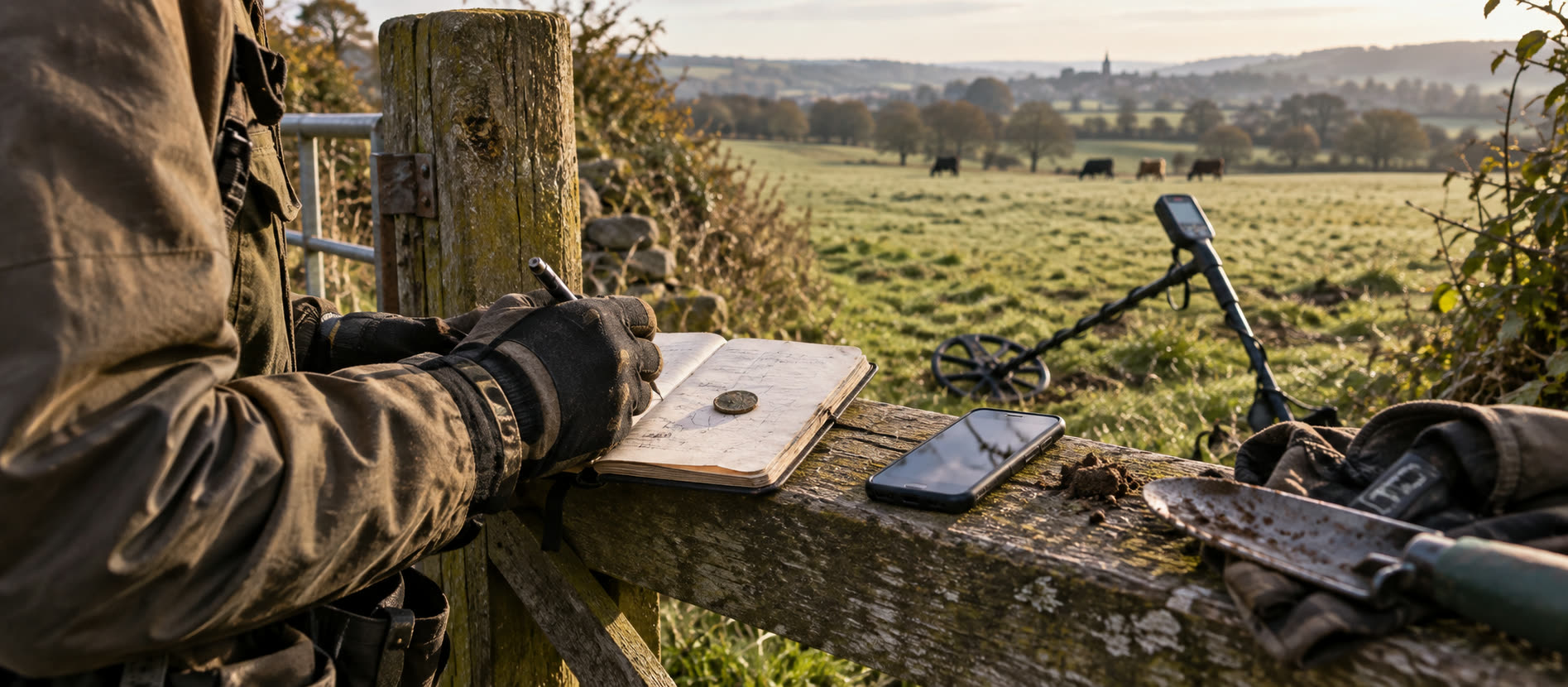
Record the exact permission boundary and any excluded areas.
Keep a short session summary even when you find nothing.
Give individual objects a separate number and private position.
One page for the outing
The log is not a trophy list. It is a repeatable account of the permission, conditions and coverage, including empty searches. That lets you avoid accidentally returning to an excluded field, compare settings under similar soil conditions and preserve the history behind an object months later. It complements the individual find record and the longer-term collection catalogue; it should not duplicate either in full.
Before leaving home, make a session ID such as CG-26-014 and associate it with the landowner agreement, permission map and the fields to be searched. Confirm whether a tenant also needs to authorise access and whether any scheduled or other protected areas are excluded. Our permission-agreement guide explains the distinction between land consent and statutory restrictions.
A copyable field-log layout
| Section | What to write |
|---|---|
| Session | ID, date, finder, permission code and contact route |
| Ground | Field name or map polygon, allowed boundary, excluded zones, crop and livestock conditions |
| Search | Start/end times, approximate route or grid, pace and area not covered |
| Setup | Detector and coil, search mode, ground balance, sensitivity and meaningful changes |
| Conditions | Soil moisture, weather, stubble height and surface disturbance |
| Finds | Each find ID, precise private position, depth/context, photo sequence and container |
| Close | Holes checked, rubbish removed, significant finds reported, next actions |
Use whatever you can operate with cold or muddy hands: a waterproof notebook and pencil, a phone form saved offline, or both. Check whether location tracking is accurate enough for the object record; an approximate track is useful for coverage but cannot replace a precise findspot. Keep the detailed map private and ask before publishing a permission location.
Record settings only when they explain a decision
A detector may have dozens of controls. Note the mode and the few settings you changed because of noise, iron or mineralised ground. Write the reason and outcome: “sensitivity 22→18 after repeated false signals near fence; quiet on clean ground” is more useful than a screenshot of every menu. Ground balance and sensitivity settings can help you interpret the later comparison.
Coverage deserves a similarly honest note. If you intended to grid the east half but spent two hours near a gate, record that. An empty area that was actually searched is different from an area merely marked on a map. See how to grid a field for a repeatable walking pattern.
Give the find its own line immediately
At the hole, assign a unique find ID, take an in-situ image if safe and record the precise position, depth and any association. Link images by filename or sequence. “Old coin near hedge” cannot be repaired into a trustworthy location after you have visited three hedges. Do not rely on a GPS track alone. For a possible group or archaeological feature, stop and follow the grouped-finds guidance.
The pouch gives numbered slips and closed containers a place away from debris. It does not keep the record accurate automatically. Put each label with its find as soon as recovered and reconcile every container against the log before leaving the field.
Close and back up the session
At the gate, check that holes are filled, sharp rubbish is safely taken away, finds are numbered and the permission area is secure. At home, transfer wet paper notes to a durable copy without discarding the originals immediately. Back up the log, map and original photographs in at least one separate place. Flag anything for an FLO and note when and how you contacted them. The Code of Practice provides the wider responsible-detecting frame; your log is how you demonstrate it in a particular field.
Common questions
Frequently asked questions
What should a metal detecting field log include?
Record the session, exact permission and exclusions, ground and weather, search coverage, meaningful setting changes, numbered finds and end-of-day actions.
Should I log sessions with no finds?
Yes. An empty search still records where you searched, conditions and coverage and prevents a misleading impression that untouched ground was surveyed.
Is a phone GPS track enough for findspots?
No. A track can show broad coverage but is not a reliable substitute for each object's precise recorded position and field number.
Can I publish my complete field log online?
Keep exact private findspots, owner details and permission maps out of public posts unless appropriate disclosure is authorised. Share necessary detail privately with recording professionals.
Helpful products
Make room for the log kit
A separated pouch pocket can carry numbered slips and small labelled containers away from sharp scrap, but the notebook or digital record remains the source of truth.

All-round field pouch
XP Finds Pouch
Best for: Regular field and wet-weather searches where quick debris storage and a separate protected pocket matter.
- Open pocket plus zipped pocket
- Washable with water drainage
- Belt, strap or MOLLE mounting
A washable belt pouch with an open debris compartment, a zipped pocket for better finds, drainage and MOLLE attachment points for a pinpointer holster or lanyard.
Know before buying: The open section is for robust scrap, not fragile objects; use a rigid finds box inside the zipped area for coins and delicate artefacts.