
Places · PASTURE 37
Metal detecting on pasture in the UK
Search pasture responsibly with a practical UK plan for permission, livestock, ground coverage, detector settings, tidy plugs and accurate find recording.
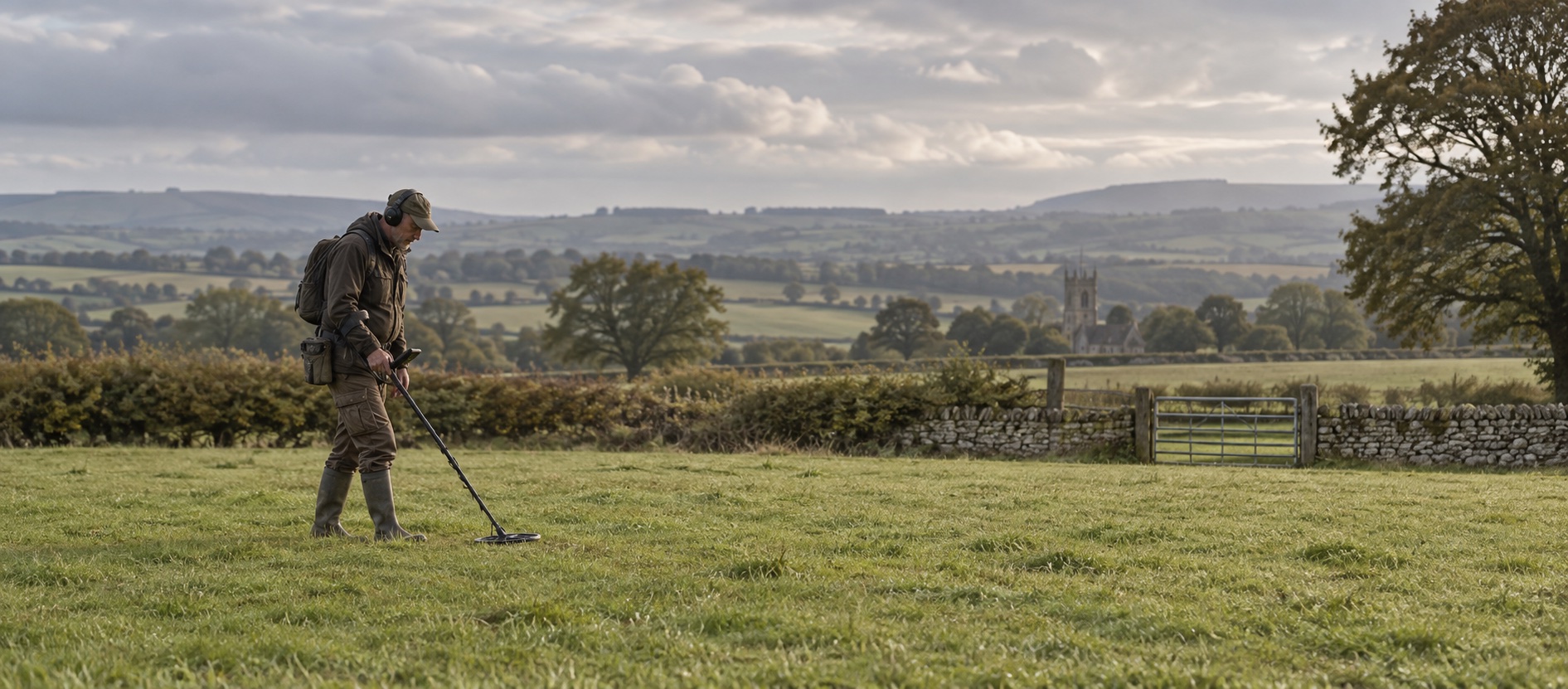
Permission must cover the exact field, date, access route and recovery method.
Short, firm turf is easier to search and reinstate than saturated or drought-stressed ground.
Record concentrations and unusual objects before cleaning; context can matter more than appearance.
Permission starts with the person managing the field
Get clear permission from the landowner or someone with authority to grant access. A tenant, grazing licensee, estate manager and landowner may have different rights and responsibilities, so ask who can agree detecting and finds ownership. Record the field boundaries, dates, parking, gates, recovery method and how potential Treasure or valuable finds will be handled.
Permission to walk a public footpath is not permission to detect the land around it. Common land and apparently unused margins also have owners and may carry additional rights or restrictions. Use the England and Wales permission checklist before treating an invitation as complete.
Check protected status as well as ownership. Scheduled monuments require consent for metal detecting, and agri-environment agreements can restrict activity around known archaeology, Sites of Special Scientific Interest and managed features. Historic England's guidance for agri-environment land is a useful starting point for the agreement holder.
Ask about livestock before opening a gate
Never assume animals are harmless because they look calm. Ask whether stock will be present, which gates must remain shut, whether a field has recently been treated and where machinery may enter. Do not search among cattle with calves, horses you do not know or any animals the farmer says to avoid.
Keep dogs away unless the land manager explicitly permits them, and follow the current Countryside Code on gates, livestock and farm operations. Leave immediately if animals become interested or your route risks separating a group.
Choose a day when the turf can recover
Short grass makes coil control and visual lane marking easier. Long wet grass holds the coil above the soil, hides holes and increases drag. Saturated ground collapses around a plug and compacts under boots; hard drought ground can split rather than lift cleanly. Postpone the session when reinstatement will be poor.
Ask the farmer about silage cuts, haymaking, lambing, spraying and grazing moves. The best search window is the one that does not interrupt the agricultural job. Avoid headlands and gateways when machinery or stock need them.
Read pasture as a used landscape
Old foot routes, former gateways, level platforms, springs, field corners and approaches to a settlement can concentrate losses. That does not make every visible bump an invitation to dig. Earthworks, banks and building remains may be archaeologically sensitive, and a concentration of objects can be evidence rather than a collection of isolated targets.
Start with a broad reconnaissance grid across ordinary ground. If signals or finds begin to cluster, slow down, reduce lane width and improve recording. Do not chase the concentration below the agreed recovery layer.
Set the detector for stability
Begin with the manufacturer's Field or general-purpose profile. Run noise cancel if available, ground balance if the detector requires it and set sensitivity only as high as the ground allows. A machine that chatters on every tuft makes weak repeatable signals harder to hear.
Use modest discrimination until you understand the site's iron and modern contamination. Pasture can contain fencing fragments, machinery parts, foil and shotgun cartridges beside older objects. Check a signal from two directions and listen for repeatability before relying on one target ID number.
A simultaneous multi-frequency detector can be useful where soil conditions and target conductivities vary. The X-TERRA ELITE is one adjustable all-round option, but its extra settings do not replace a calm starting profile or careful sweep.
Use lanes that you can repeat
Choose two fixed features at opposite field edges and walk straight lanes between them. Keep each sweep low and level, overlapping the previous arc. On a slope, work across only where footing is safe; otherwise shorten the arc and follow the contour.
Break a large permission into named blocks. Record the start and finish of each block so a later visit can continue rather than wander over the same easy ground. A phone track is helpful, but field-edge markers and written notes still work if reception or battery fails.
Choose the coil for the ground, not the field size
A standard elliptical coil is the useful first pass. A large coil covers clean open ground but becomes tiring and combines more nearby metal into each response. A small coil separates targets better around an old gateway or iron patch and is easier between tussocks, though it takes more lanes to cover the same area.
The search-coil guide explains size, shape and Double-D behaviour. Before buying another coil, slow down and check whether poor overlap or a rising sweep is the real problem.
Pinpoint before cutting turf
Use the detector's pinpoint function or cross the target at right angles to estimate the centre. Probe with a pinpointer only after the recovery method permits entry. Place a cloth or kneeling pad beside the target to contain loose soil and protect the grass.
Cut the smallest plug that can be lifted without tearing roots, preferably leaving one side attached when conditions allow. Work beside the estimated centre rather than pushing a blade toward the target. Recheck the hole, plug and spoil after recovery, remove sharp rubbish and return soil in its original order.
The pinpoint-and-recover guide gives a complete sequence. A pinpointer reduces widening only when it is retuned and used methodically; waving it randomly through loose soil does not protect the surface.
Know when to stop
Stop and record if you encounter:
- several objects close together;
- a container, compact layer or structural material;
- articulated or human bone;
- an unusual concentration of coins or fragments;
- a target continuing below the landowner's agreed recovery depth.
Photograph the situation before moving more soil, mark the location and contact the landowner. A Finds Liaison Officer can advise on archaeological objects, and possible Treasure in England or Wales must be reported within the legal time limit. Read how to record a find before the session so the equipment is already in the pouch.
Finish as though you were never there
Press each plug level, lift flattened grass and check from several angles for gaps. Remove all modern rubbish you can carry safely. Close gates, clean tools and boots before moving between farms where soil-borne disease or invasive plants are a concern, and tell the farmer about broken fencing, injured stock or other hazards.
Share a concise end-of-day summary with the landowner: area covered, ordinary finds, rubbish removed and anything awaiting specialist advice. That habit builds the trust on which future pasture access depends.
Common questions
Frequently asked questions
Do I need permission to metal detect on pasture?
Yes. Obtain permission from the landowner or authorised occupier for the exact field, visit and recovery method, and agree how finds will be handled before searching.
When should I avoid digging pasture plugs?
Avoid recovery when turf is saturated, frozen or drought-stressed, or when the land manager says agricultural work or livestock makes access unsuitable. Poor conditions can prevent clean reinstatement.
Which detector setting works best on pasture?
Start with the manufacturer's Field or general-purpose profile, run noise cancel and ground balance where required, then raise sensitivity only until the detector remains stable.
How deep can I dig on pasture?
Only within the recovery depth and method agreed with the landowner. Stop if a target continues into a compact layer, feature or possible archaeological context.
Helpful products
Practical tools for permitted pasture recovery
A narrow spade and a dependable pinpointer can reduce unnecessary disturbance, but only where the landowner has agreed those tools and the turf will reinstate cleanly.

Mid-range spade
Black ADA Extended Invader
Best for: Pasture and cultivated field permissions where a narrow plug and lower carry weight matter.
- 880 mm overall length
- 14-gauge mild-steel blade
- 1.325 kg
A narrow carbon-steel blade, serrated ripper edge and elongated handle create a focused recovery tool without the weight of a full stainless spade.
Know before buying: The mild-steel blade needs cleaning and drying after use, and its aggressive edge must be used carefully around roots, targets and archaeology.

Premium pinpointer
Garrett PRO-Pointer AT
Best for: Regular inland, beach and shallow-water detecting where simple controls and a robust waterproof body matter.
- 11.5 kHz
- Whole pinpointer to 6 m (IP68)
- 200 g with battery
A highly visible waterproof probe with three sensitivity levels, proportional audio and vibration, fast retune and a 360-degree detection area.
Know before buying: One button handles power, retune, sensitivity and silent mode, so the control sequence takes a little practice. It uses a replaceable 9V battery.