
Detector school · SEARCH COILS 38
Metal detector search coils explained
Understand metal detector coil size, shape, Double-D and concentric designs, target separation, depth trade-offs and compatibility before buying another coil.
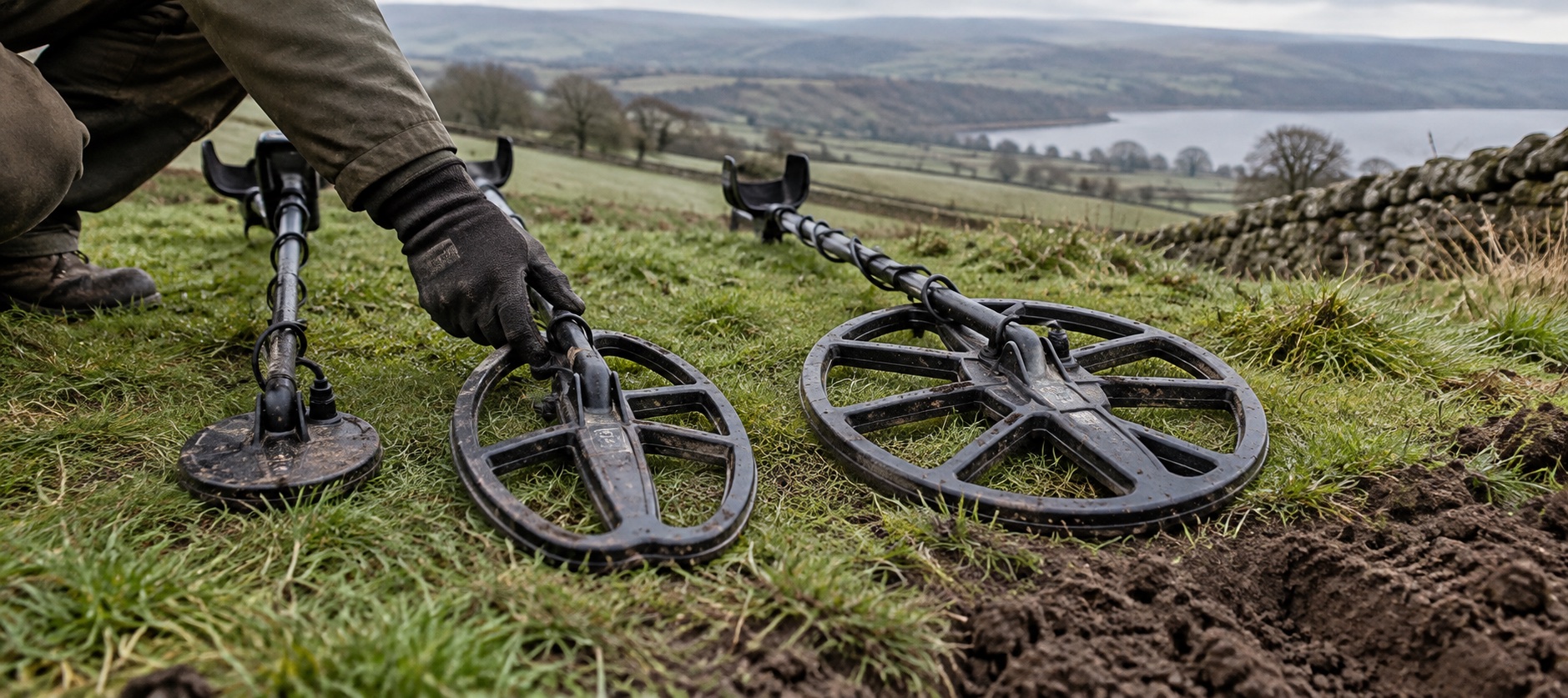
A larger coil does not make every small target deeper, especially in iron or noisy soil.
Double-D and concentric coils create different search patterns and overlap needs.
Use only coils approved for the exact detector family and software where specified.
What the search coil does
The coil transmits the detector's electromagnetic field and receives the response created by conductive and ferrous objects. Its windings, size and shape determine how that field enters the ground and how much ground is sampled during each sweep. The control unit interprets the response, but it cannot recover information the coil never captured cleanly.
That is why a coil is not merely a plastic disc. Changing it alters coverage, balance, target separation, ground response and sensitivity to different target sizes. It may improve a particular site while making another harder.
Small, standard and large coils
There is no universal size boundary, but three practical groups help:
| Coil size | Strongest use | Main trade-off |
|---|---|---|
| Small Roughly 5–8 inches | Dense iron, stubble, woodland gaps and small targets | Slower ground coverage and usually less depth on large targets |
| Standard Roughly 9–12 inches | General fields, parks and beaches | A compromise rather than a specialist answer |
| Large Roughly 13 inches and above | Open, clean ground and larger deep targets | More weight, ground response and target masking |
Minelab's official coil-selection guidance describes the same central trade-off: larger coils favour coverage and potential depth, while smaller coils improve manoeuvrability and separation. The result still depends on target size, soil, sensitivity, frequency system and sweep control.
Why a bigger coil can hear less
A large coil receives a response from a larger volume of ground. In clean mild soil, that may help with a broad or deep target. In mineralised ground or a patch containing several iron objects, the detector must process more competing information. A desirable response can be distorted or masked.
The larger coil also places more mass farther from the hand. As fatigue grows, the operator often lifts the coil at the end of each arc or loses overlap. The theoretical gain disappears when coil-to-ground distance becomes inconsistent.
Why a small coil separates targets
A small detection footprint is less likely to cover a nail and a coin at the same instant. That gives the detector a cleaner opportunity to respond to each object as the coil moves. Separation improves further when the sweep is short, level and slow enough for the detector's recovery behaviour.
Small coils also fit between crop stalks, roots and playground equipment. They are not automatically more sensitive to every small object, but their reduced ground load and close placement can make weak targets easier to isolate.
Double-D coils
Double-D coils use overlapping D-shaped windings. The useful search region forms a relatively narrow band running along the centre of the coil, giving consistent coverage along its length. This makes lane overlap more predictable and often provides stable behaviour on mineralised ground.
The detector still responds outside an imaginary razor-thin line, and the strongest point varies with depth and target position. Do not assume the geometric centre is the target without crossing the signal from another direction or using pinpoint mode.
Concentric coils
Concentric coils normally use circular or elliptical transmit and receive windings sharing a centre. Their detection pattern is often described as cone-shaped: broad near the coil and narrower with depth. Pinpointing can feel intuitive around the centre, but deeper coverage requires greater sweep overlap.
They can provide clean responses in mild ground, while mineralisation may favour a Double-D design. The detector manufacturer chooses which windings its electronics support; coil type is not a universal plug-in preference.
Minelab's coil overview compares Double-D, concentric and monoloop configurations and explains why each field pattern has different strengths.
Round versus elliptical
A round coil gives symmetrical coverage and is easy to rotate around a target. An elliptical coil puts useful length into a narrower body, helping it pass between stubble, scrub and rocks while still covering ground. The narrow end can also help interrogate a crowded signal.
Shape does not override winding and size. Two coils with similar outer dimensions can behave differently because their windings, frequency design and detector platform differ.
Multi-frequency coil compatibility
A coil must be electrically and electronically compatible with the detector. Connector shape alone proves nothing. The windings, impedance, shielding, identification circuitry and software all matter, especially on simultaneous multi-frequency platforms.
Use the manufacturer's compatibility chart for the exact model and coil code. Do not force a connector or use an unapproved adapter. At best the detector may show a coil error; at worst an unsuitable coil or cable arrangement can damage hardware or defeat waterproofing.
Coil families for the detectors in our guides
This is a quick reference to manufacturer-listed options, not a promise that similarly named coils will fit. Standard packages are shown; a special bundle may include another coil.
| Detector | Coil in the standard box | Manufacturer-listed options | Check before ordering |
|---|---|---|---|
| VANQUISH 360 | V10X, 10 × 7 in | Minelab lists V-series X and EQUINOX-series coils for the VANQUISH 60 series in its coil FAQ. | Confirm the listing names the VANQUISH 60 series, not merely an older VANQUISH model. |
| X-TERRA PRO and X-TERRA ELITE | V12X, 12 × 9 in | V8X, V10X, V12X and specified EQUINOX EQX coils in Minelab's compatibility guide. | Older X-TERRA 305, 505 and 705 coils are not the same family; Minelab explicitly excludes them for the ELITE in its FAQ. |
| SIMPLEX Lite | SX24, 9.5 × 6 in | SX24, SX28 and SX35 on Nokta's Lite accessories page. | Match the SX coil code and exact SIMPLEX model. |
| SCORE | SC30, 12 × 9 in | SC24, SC30 and SC35 on Nokta's SCORE page. | Match the SC coil code; the similarly sized SX coil is listed for a different family. |
Check the exact model, coil code, seller listing and current manufacturer instructions before paying. These are compatibility claims, not field-performance comparisons. The SIMPLEX Lite and SCORE pages show their standard contents; Minelab's X-TERRA ELITE page also explains its bundle variations.
The X-TERRA ELITE is supplied with a medium elliptical Double-D coil that suits a wide mix of UK ground. That stock setup is a better baseline than buying a large accessory coil on day one.
Coil covers and false signals
A removable skidplate protects the coil housing from abrasion. Soil, magnetic sand and salty moisture can collect between the cover and coil, then move during the sweep and create unexplained noise. Minelab's general FAQ specifically warns that dirt or moisture under a skidplate can cause false signals.
Remove and clean the cover as the manual allows. Rinse beach sand with fresh water, dry both parts and inspect for cracks. Never lever the cover off with a metal tool beside the coil windings.
Cable routing matters
Run the cable firmly up the lower shaft so it cannot flap beside the coil. Leave enough slack at the joint for the coil to change angle without pulling the connector. Wind the remaining cable evenly and secure it before the control unit.
A loose loop near the coil can move through the electromagnetic field and produce intermittent signals. A cable pulled tight can damage the entry point when the coil folds for transport.
Match the coil to the site
- Choose a small coil for dense iron, stubble, root-filled margins and tight spaces.
- Keep the standard coil for the first survey of ordinary pasture, parks and beaches.
- Consider a large coil only for physically manageable, relatively clean open ground where coverage or larger deep targets are the priority.
- Choose an elliptical coil where narrow access is useful without giving up too much length.
Before buying, compare the coil's actual mass as well as diameter. Fit the detector to your arm, check the manufacturer's waterproof rating and make sure the existing shaft and lower-stem hardware are included or compatible.
Test one variable at a time
Create a small practice area with safe targets at known positions. Sweep the stock coil using a recorded mode, sensitivity and recovery setting. Repeat with the new coil at the same height and pace. Compare separation, stability and fatigue rather than only the loudest response.
A coil that transforms an iron-filled gateway may be inefficient over a clean twenty-acre field. The right result is not a permanent upgrade; it is a tool matched to a repeatable job.
Common questions
Frequently asked questions
Does a bigger metal detector coil always go deeper?
No. A large coil may improve coverage and depth on larger targets in clean ground, but it also receives more ground and nearby metal, which can reduce separation and stability.
When is a small search coil better?
A small coil is useful in dense iron, stubble, undergrowth and tight spaces. Its smaller detection footprint can separate close targets and is usually easier to balance.
Can I fit any coil with the same connector?
No. Connector shape does not prove electrical or software compatibility. Use only a coil approved by the manufacturer for the exact detector family and follow any firmware requirements.
Can dirt under a coil cover cause false signals?
Yes. Moving soil, magnetic sand or salty moisture trapped between the skidplate and coil can create noise. Remove and clean the cover only as the manual allows.
Helpful products
Detectors with useful standard coils
Both models ship with broad all-round coils and support manufacturer-approved alternatives. Learn the supplied coil before paying for a specialised size.

Upper mid-range
Minelab X-TERRA ELITE
Best for: Regular field, park and beach use where stable mixed-ground performance and detailed controls justify a higher budget.
- Multi-IQ; 15 kHz inland option
- Whole detector to 5 m (IP68)
- 1.3 kg
Multi-IQ simultaneous multi-frequency operation, six search profiles and a 5 m waterproof build make this a capable step-up detector for varied UK ground.
Know before buying: Its larger coil and deeper menu demand more concentration than a simple starter model, and wireless audio uses Minelab's compatible low-latency system rather than ordinary Bluetooth.

Mid-range
Nokta SCORE
Best for: Mixed inland and beach use for someone who wants simultaneous frequency operation without a dense advanced-control menu.
- Simultaneous multi-frequency
- Whole detector to 5 m (IP68)
- 1.2 kg
A light, rechargeable simultaneous multi-frequency detector with three search modes, 60 target IDs and full 5 m waterproofing.
Know before buying: The simplified SCORE has fewer adjustment options than Nokta's DOUBLE and TRIPLE SCORE models, so keen tinkerers may outgrow its control set.