
FINDS CARE · COLLECTION RECORDS
How to catalogue your metal detecting finds
Build a find-numbered collection catalogue that connects objects, exact locations, photos, permissions and PAS records without losing ownership or context.
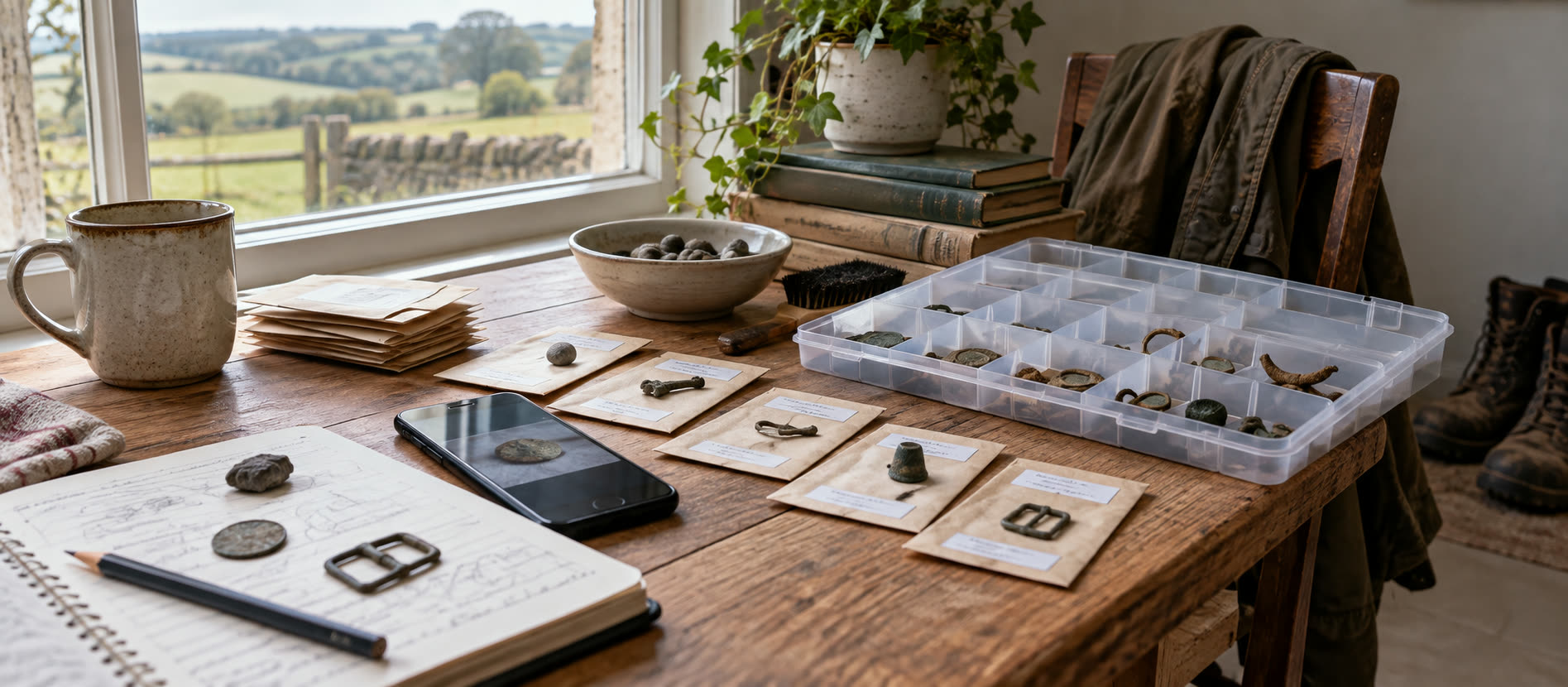
Give every object a stable ID that never depends on box position.
Keep exact locations and permission terms in a private record.
Back up the register and original photos separately from the objects.
Do not start by buying more boxes
The common failure is a beautiful divided tray full of unnumbered objects. When finds move between compartments, nobody can reconstruct which field, permission or photograph belonged to which item. Start with a permanent ID and an index; storage follows. Our field recording guide covers the moment of discovery. This guide is the next layer: maintaining a collection over months and years.
Choose an ID such as CG-26-0017, where the prefix is yours and the serial remains unique. A spreadsheet, database or ruled notebook all work if you can keep them up to date. Do not recycle an ID when an object is transferred, identified differently or lost. Put the ID on a removable label with the container, never on a fragile object.
The minimum catalogue columns
| Field | Record it as |
|---|---|
| Find ID | Permanent identifier, independent of tray or shelf |
| Discovery | Date, finder, permission code, field and precise private grid reference or coordinates |
| Context | Depth or layer if known, soil, associated objects, how recovered |
| Object | Plain-language description, material as observed, dimensions, condition |
| Images | Original filenames for in-situ, both faces, edge and scale |
| Custody | Landowner agreement, current holder, any handover or receipt |
| Reporting | FLO contact, PAS number, Treasure reference or national equivalent, if assigned |
| Storage | Current box/shelf location and any condition warning |
Unknown is a valid value. Never fabricate a depth or turn an approximate phone pin into a precise grid reference. Keep an edit-history note when an identification changes. For sensitive findspots, store the full record privately and create a separate public display version without coordinates or landowner details.
Link the object, photo and field log
Use the same ID in the collection index, the session field log, image filenames and the removable container label. Photograph the object and label together once, then keep individual object views clean. Keep the original-resolution files; cropped social-media images alone are a poor archive. The finds photography guide gives a repeatable shot sequence.
Do not rename a PAS reference as your own ID. Store both identifiers and the link between them. If two fragments might join, retain two original find IDs and create a relationship field, rather than erasing the separate discovery positions. If they came from one concentrated context, review the grouped-finds stop rule before further digging.
Storage is object-specific
Separate finds so they do not rub, leak residues onto one another or lose their labels. A compartment case may be fine for short field transit of stable ordinary objects, but a damp iron find, flaking coin or piece with attached organic material needs advice rather than a sealed mixed tray. Storing found coins and storing iron explain why there is no one universal box.
The larger cushioned field case is convenient for carrying a few robust, individually numbered pieces home. Do not assume that its foam is inert, that four clips create a safe microclimate, or that a closed case conserves a wet archaeological object. Move from field transport to suitable individually assessed storage when the object is stable and identified.
Reconcile the register after each outing
At home, check each field number against its container, location and photographs before cleaning tools or emptying your pouch. Mark items still awaiting advice. Back up a digital register and images to a separate location; test that you can reopen them. A paper register benefits from a photographed or scanned copy. If you give an object to an FLO or landowner, note the transfer and any receipt, not just a new shelf location.
Review the collection periodically for new flaking, corrosion, illegible labels and orphaned photos. Keep a concise export that another person could understand if you could no longer explain the system. Context and custody are the lasting value; the storage box is replaceable.
Common questions
Frequently asked questions
What is the minimum useful finds catalogue?
Keep a permanent find ID, discovery date and precise private place, description, images, permission and custody details, reporting reference and current storage location.
Can I label a find by its box position?
No. Box positions change. Use a permanent identifier on a separate container label and link it to the same ID in your field log and photographs.
Should exact findspots be public in my catalogue?
Keep precise findspots in a private master record for legitimate reporting and landowner arrangements; use a separate location-safe version for public display.
Is a foam finds box suitable for every object long term?
No. Materials and condition differ. Foam contact, trapped moisture and mixed storage can be harmful; seek specialist guidance for fragile or unstable finds.
Helpful products
A box is a location, not the catalogue
A rigid case can hold robust labelled finds for transit; keep the master record independent of the container and assess long-term storage by material and condition.

Larger cushioned field case
CMD Large Finds Box
Best for: Detectorists who need one larger cushioned transit case inside a pouch or bag.
- Foam-lined rigid case
- Four closing clips
- Large field format
A rigid field case with a foam-lined interior, four closing clips and a supplied lanyard for carrying ordinary small finds between the field and home.
Know before buying: Foam contact and a closed case are not automatically suitable for damp, unstable or archaeologically significant objects in long-term storage.