
Technique · CROWDED GROUND
How to detect around iron without missing good targets
Search iron-littered UK ground with careful coil control, repeatable audio, recovery speed and restrained iron rejection without missing nearby targets.
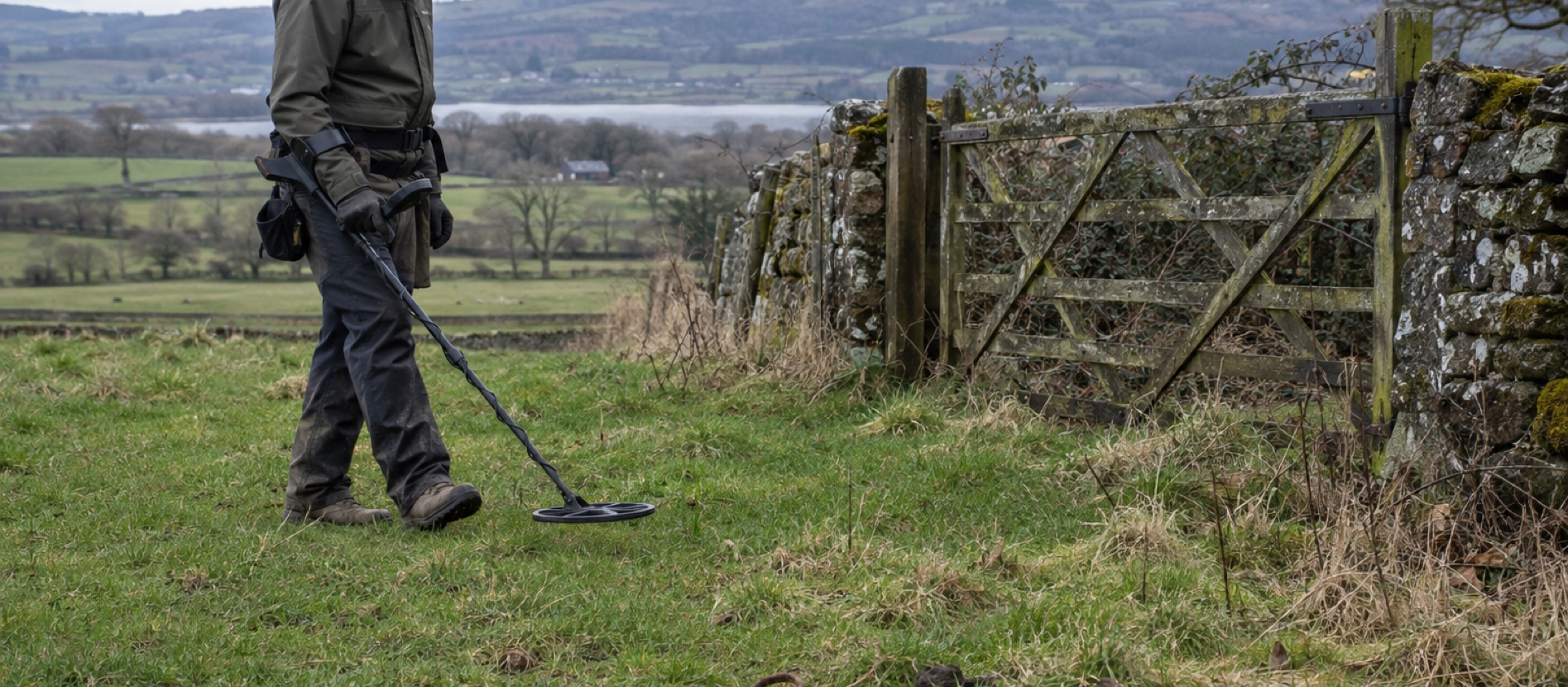
A smaller compatible coil can isolate close targets, but covers ground more slowly.
Fast recovery and low iron bias trade calm audio for more mixed information.
Do not chase promising signals below the landowner's agreed recovery depth.
Why old iron makes a good signal difficult
A nail close to a coin may dominate part of the coil's view. The detector hears a combined response rather than two neatly separated objects. Bent iron can also give a short non-ferrous chirp at the edge of a sweep. These are different problems: masking hides a target, while falsing makes iron sound attractive. A high target ID alone will not tell you which has happened.
On a new permission, dig a representative sample of clean and doubtful signals within the agreed recovery rules. Learn the site's fencing wire, horseshoe fragments, bottle caps and farm scrap before silencing broad target ranges. The signal-reading guide explains why a compact response that survives a second angle deserves more attention than one isolated edge chirp.
Set a calm baseline before touching iron controls
Choose the manufacturer's Field or suitable general profile. Run noise cancel if available, ground balance as the model requires and lower sensitivity until random chatter stops. Keep the coil cable secure and the coil clear of boot eyelets, spade and gate hardware. Electrical interference and ground noise can resemble iron problems.
Begin with the factory iron settings and only mild discrimination. If the detector offers ferrous volume, a quieter iron tone can leave the location of rubbish audible without exhausting you. Fully muting iron may make a field pleasant but removes context: several low grunts around one high note suggest a crowded patch worth slower inspection.
Work a doubtful target from several angles
When a high note appears among iron, mark its apparent centre with your boot position rather than immediately widening the sweep. Use short, level passes over that centre. Turn roughly a quarter circle and repeat. Then move the coil a little beyond the signal to hear whether a large iron response continues outside the compact high note.
A coin beside a nail may sound clean in only one direction. A bent nail may also chirp from one direction, so this method improves judgement rather than proving identity. Listen for a consistent narrow location and check whether the signal reappears on several passes at the same point. If the response is broad, moves as you circle, or appears only at the very end of the coil, treat it cautiously. Target ID is a supporting clue, not a verdict.
Use recovery speed deliberately
Recovery speed controls how quickly a detector reports neighbouring responses. A faster setting can help distinguish a nail and a coin a short distance apart. It can also shorten faint deeper responses. Test one step higher on a surface coin placed beside a nail, then repeat at the factory setting with the same coil speed. Do not jump to maximum merely because the field has old iron.
On the X-TERRA ELITE, recovery and iron bias are separate adjustments. Minelab lists adjustable recovery and an iron-bias range for that model. A shorter response is not automatically a more accurate one; listen for whether the coin remains identifiable between iron reports. The iron-bias guide explains why making ambiguous iron quieter can also conceal a desirable neighbour.
A coil-size change can beat another menu change
An 11- or 12-inch coil covers open ground quickly but may see several objects under its footprint at once. A smaller manufacturer-compatible coil can place less iron in the detection area, helping separation around old gateways or demolished farm features. Its cost is narrower coverage and sometimes a weaker response to isolated larger or deeper objects. Check exact compatibility before buying; a coil that fits the shaft is not necessarily electrically compatible.
The SIMPLEX Ultra has an 11-inch supplied coil and adjustable recovery speed. Its 15 kHz operation is single-frequency, unlike the X-TERRA ELITE's simultaneous Multi-IQ. For a mainly inland iron site, patient sweep control and a suitable smaller coil can matter more than the frequency label. Coil sizes explained sets out the coverage trade-off.
Avoid the three common overcorrections
Too much discrimination: rejecting every low number can remove small or partly masked non-ferrous targets alongside iron. Keep enough ferrous audio to understand the patch.
Maximum recovery: fast processing may make shallow close objects clearer while weakening long, marginal sounds. Use the smallest change that separates the test targets.
Rushing the sweep: a large coil passed quickly over dense nails spends little time centred on the gap. Slow down, overlap more and recheck from another direction. Minelab's detector concepts guide describes how ground, target shape and coil size affect responses; settings do not remove those physical limits.
Protect context on a promising patch
An iron concentration can mark past use of a field, not merely a rubbish dump. Do not strip it indiscriminately or dig through a compact layer to follow a faint target. Record find positions and associated objects, photograph anything unusual in place and stop when the landowner's agreed depth or an archaeological context is reached. The find-recording guide helps keep useful information with the object.
The best outcome is not the quietest detector. It is a stable search in which you can recognise ordinary iron, notice a repeatable neighbour and recover it responsibly.
Common questions
Frequently asked questions
Can a metal detector find a coin beside a nail?
Sometimes. Target spacing, orientation, coil size, ground and settings all matter. Use short overlapping sweeps from more than one direction; no setting guarantees separation when iron physically masks a target.
Should I turn iron discrimination up on a nail-filled field?
Start with modest rejection. Excessive discrimination can silence mixed responses, including a desirable object close to iron. Lower ferrous volume may be more informative than muting iron completely.
Does faster recovery always help around iron?
No. It can distinguish close responses but may shorten a weak marginal signal. Test one step at a time with the same coin-and-nail arrangement.
Is a smaller coil worth using around old gates?
A smaller compatible coil often sees fewer adjacent objects at once and is easier to place between iron. It covers less ground, so search lanes must be tighter.
Helpful products
Detectors with useful iron-site controls
X-TERRA ELITE and SIMPLEX Ultra both let a patient operator adjust recovery behaviour; they differ in frequency system and iron handling. Neither replaces careful coil placement.

Upper mid-range
Minelab X-TERRA ELITE
Best for: Regular field, park and beach use where stable mixed-ground performance and detailed controls justify a higher budget.
- Multi-IQ; 15 kHz inland option
- Whole detector to 5 m (IP68)
- 1.3 kg
Multi-IQ simultaneous multi-frequency operation, six search profiles and a 5 m waterproof build make this a capable step-up detector for varied UK ground.
Know before buying: Its larger coil and deeper menu demand more concentration than a simple starter model, and wireless audio uses Minelab's compatible low-latency system rather than ordinary Bluetooth.

Settings-led beginner
Nokta SIMPLEX Ultra
Best for: Inland permissions and freshwater use for a beginner who wants settings to learn rather than automatic multi-frequency operation.
- 15 kHz single frequency
- Whole detector to 5 m (IP68)
- 1.2 kg
A fully waterproof 15 kHz detector with six search modes, manual or automatic ground balance and unusually detailed tone and recovery controls for the price.
Know before buying: Beach mode helps with salt response, but the single 15 kHz platform can still need lower sensitivity and careful ground setup on wet salt sand.