
Technique · LISTEN FIRST
How to read metal detector signals
Learn to judge repeatable, broken and one-way detector signals using tone, target ID, coil position, iron context and a careful second sweep.
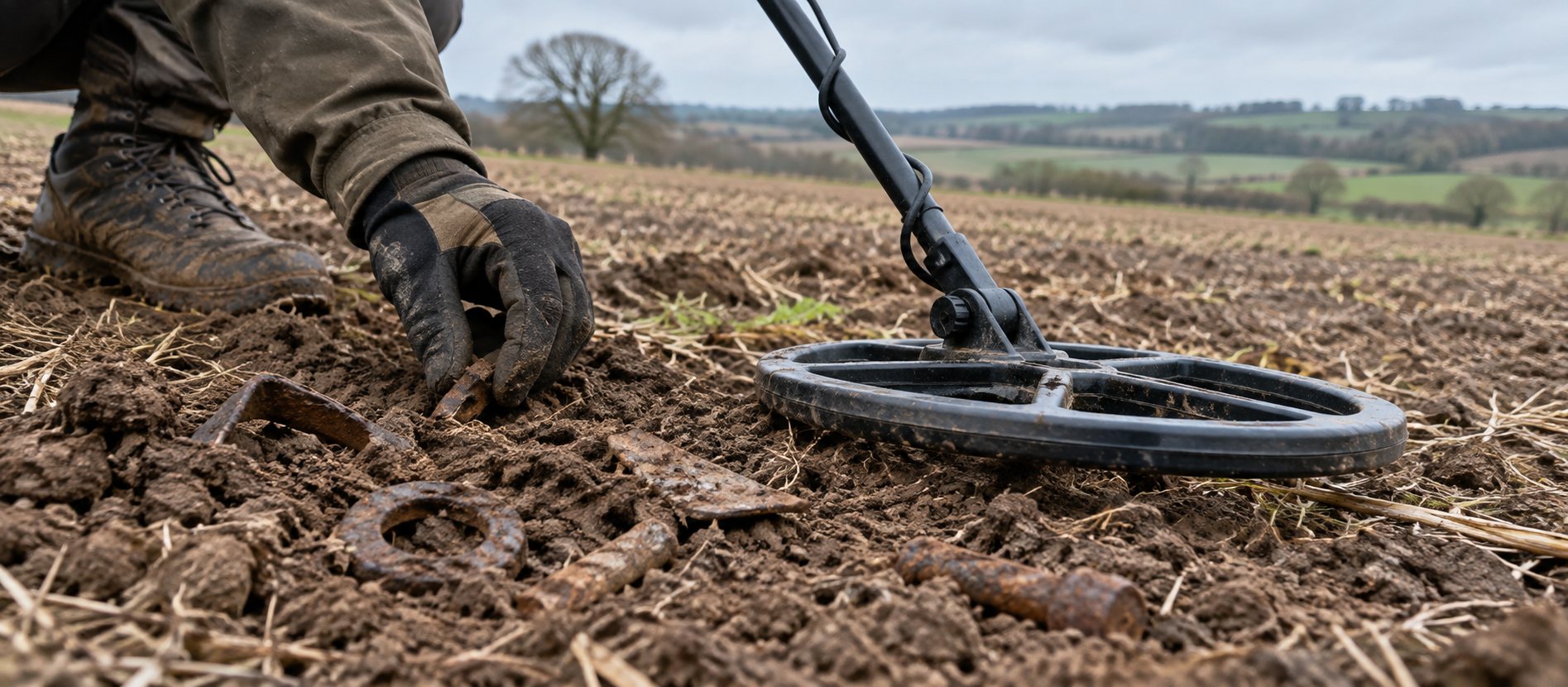
Tone, width, repeatability and target ID should be read together.
The same object can sound different with depth, angle, soil and nearby metal.
Confirm the response before cutting; stop if recovery reveals a significant context.
The first question is whether it repeats
When a tone interrupts a normal sweep, stop walking. Sweep the same short line several times without raising the coil at either end. Move the coil a little left and right to find the strongest centre. Then rotate around the spot and approach from a different direction.
A compact response that repeats in both directions is worth attention. A brief chirp at one outer edge of the coil may be a nail's halo, but should not be dismissed automatically on an iron-rich site. Your task is to gather clues before disturbing the ground, not to assign an object name from one beep.
Tone shape and target width
A clean, isolated small target often gives a relatively narrow, defined response as the coil passes its centre. A large sheet of metal, buried pipe or long iron object can sound broad across a wider sweep. Depth and target angle change this: a deep coin can be faint and less precise, while a shallow fragment can sound surprisingly strong.
Shorten the sweep to map the response boundary. If sound occurs over a wide area, do not keep widening a hole in pursuit of the display's approximate centre. Check the site's known services and ask the landowner before any recovery near buildings, cables or pipes.
Target ID is a clue, not an identification
A detector assigns a number or category to the electromagnetic response it sees. Soil, corrosion, nearby iron and a target on edge can move that number. A stable ID increases confidence that the response is consistent; it does not prove the object is a coin. A jumpy ID does not prove it is rubbish.
The target-ID guide explains the variables in detail. Learn your own detector with modern UK coins, foil, pull tabs, nails and small brass items. A number from a different model's video should not determine what you dig.
Broken signals
A response may break because discrimination rejects part of it, iron is close, the target is deep or irregular, the coil is moving too quickly, or electrical/ground noise interrupts it. Begin by checking sweep height and stability. Open the discrimination pattern or use the model's all-metal shortcut to hear what was being silenced.
If the broken high note has a repeatable location between two iron tones, inspect it from several directions. If it becomes a broad, wandering sound with no centre, ground or large iron is more likely. Neither result is certain. On a new permission, recover representative examples where the agreed method allows it and compare them with the audio you recorded mentally or in notes.
One-way responses
An object close to iron may give a desirable tone from one approach and ferrous information from another. So can bent iron or a bottle cap. Rotate a quarter turn, shorten the arc and sweep through the centre rather than across one coil edge. Listen for a non-ferrous note that stays tied to one compact point.
Low iron bias may expose more uncertain mixed responses, while high bias may quiet some iron. Do not change that setting during every target check. You need a stable baseline to learn the site.
When the machine is unstable everywhere
If random noise occurs with the coil held still, check electrical interference and cable connections. If it appears only while moving across damp clay or wet salt, check the ground mode, balance and sensitivity. If it follows coil bumps, inspect cable and skidplate.
Turning discrimination up until the machine goes silent may hide the symptom rather than solve it. A calmer sensitivity setting often gives more useful information.
A repeatable five-step target check
- Mark the spot mentally and stop walking.
- Resweep low and level on a short line to locate the centre.
- Cross at roughly a right angle and compare tone and ID.
- Open the pattern briefly if the sound is broken and check for nearby iron.
- Pinpoint and recover only if the site rules permit it and the target is not in a sensitive feature.
Do not spend several minutes over every obvious modern fragment. Give extra attention to compact uncertain responses in an otherwise promising patch, especially after confirming the detector is stable.
Headphones and field notes
Headphones can reveal quiet changes in tone that a speaker loses to wind or traffic, but connection compatibility and latency matter. The ML85 is a relevant example for supported newer Minelab detectors such as X-TERRA PRO and X-TERRA ELITE; it is not a universal Bluetooth headset and is not submersible.
Record a few target examples: mode, ground, tone character, ID range, whether the signal repeated both ways and what was recovered. After ten or twenty examples, your own record becomes more useful than a generic sound chart. Never claim a findspot or object identity from an audio clip alone.
Recover without losing context
Use the pinpoint-and-recover method to cut beside the estimated object, keep soil contained and reinstate the surface. Photograph and record an unusual or associated find before cleaning. If several objects, compact layers or possible human remains appear, stop and seek appropriate advice rather than treating the initial signal as authority to keep digging.
Common questions
Frequently asked questions
What is a repeatable metal detector signal?
It sounds at a consistent compact position on several low, level sweeps, ideally from more than one direction. Repeatability raises confidence but does not identify the object.
Should I ignore a one-way signal?
Not automatically. Bent iron can cause it, but a non-ferrous target beside iron may also sound better from one direction. Shorten the sweep, rotate and check for a consistent centre.
Why does target ID jump on a good find?
Depth, angle, nearby iron, mineralised soil and coil position can move the reading. Judge tone, width, repeatability and context together rather than demanding one fixed number.
When should I stop digging an uncertain signal?
Stop when permission depth is reached or recovery reveals a compact layer, associated objects, possible human remains or another sensitive context. Record the location and seek appropriate advice.
Helpful products
Tools that help you listen and recover carefully
Use only headphones compatible with the exact detector. A pinpointer helps after the coil has already narrowed a permitted target; it does not interpret the first signal.

Premium wireless headphones
Minelab ML85 Headphones
Best for: X-TERRA PRO, X-TERRA ELITE, EQUINOX 700/900 and MANTICORE owners who want the intended wireless connection.
- Low-latency 2.4 GHz wireless
- Not submersible
- 221 g
Low-latency wireless audio, a detachable 3.5 mm cable and long rechargeable runtime make the ML85 a flexible match for supported newer Minelab detectors.
Know before buying: Minelab's wireless system is proprietary and model-specific; these are not submersible and do not wirelessly pair with older models such as the EQUINOX 800.

Premium pinpointer
Garrett PRO-Pointer AT
Best for: Regular inland, beach and shallow-water detecting where simple controls and a robust waterproof body matter.
- 11.5 kHz
- Whole pinpointer to 6 m (IP68)
- 200 g with battery
A highly visible waterproof probe with three sensitivity levels, proportional audio and vibration, fast retune and a 360-degree detection area.
Know before buying: One button handles power, retune, sensitivity and silent mode, so the control sequence takes a little practice. It uses a replaceable 9V battery.