
FIELD CHECK · COIL AND CABLE
Metal detector coil cable problems: safe checks
Diagnose cable slap, loose connectors, intermittent signals and visible coil damage with safe checks before seeking authorised metal detector repair.
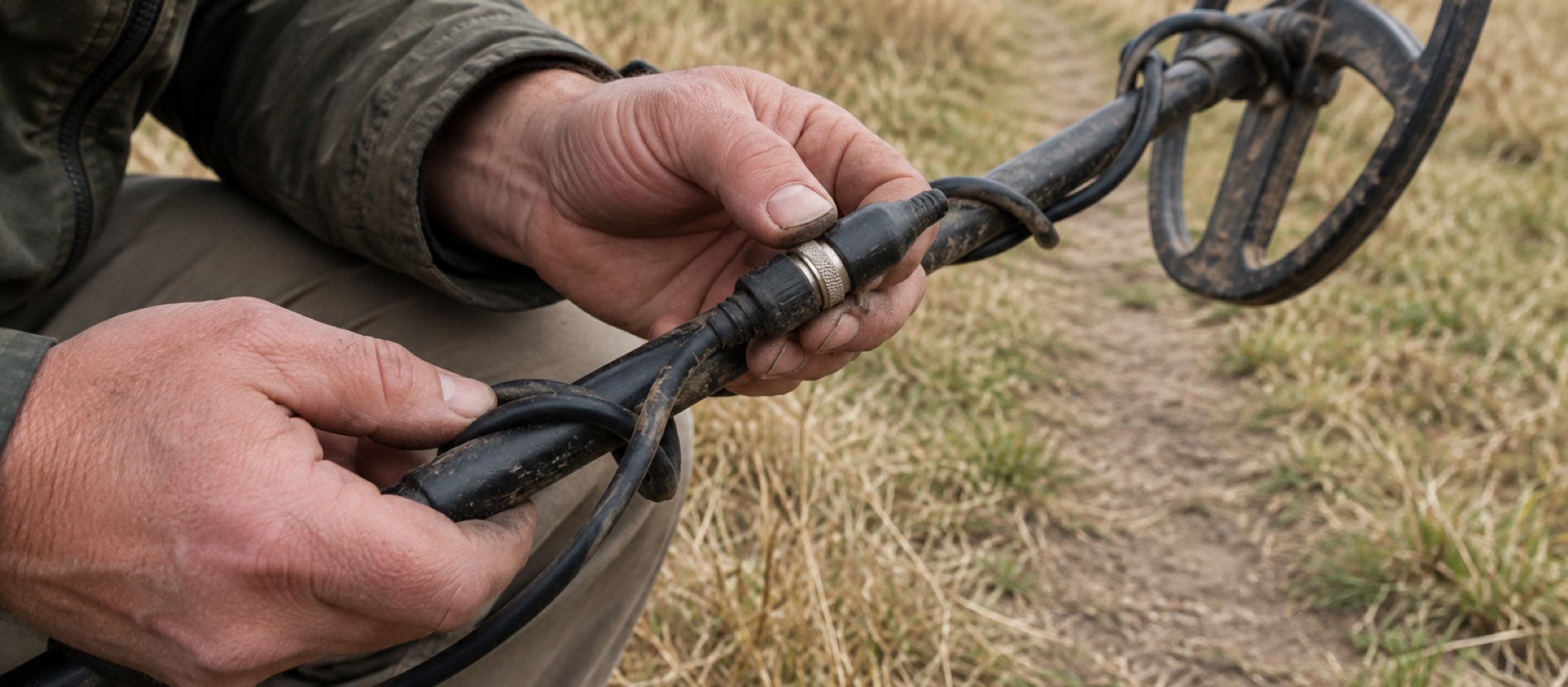
Cable movement can create false responses that resemble targets.
Do not force pins, tape over a failed seal or open a sealed control box.
Compare on a clean patch away from electrical interference.
Recognise the pattern before assuming a fault
A cable or connector problem often sounds intermittent: a beep appears as the shaft moves, the coil crosses stubble or the cable is touched, rather than at one fixed point in the soil. But electrical interference, high sensitivity, a metal boot fitting or iron beneath the surface can produce similar confusion. Start with the detector on a clean, permitted patch away from fences, phones, overhead equipment and your spade. Leave the settings at a calm baseline. Our false-signal guide separates those causes.
Hold the coil still above clean ground. If the machine becomes quiet, make a normal sweep. If noise accompanies every end-of-swing jolt, look at cable routing and coil movement. If chatter continues while the coil is motionless, try the manufacturer's noise-cancel procedure and lower sensitivity. A single controlled change at a time is more useful than immediately resetting the detector.
Inspect safely, power off
Switch the detector off before handling the connector. Check the cable jacket from coil exit to plug for cuts, kinks, crushed points, stretched sections or damage from a spade. Inspect the coil shell, mounting ears and skid plate. Clean visible dry grit from accessible surfaces according to the manual. Do not pry open a sealed coil, scrape contacts with metal or apply household lubricant to a connector. If it has been submerged, follow the exact drying and seal instructions before opening any user-accessible connection.
The cable should be wound around the shaft enough to prevent it flapping, with a small relaxed loop near the coil joint so the coil can angle over ruts. Too much slack lets the cable slap; too little pulls the cable every time you tilt the coil. Minelab's assembly guidance explicitly warns against forcing a connector. Your own detector's manual takes priority because plugs and waterproof boundaries differ.
Reseat and retest the connection
If the cable and housing look sound, disconnect and reseat the plug only if your model permits the owner to do so. Align the keyed connector and use the retaining method in the manual; resistance is a reason to stop, not tighten harder. Check that a coil cover is not packed with wet sand or iron grit, then repeat a short sweep over a known clean area and a separate known target. Do not flex a suspect cable repeatedly to 'find the break': that can worsen an intermittent fault.
If you have a known compatible spare coil, changing it can isolate whether the coil assembly is at fault. Compatibility is electrical and software-specific, not merely the right plug shape. Read search coils explained before ordering a substitute. Keep a note of the detector model, coil code, symptoms and conditions for warranty support.
When to stop field troubleshooting
Stop using the machine if insulation is exposed, the coil shell is cracked, a pin is bent, water is visible where it should not be, or the fault returns after a correctly seated connection and stable settings. Contact the manufacturer's support or an authorised UK dealer. Repairing a sealed cable yourself may damage waterproofing and affect the warranty. A replacement coil can be sensible if the manufacturer confirms that the cable is integral and the coil has failed, but verify the exact fit before spending.
For routine prevention, rinse salt only as the manual allows, dry the equipment before storage and check the cable at the coil joint after each trip. The maintenance guide provides a broader inspection routine, while post-beach cleaning covers the extra salt risk.
Common questions
Frequently asked questions
Can a loose coil cable cause false signals?
Yes. Cable movement against the shaft or tension at the coil joint can cause intermittent responses. Secure it while leaving enough pivot slack.
Should I tighten a coil connector as hard as possible?
No. Switch off, align the exact connector and secure it as the manual directs. Stop if there is resistance or bent-pin damage rather than forcing it.
How do I tell cable noise from electrical interference?
Check whether noise follows shaft or cable movement on a clean patch. Noise that continues with the coil still may instead be EMI, ground response or another fault.
Can I repair a cracked waterproof coil cable myself?
A home repair can compromise sealing and warranty. Stop using damaged equipment and ask the maker or an authorised dealer about a correct repair or compatible replacement.
Helpful products
If replacement is the only sensible route
Check manufacturer-approved coil compatibility and warranty support first. The detector listing is context, not a reason to replace a repairable cable.

Upper mid-range
Minelab X-TERRA PRO
Best for: A committed inland beginner who wants to learn how frequency, ground balance and audio choices change detector behaviour.
- Selectable 5 / 8 / 10 / 15 kHz
- Whole detector to 5 m (IP68)
- 1.3 kg
Selectable 5, 8, 10 and 15 kHz operation, six search profiles and detailed tone and discrimination controls give a keen beginner more room to progress.
Know before buying: Selectable frequencies are not simultaneous multi-frequency, and the extra controls create a steeper first-week learning curve.