
Workshop · BEACH CLEANING 41
How to clean a metal detector after the beach
Remove salt and sand safely after beach detecting with separate routines for waterproof detectors, waterproof coils and non-submersible control boxes.
A waterproof coil does not make the control box or headphone socket waterproof.
Do not use solvents, abrasives, lubricants or high-pressure water unless the manual explicitly permits them.
Open charging ports and connectors only in a clean, dry state.
Clean before salt dries into the joints
Salt water is conductive and corrosive. Sand works into coil covers, locking collars, headphone sockets and lower shafts, where it grinds surfaces each time the detector is adjusted. A quick fresh-water rinse after every coastal session is easier than freeing a seized joint later.
Do the first clean away from loose dry sand. Switch the detector off, remove headphones and empty the finds pouch so nothing sharp can scratch the equipment. Keep port caps and battery covers closed until the outside is free of salt and grit.
Check the waterproof boundary
Read the exact model manual before applying water. Detectors fall into three broad groups:
| Construction | What can normally be rinsed | Main risk |
|---|---|---|
| Fully waterproof detector | Coil, shaft and control housing within the stated rating | Open, dirty or damaged seals and ports |
| Waterproof coil only | Coil and permitted lower cable section | Water entering the control box or connector |
| Weather-resistant detector | Damp-cloth cleaning only where specified | Treating rain resistance as immersion protection |
Garrett's waterproof-detector guidance stresses that “waterproof” may describe only one component. The complete system rating and manual decide what can be submerged or hosed.
Rinse the coil and lower shaft
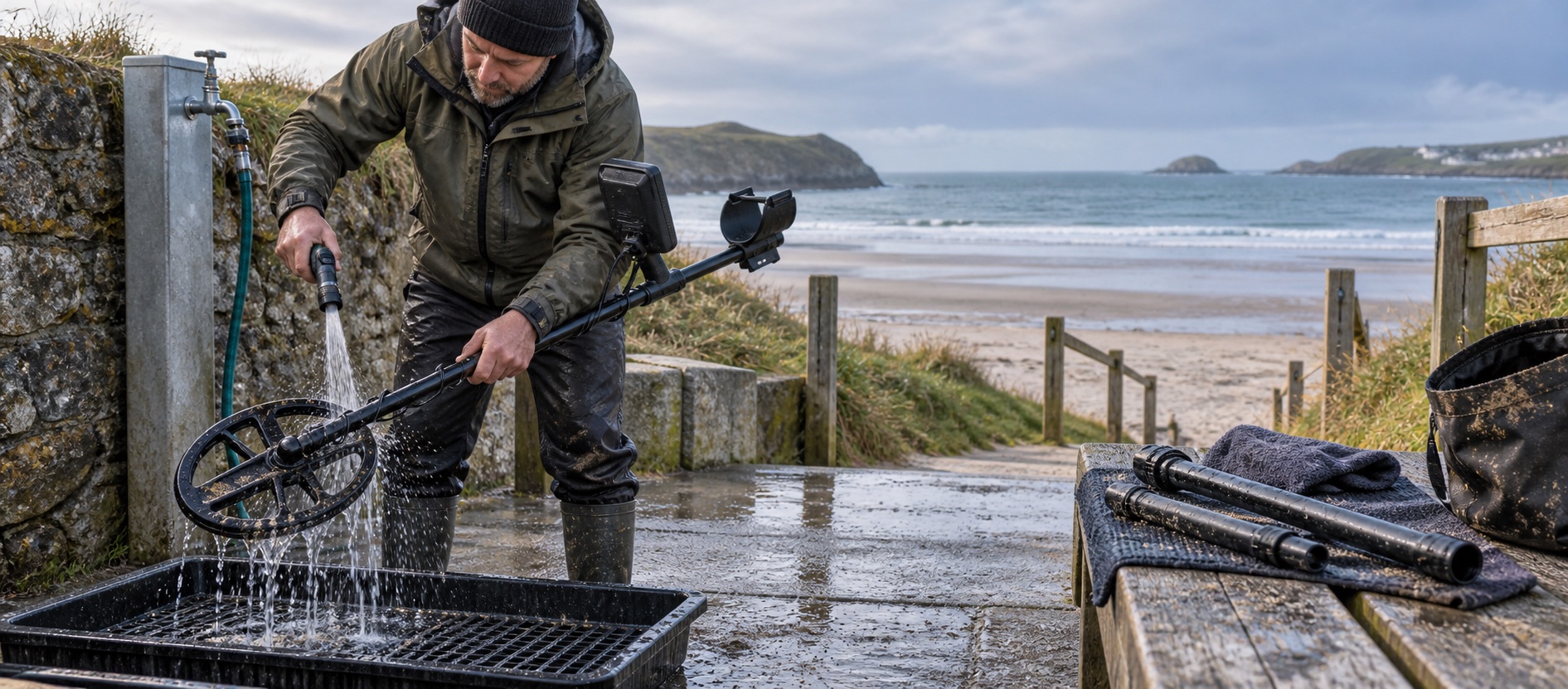
Use a gentle stream of clean fresh water. Turn the coil so water carries sand away from the ears, bolt and cable entry rather than forcing it deeper. Move the coil through its normal angle while rinsing around the joint.
Wipe with a soft non-scratch cloth. Do not scrub the cable, use a pressure washer or strike the coil against a hard surface to release sand. Check the cable for cuts, flattened sections and strain around both entry points.
Nokta's SIMPLEX manual instructs owners to wash the system box, shaft and coil with tap water after salt-water use, ensure no salt remains in connectors and avoid chemicals. Apply that only to the waterproof model covered by the manual.
Remove and clean the skidplate
If the manufacturer makes the coil cover removable, take it off over a tray after the first rinse. Wash the inside of the cover and underside of the coil separately. Magnetic black sand, salt crystals and fine grit trapped between them can move during a sweep and cause false signals.
Dry both pieces before refitting. Inspect for cracks, worn-through edges and grit around clips. Never use a screwdriver or knife beside the coil housing; use the removal method specified by the manufacturer.
Flush telescopic shafts and collars
Extend or separate the shaft only after the outside has been rinsed. Hold open tubes downward and let fresh water carry sand out. Clean cam locks and threaded collars gently without forcing gritty parts back and forth.
Lay the sections on a towel with openings facing down. Do not store a wet carbon or aluminium section sealed inside another tube. Check plastic bushes and locking parts for wear before reassembly.
Clean a fully waterproof control unit
Keep every cap closed and inspect it before rinsing. Use low-pressure fresh water, paying attention to buttons, speaker openings and the area around sealed connectors. Do not press buttons underwater unless the manual says they are designed for it.
The X-TERRA ELITE is rated IP68 to 5 m, making a complete gentle rinse possible when all seals are correctly fitted. Its waterproof build reduces cleaning risk but does not make salt harmless.
Clean a detector with only a waterproof coil
Keep the control box above the wet area. Rinse the coil and allowed cable section, then wipe the shaft and control pod with a clean damp cloth. Do not let water run along the cable into a non-waterproof connector.
Minelab's global FAQ gives this distinction for relevant models: a waterproof coil may be washed, while a non-waterproof screen pod must not be submerged. The model manual takes precedence over any general guide.
Connectors, caps and seals
Leave connectors closed during the dirty rinse. Once the outside is fully clean and dry, move indoors to a clean surface before opening a charging port, headphone socket or battery compartment. Brush away remaining dry grit with a soft non-metallic brush.
Inspect O-rings and sealing faces under good light. Hair, sand, a twisted seal or a damaged cap can defeat the waterproof rating. Do not add grease or lubricant unless the manual specifies an exact approved product and method. Petroleum grease can damage plastics and seals.
Dry before charging
Pat surfaces dry and allow the detector to air-dry in a ventilated indoor space. Keep it away from radiators, hairdryers and direct hot sun. Water trapped around a charging port can bridge contacts or carry salt inward when the cable is inserted.
Charge only when the port, plug and surrounding recess are visibly dry. If water entered a compartment that should remain dry, do not power or charge the detector; follow the manufacturer's support process.
Clean headphones, tools and pouch separately
Ordinary wireless headphones are not submersible. Wipe them according to their manual and dry ear pads before storage. Rinse waterproof headphones only within their stated rating and with any connector cap correctly fitted.
Wash sand and salt from the recovery tool, pinpointer and draining finds pouch, keeping archaeological finds in their own containers. Salt trapped in a pouch can corrode modern rubbish and transfer residues to better finds.
Reassemble and test
When every part is dry, refit the skidplate, shaft and cable without overtightening. Confirm the coil moves firmly but does not strain the ears. Switch on away from metal and run a brief air or ground test.
Persistent falsing can indicate grit under the skidplate, a moving cable, a loose connector or damage from the session. Work through those checks before assuming the detector needs higher discrimination.
A five-minute post-beach routine
- Switch off and keep all ports closed.
- Gently rinse every part the model manual says is waterproof.
- Remove trapped sand from the skidplate and shaft joints.
- Wipe non-waterproof parts with a damp cloth.
- Air-dry completely before opening ports, charging or storage.
Store the detector cool and dry with the shaft relaxed and the cable free from tight bends. That short routine protects a beach detector more reliably than occasional aggressive cleaning.
Common questions
Frequently asked questions
Can I rinse my whole metal detector after the beach?
Only if the manufacturer rates the complete detector as waterproof and every seal is correctly closed. With coil-only models, keep the control box dry and rinse only permitted parts.
When can I charge a detector after rinsing it?
Charge only when the detector, charging port, plug and surrounding recess are completely clean and dry. Never insert a cable into a wet or salty connector.
Should I use detergent or lubricant on beach equipment?
Use fresh water and a soft cloth unless the exact manual specifies otherwise. Solvents, abrasives and unapproved lubricants can damage plastics, seals and waterproofing.
Why should I remove the coil cover after beach detecting?
Salt, black sand and grit can become trapped underneath, where movement may cause false signals and abrasion. Clean and dry both parts using the manufacturer's removal method.
Helpful products
Fully waterproof beach-capable detectors
These models pair complete 5 m waterproofing with dedicated salt-beach operation. They still require fresh-water cleaning and correct seal care after salt exposure.

Upper mid-range
Minelab X-TERRA ELITE
Best for: Regular field, park and beach use where stable mixed-ground performance and detailed controls justify a higher budget.
- Multi-IQ; 15 kHz inland option
- Whole detector to 5 m (IP68)
- 1.3 kg
Multi-IQ simultaneous multi-frequency operation, six search profiles and a 5 m waterproof build make this a capable step-up detector for varied UK ground.
Know before buying: Its larger coil and deeper menu demand more concentration than a simple starter model, and wireless audio uses Minelab's compatible low-latency system rather than ordinary Bluetooth.

Mid-range
Nokta SCORE
Best for: Mixed inland and beach use for someone who wants simultaneous frequency operation without a dense advanced-control menu.
- Simultaneous multi-frequency
- Whole detector to 5 m (IP68)
- 1.2 kg
A light, rechargeable simultaneous multi-frequency detector with three search modes, 60 target IDs and full 5 m waterproofing.
Know before buying: The simplified SCORE has fewer adjustment options than Nokta's DOUBLE and TRIPLE SCORE models, so keen tinkerers may outgrow its control set.