
RESPONSIBLE DETECTING · SAFETY
Dangerous finds while metal detecting
What to do if a metal detecting find may be ordnance, human remains, sharps or another hazard: stop, leave it undisturbed and get the right help.
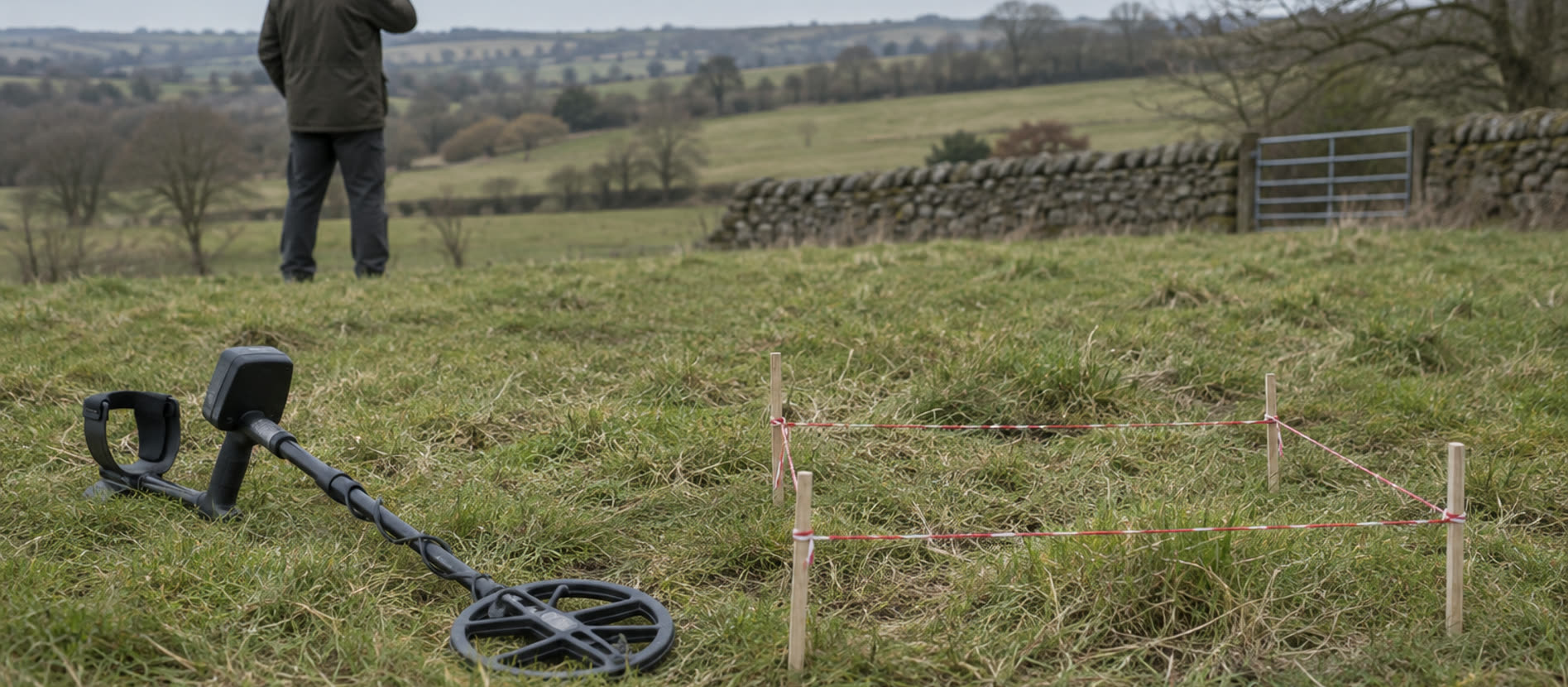
Never test or transport a suspected explosive object.
Stop work around possible human remains and contact police.
Treat sharp or chemically suspect waste as a safety issue, not a collectible.
This is a field safety guide, not a way to identify or make a hazardous object safe. If there is an immediate risk, call 999 from a safe place and follow the emergency services' instructions.
Suspected ordnance: do not investigate
An old shell, mortar, grenade, flare, cartridge or metal cylinder may still be dangerous. Corrosion does not prove that it is inert. If a target suggests unexploded ordnance, stop digging and do not touch, uncover further, shake, clean, dismantle or carry it. Move away by the route you used, warn others away without returning to the object and call police from a safe location. Do not drive it to a police station or try to dispose of it yourself.
The Royal Navy's account of bomb-disposal call-outs illustrates why specialist teams, not finders, deal with these objects. UK police guidance also says to leave suspected ordnance untouched and call 999. Give responders the location and what you saw from a distance. Do not post a live location publicly or return to take better photographs.
Possible human remains: stop excavation
Bone can be animal, archaeological or recent. A detectorist should not decide that distinction by digging further. If you uncover possible human remains, leave them in place, stop work nearby and contact police. Protect the location by keeping others back without disturbing the material. A local authority's exhumation guidance advises contacting police and stopping work when human remains are found during excavation. Follow police directions before contacting archaeological specialists or the landowner about next steps.
Sharps, chemicals and industrial waste
Needles, broken glass, pressurised containers, chemical residues and sharp scrap are different hazards from an ordinary rusty nail. Do not reach blindly into spoil or use a finds pouch as a sharps container. HSE guidance notes that discarded needles can expose people to blood-borne infection. If you are injured, seek prompt medical advice and give the clinician an accurate account of the object and site; for an emergency, use 999.
Where a site is contaminated or a container leaks, leave it alone and follow the land manager's or emergency service's instructions. Do not wash material into a drain, burn it or take it home for identification.
A practical stop-work sequence
- Stop detector use and do not disturb the object further.
- Move yourself and others away without approaching again to mark it.
- Call 999 for suspected explosive danger or another immediate emergency; explain the location and what you can describe safely.
- For possible human remains, stop the excavation and contact police. Follow their directions on preserving the scene.
- Tell the landowner or site manager once it is safe to do so, and preserve any notes already made. Do not independently resume work nearby.
No fixed distance can be safely prescribed for an unknown item. Let responders set a cordon and decide when the location is clear.
The product above belongs to normal field organisation after a site has been confirmed safe. It has no role in handling a hazardous find. For normal discoveries, return to the responsible detecting code and record-a-find process.
Common questions
Frequently asked questions
What if I find something that might be an old shell?
Do not touch, move, clean or transport it. Leave the area, keep others from approaching without returning to it and call 999 from a safe place.
Can a corroded explosive be harmless?
You cannot determine that by appearance. Treat suspected ordnance as potentially dangerous and leave assessment to police and specialist disposal teams.
What should I do if I uncover possible human bone?
Stop work and leave the material in place. Contact police and follow their directions rather than digging to decide whether it is archaeological or recent.
Should I carry a dangerous find to a police station?
No. Do not transport suspected ordnance or unknown hazardous material. Contact police from a safe location and let responders direct the next step.
Helpful products
For routine finds only
A finds pouch is for safe, ordinary objects on permitted ground. Never put suspected ordnance, human remains or unknown hazardous material in it.

All-round field pouch
XP Finds Pouch
Best for: Regular field and wet-weather searches where quick debris storage and a separate protected pocket matter.
- Open pocket plus zipped pocket
- Washable with water drainage
- Belt, strap or MOLLE mounting
A washable belt pouch with an open debris compartment, a zipped pocket for better finds, drainage and MOLLE attachment points for a pinpointer holster or lanyard.
Know before buying: The open section is for robust scrap, not fragile objects; use a rigid finds box inside the zipped area for coins and delicate artefacts.