
PERMISSIONS · FINDS OWNERSHIP
Who owns metal detecting finds in the UK?
Find out why finders do not automatically own buried objects, how Treasure and Scottish Treasure Trove differ, and what to agree with the landowner.
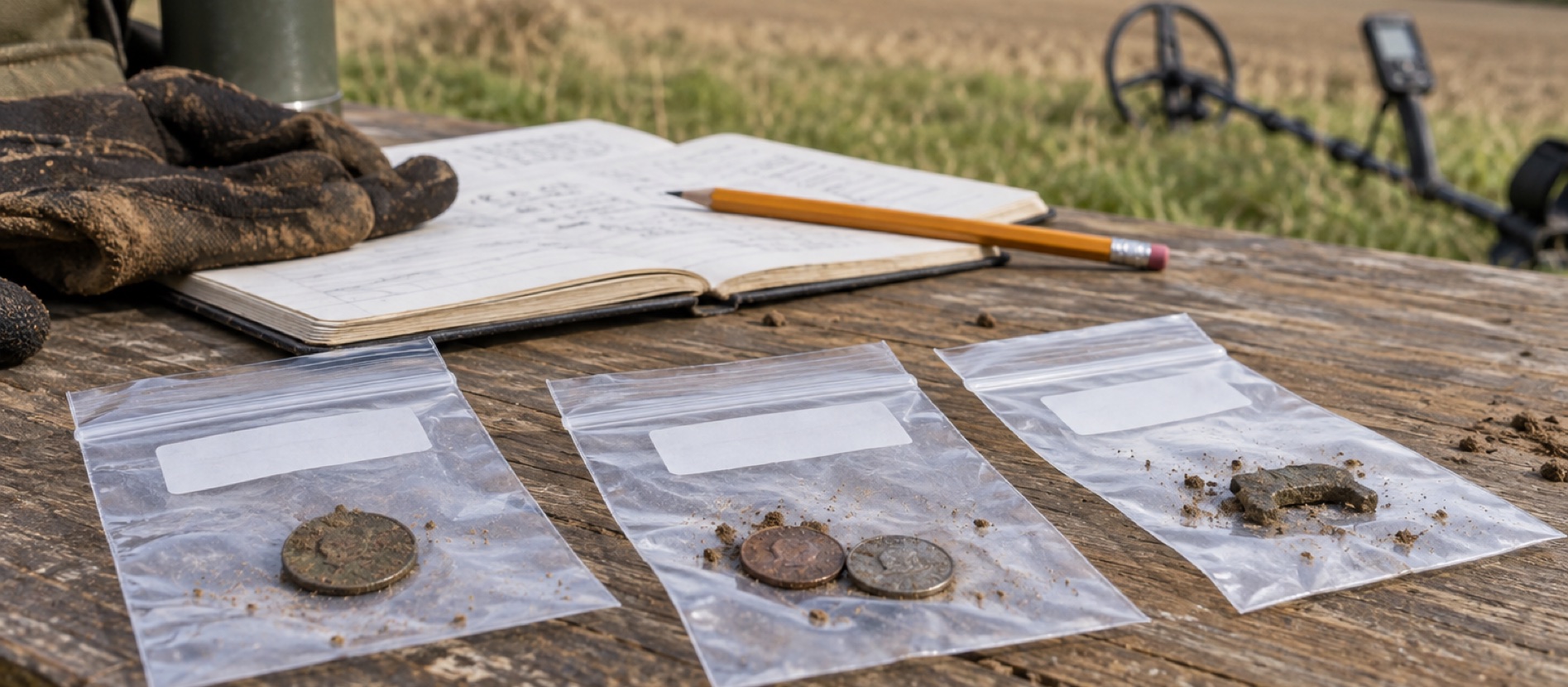
Agree ordinary finds and any reward sharing before searching.
Do not sell, clean or divide a find that may require statutory reporting.
Apply the law of the nation where the object was found.
This page is general information, not legal advice on a particular object or dispute. Ask the relevant authority or a solicitor if title is contested.
Does “finders keepers” apply?
Not as a general rule. The original owner of a recently lost object may still have the strongest claim. For an older non-Treasure object, title can depend on where and how it was found and on the rights of the landowner or occupier. HMRC's overview of found-object ownership describes the distinction between items on the surface and items buried in or attached to land; buried objects commonly fall to the landowner. An agreed detecting permission can say who may retain ordinary finds, but do not assume a handshake transfers everything under the soil.
England and Wales heritage teams also advise agreeing finds ownership in writing before detecting. See Suffolk's landowner guidance. Document the parcel, landowner or tenant, allowed recovery and what happens to objects of archaeological interest. A clear permission agreement prevents most avoidable disputes.
England and Wales: possible Treasure
An object that might qualify as Treasure is not simply a private find to divide. GOV.UK's current Treasure Act Code governs reporting, assessment, Crown title, possible museum acquisition and discretionary rewards. Report a possible Treasure find within the statutory 14-day window; a private share agreement cannot change that duty. The finder, landowner and/or occupier may be eligible for a reward, but a reward is not automatic or necessarily a fixed 50:50 split. The decision considers the Code, conduct and any agreement. Read our reporting-Treasure guide before moving a potentially associated group.
Scotland: Crown Treasure Trove rights
Scotland's Crown rights extend to portable antiquities of archaeological, historical or cultural significance, not just objects meeting the England and Wales Treasure definition. Treasure Trove Scotland says landowners have no automatic property right to such portable antiquities and need a written finder agreement to claim a share of an ex gratia reward. The finder should report an archaeological object through the Scottish process, not privately allocate it to either party. See the Scotland guide for reporting and findspot steps.
Northern Ireland: archaeological finds and Treasure
The Department for Communities says non-Treasure archaeological objects found in the ground are usually considered the landowner's and that removal without consent may be theft. Archaeological objects must be reported within 14 days to National Museums NI. Potential Treasure follows the Treasure Act and coroner route. Northern Ireland also restricts archaeological searching itself; check the licensing rules before assuming the landowner's permission is enough.
A safe sequence when title is unclear
- Stop cleaning, selling or splitting the object or associated group.
- Record the exact findspot, depth, nearby material and the landowner's identity.
- Keep each object separately with its location note and protect fragile surfaces.
- Inform the landowner and contact the relevant national reporting route promptly.
- Keep copies of the permission and any custody or receipt documents.
This is also why product photographs and social-media valuations should come last. A precise findspot and a lawful chain of custody matter more than guessing the object's price.
Common questions
Frequently asked questions
Does a finder automatically own a buried object?
No. The original owner may retain title, and non-Treasure objects buried in land commonly belong to the landowner. Agree ordinary finds in writing before searching.
Who owns a Treasure find in England or Wales?
Potential Treasure follows the statutory process and, when declared Treasure, Crown title applies subject to the law's qualifications. A finder or landowner may be considered for a reward but does not simply own the object.
Who owns archaeological finds in Scotland?
Portable antiquities of archaeological, historical or cultural significance are subject to Crown Treasure Trove rights and must be assessed through that route.
Is a Treasure reward always split 50:50?
No. Reward decisions are discretionary and can reflect the current Code, the parties' agreement and their conduct. Do not treat a common split as a guaranteed legal entitlement.
Helpful products
Preserve each find's identity
Separate compartments help avoid mixing objects and locations while ownership or reporting is resolved.

Compact starter pouch
Garrett Finds Pouch
Best for: Beginners who want a compact branded pouch for parks, fields and dry beach searches without a bulky belt system.
- Simple waist-mounted storage
- Wipe-clean fabric
- Lightweight shell pouch
A straightforward lightweight waist pouch that keeps recovered rubbish out of clothing pockets and gives a beginner a dedicated place for ordinary finds.
Know before buying: Its simpler layout offers less protection and organisation than larger multi-pocket pouches; add a rigid finds box for anything old, thin or fragile.