
BUYING GUIDE · CULTIVATED GROUND
Best metal detectors for ploughed fields
Compare three current detectors for permitted UK ploughed fields, focusing on coil control over furrows, iron response, settings, weight and find context.
Our recommendations
Three routes into cultivated ground
Our picks compare manufacturer specifications against open coverage, variable soil and rough footing. Match the machine's weight and controls to the land you actually have permission to search.

Upper mid-range
Minelab X-TERRA ELITE
Best for: Regular field, park and beach use where stable mixed-ground performance and detailed controls justify a higher budget.
- Multi-IQ; 15 kHz inland option
- Whole detector to 5 m (IP68)
- 1.3 kg
Multi-IQ simultaneous multi-frequency operation, six search profiles and a 5 m waterproof build make this a capable step-up detector for varied UK ground.
Know before buying: Its larger coil and deeper menu demand more concentration than a simple starter model, and wireless audio uses Minelab's compatible low-latency system rather than ordinary Bluetooth.

Mid-range
Nokta SCORE
Best for: Mixed inland and beach use for someone who wants simultaneous frequency operation without a dense advanced-control menu.
- Simultaneous multi-frequency
- Whole detector to 5 m (IP68)
- 1.2 kg
A light, rechargeable simultaneous multi-frequency detector with three search modes, 60 target IDs and full 5 m waterproofing.
Know before buying: The simplified SCORE has fewer adjustment options than Nokta's DOUBLE and TRIPLE SCORE models, so keen tinkerers may outgrow its control set.

Upper mid-range
Minelab X-TERRA PRO
Best for: A committed inland beginner who wants to learn how frequency, ground balance and audio choices change detector behaviour.
- Selectable 5 / 8 / 10 / 15 kHz
- Whole detector to 5 m (IP68)
- 1.3 kg
Selectable 5, 8, 10 and 15 kHz operation, six search profiles and detailed tone and discrimination controls give a keen beginner more room to progress.
Know before buying: Selectable frequencies are not simultaneous multi-frequency, and the extra controls create a steeper first-week learning curve.
| Detector | Frequency approach | Listed weight | Main strength | Watch for |
|---|---|---|---|---|
| Minelab X-TERRA ELITE | Simultaneous Multi-IQ | 1.3 kg | Broad controls for mixed ground | Bigger standard coil over clods |
| Nokta SCORE | Simultaneous multi-frequency | 1.2 kg | Simpler field setup | Fewer advanced adjustments |
| Minelab X-TERRA PRO | Selectable single frequencies | 1.3 kg | Learnable frequency and audio controls | Not simultaneous multi-frequency |
What changes on a ploughed field?
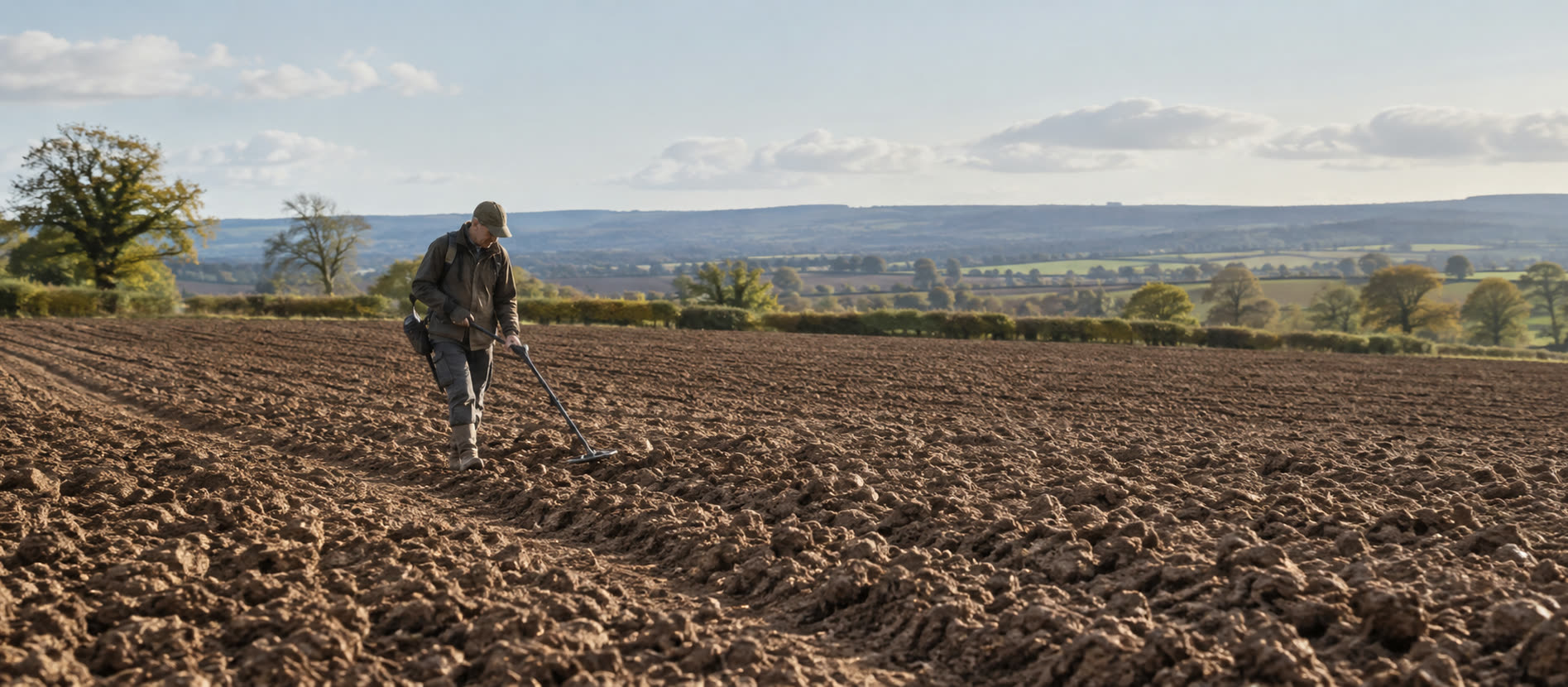
Furrows make coil-to-soil distance vary at every step. Loose clods, target tilt and air gaps make one object sound different from the same object in settled pasture. A machine with sensible ground adjustment and usable audio helps, but no specification removes the need to keep a coil low and level. Choose a shaft length and weight you can sustain while walking the furrow line; avoid crossing deep ridges merely to follow a theoretical grid. The ploughed-field method guide covers permission, cultivation timing and recovery limits.
Fields can also hold iron from tools and fences as well as older scattered material. Do not buy from a single impressive depth demonstration. A stable detector that lets you revisit a compact broken signal from two angles is more useful than one chattering at maximum sensitivity. The depth guide and target-ID guide explain why claims of universal coin depth are misleading.
Most flexible regular-field choice: Minelab X-TERRA ELITE
The X-TERRA ELITE combines Multi-IQ simultaneous multi-frequency with adjustable iron and audio controls. It has a 1.3 kg listed weight and a relatively broad supplied coil. We choose it for a frequent user who will search varying cultivated soil, compare small iron-adjacent responses and take time to learn the controls. Start with a maker Field profile, then change sensitivity, noise cancel or other settings only when the actual ground gives a reason.
The larger coil can span furrows and cover open ground, but it is harder to hold consistently over deep ridges and may combine closely spaced targets. Shorten the sweep and slow down before buying a different coil. The waterproof rating is useful for rain or subsequent beach use, not a reason to work a waterlogged cultivated field.
Simpler multi-frequency option: Nokta SCORE
Nokta specifies simultaneous multi-frequency operation, a Field mode, 1.2 kg listed weight and a less elaborate menu than its higher SCORE variants. That combination suits someone who wants mixed-ground frequency behaviour without managing many advanced controls during every field visit. Begin in Field mode and aim for a calm repeatable response rather than chasing the highest sensitivity setting.
Its simpler control set is a limitation on dense iron or highly variable conditions if you want fine audio and recovery tailoring. The question is whether your permission actually demands that flexibility. A steady lane and consistent coil height can improve coverage before any upgrade. The SCORE versus SIMPLEX Ultra comparison sets out the broader control trade-off.
Frequency-learning option: Minelab X-TERRA PRO
The X-TERRA PRO offers selectable 5, 8, 10 and 15 kHz operating frequencies rather than simultaneous multi-frequency. It gives a committed learner room to understand ground balance, tone and discrimination choices on a regular permission. Its listed 1.3 kg weight is not extreme, but the balance of a particular coil and your grip should be tried if possible. Do not keep changing frequency to chase each uncertain signal; establish a stable baseline first.
Its relative disadvantage is that selecting a frequency is a decision you must make, and a single selected frequency is not equivalent to the ELITE or SCORE running multiple frequencies simultaneously. Read the X-TERRA PRO model guide before deciding which controls you will actually use.
Coil size and recovery boundaries
An open, lightly contaminated field may reward the coverage of a standard coil. On broken ridges or around iron, a smaller compatible coil may be easier to keep close and can separate adjacent responses, but needs more lanes. Our search-coil explainer covers that choice. A narrow field spade is useful only where the farmer has approved the tool and the recovery layer; the spade comparison should not be read as permission to dig deeper.
Before the first cultivated-field search
Agree the exact field, timing, recovery depth, finds handling and any stewardship restrictions. Walk with the furrows where safe, mark small blocks and document the settings used. Ploughing can move objects and expose concentrations; if you encounter a group, compact layer or feature, stop and record it rather than removing more soil. The grouped-finds guide and FLO guidance explain the next step. Leave the field ready for cultivation, with safe sharp litter removed and gates as you found them.
Common questions
Frequently asked questions
What detector works on ploughed fields?
Choose a machine you can keep level over furrows with calm audio and controls you understand. The ELITE, SCORE and X-TERRA PRO offer different levels of adjustment and frequency behaviour.
Is the X-TERRA PRO simultaneous multi-frequency?
No. It lets you select a single operating frequency. The X-TERRA ELITE and Nokta SCORE use simultaneous multi-frequency operation.
Will a large coil always be better on open ploughed land?
No. It may cover ground but can lift over ridges and blend neighbouring iron. Start with the standard coil and adjust sweep length and lane spacing first.
Does ploughing remove archaeological restrictions?
No. Scheduled status, stewardship conditions and finds-reporting duties remain relevant, and a concentration or exposed feature should be recorded rather than dug through.