
Head-to-head · TWO NOKTAS
Nokta SCORE vs SIMPLEX Ultra
Choose between the base Nokta SCORE and SIMPLEX Ultra with a comparison of multi-frequency, wet sand, recovery, ground balance, coils and controls.
Our recommendations
Choose the system before the menu
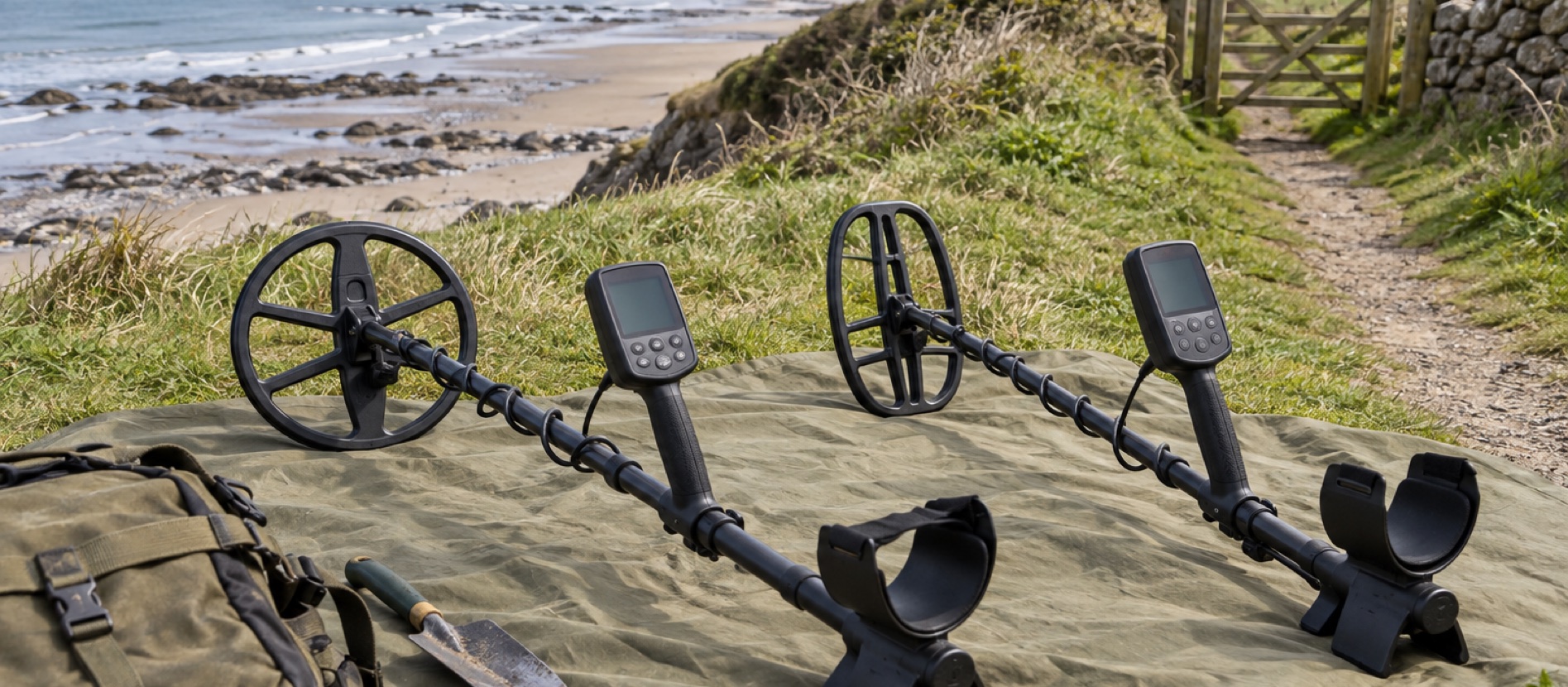
These are both Nokta detectors, but the base SCORE is not a stripped-down SIMPLEX Ultra. Frequency processing and user-adjustable controls pull them toward different owners.

Mid-range
Nokta SCORE
Best for: Mixed inland and beach use for someone who wants simultaneous frequency operation without a dense advanced-control menu.
- Simultaneous multi-frequency
- Whole detector to 5 m (IP68)
- 1.2 kg
A light, rechargeable simultaneous multi-frequency detector with three search modes, 60 target IDs and full 5 m waterproofing.
Know before buying: The simplified SCORE has fewer adjustment options than Nokta's DOUBLE and TRIPLE SCORE models, so keen tinkerers may outgrow its control set.

Settings-led beginner
Nokta SIMPLEX Ultra
Best for: Inland permissions and freshwater use for a beginner who wants settings to learn rather than automatic multi-frequency operation.
- 15 kHz single frequency
- Whole detector to 5 m (IP68)
- 1.2 kg
A fully waterproof 15 kHz detector with six search modes, manual or automatic ground balance and unusually detailed tone and recovery controls for the price.
Know before buying: Beach mode helps with salt response, but the single 15 kHz platform can still need lower sensitivity and careful ground setup on wet salt sand.
| Feature | Base SCORE | SIMPLEX Ultra | Practical effect |
|---|---|---|---|
| Frequency | Simultaneous multi-frequency or 15 kHz | Fixed 15 kHz single frequency | SCORE has the stronger wet-salt starting system |
| Modes | Park Field Beach | Field Park 4 Tone 99 Tone Beach All Metal | Ultra offers more audio starting points |
| Recovery speed | No user adjustment on base model | Adjustable 1 to 5 | Ultra lets you test close-target separation |
| Ground balance | No user adjustment on base model | Automatic or manual | Ultra offers deliberate mineral-ground correction |
| Iron controls | Basic discrimination patterns; no user iron filter | Iron Off and tone controls | Ultra provides more ways to hear or mute iron |
| Standard coil | 12 by 9-inch SC30 DD | 11-inch SX28 DD | SCORE favours open coverage; Ultra is slightly narrower |
| Target IDs | 1 to 60 | 1 to 99 | Numbers are brand/model-specific and not object labels |
| Waterproofing | Whole detector to 5 m | Whole detector to 5 m | Confirm accessory and connector ratings |
Do not confuse base SCORE with DOUBLE or TRIPLE SCORE
Nokta's SCORE family comparison distinguishes the base SCORE from DOUBLE and TRIPLE SCORE. The base model lacks user recovery-speed, iron-filter and ground-balance adjustments that appear on higher variants. Its simultaneous multi-frequency system is still the central advantage over the SIMPLEX Ultra's fixed 15 kHz, particularly for a buyer who wants one easy detector for ordinary inland sites and regular wet salt sand.
The SIMPLEX Ultra specification lists recovery speed, tone break, tone frequency, tone volume and automatic/manual ground balance. Those controls can reward patient learning on varied inland ground. More controls do not mean it is automatically the better beach detector. This is a choice between a simpler frequency system for mixed conditions and a more adjustable single-frequency machine.
Why choose the base SCORE?
The SCORE combines simultaneous multi-frequency with Park, Field and Beach modes. You can use its 15 kHz single-frequency option too, but most buyers will value the simple multi-frequency starting point. Its 12-by-9-inch SC30 coil covers open ground, the listed weight is 1.2 kg and the entire detector is IP68 rated to 5 m. Those specifications make it a plausible first all-round machine without a dense setup menu.
Its limitation is deliberate simplicity. The base model has only five sensitivity levels and lacks user recovery speed, iron filter and ground balance. In a dense nail patch, careful sweep, sensible discrimination and a smaller compatible coil may help, but you cannot follow a DOUBLE SCORE settings video and expect the same controls to exist. Buy by exact model name and included coil rather than the word “SCORE” in a headline.
Why choose SIMPLEX Ultra?
The Ultra's Field, Park, 4 Tone, 99 Tone, Beach and All Metal modes let a learner hear targets in several ways. Its 1–5 recovery scale can trade a longer marginal response for closer target separation. Tone controls can preserve some iron information without making every ferrous object equally loud. Automatic and manual ground balance give a way to respond to changing soil.
The supplied SX28 coil is 11 inches, its listed weight is 1.2 kg and the complete machine is waterproof to 5 m. A fixed 15 kHz frequency keeps operation understandable but is not simultaneous multi-frequency. On wet salt, its Beach mode can help, yet difficult tide-line sand may demand lower sensitivity and more compromise than a suitable multi-frequency Beach mode. The mineralised-soil guide explains why balance and stability matter inland too.
Inland fields and iron patches
In clean pasture or short stubble, either can search effectively when the coil is kept low and lanes overlap. The SCORE asks fewer setting decisions; the Ultra lets you tune response when a field changes. On a gate-area iron patch, the Ultra's recovery and tone controls offer more room to explore, but setting them aggressively can hide marginal targets. A smaller coil and methodical second-angle check may improve either detector.
Do not compare their displayed target numbers as though both use one scale. SCORE uses 1–60 and Ultra uses 1–99; depth, orientation and nearby iron can move a reading on each. Detecting around iron shows how to judge a mixed response by its repeatable centre rather than the highest number seen on a screen.
Wet beach sand is the sharper divide
Salt water makes connected wet sand conductive, and a detector can respond to that ground as if it were a broad target. The SCORE's simultaneous multi-frequency Beach mode is the more forgiving starting choice of this pair for regular tide-line work. The Ultra's single-frequency Beach mode may still be useful for occasional wet sand, but a buyer should not infer identical salt handling from the shared waterproof rating. Wet-sand detectors and wet versus dry sand explain this difference in context.
Both are rated IP68 to 5 m as complete detectors. Headphones, connectors and charging-port conditions have their own limits. Ordinary wireless audio will not work reliably underwater. Check the exact manual and accessories before entering surf, and clean salt and sand as instructed after the session.
Which should you buy?
Choose base SCORE if regular wet sand, quick mixed-ground setup and simultaneous multi-frequency matter more than adjustable recovery or ground balance. Choose SIMPLEX Ultra if most permissions are inland and you want to learn detailed tones, recovery and manual balance with a smaller standard coil. If you want both simultaneous multi-frequency and those user controls, compare higher SCORE variants or another suitable model rather than pretending either of these two gives everything.
No model here guarantees more finds or a fixed depth. Confirm the exact retailer bundle, fit and headset requirements before buying. A stable mode and consistent sweep will matter every outing.
Before the first search
Check the exact permission, assemble and seal the detector as the manual directs, then practise with a known coin and nail on permitted ground. Keep the first profile simple and record any change that genuinely helps. The first-day plan gives an orderly start.
Common questions
Frequently asked questions
Is the base Nokta SCORE multi-frequency?
Yes. It offers simultaneous multi-frequency as well as a 15 kHz option. SIMPLEX Ultra is fixed single-frequency at 15 kHz.
Can I change recovery speed on the base SCORE?
No. Nokta lists that user control on DOUBLE and TRIPLE SCORE, not the base SCORE. SIMPLEX Ultra does offer a 1–5 recovery-speed setting.
Which is better for regular wet beach sand?
The base SCORE is the more forgiving starting choice of this pair because it combines simultaneous multi-frequency with a Beach mode. Waterproofing alone does not determine salt stability.
Does SIMPLEX Ultra offer more settings?
Yes. It includes automatic/manual ground balance, recovery speed and detailed tone controls. Choose those if you mainly search inland and want to learn how adjustments affect the response.