
Buying guide · IRON-RICH GROUND
Best metal detectors for iron-contaminated sites
Compare metal detectors for UK iron-rich fields and former farmyards by recovery control, coil choice, iron audio and practical target separation.
Our recommendations
Three credible iron-site options
These are shortlisted for controls that can be tested on iron-rich permissions, not for a claim that any detector can classify every nail correctly. Check exact model and coil compatibility before ordering.

Upper mid-range
Minelab X-TERRA ELITE
Best for: Regular field, park and beach use where stable mixed-ground performance and detailed controls justify a higher budget.
- Multi-IQ; 15 kHz inland option
- Whole detector to 5 m (IP68)
- 1.3 kg
Multi-IQ simultaneous multi-frequency operation, six search profiles and a 5 m waterproof build make this a capable step-up detector for varied UK ground.
Know before buying: Its larger coil and deeper menu demand more concentration than a simple starter model, and wireless audio uses Minelab's compatible low-latency system rather than ordinary Bluetooth.

Upper mid-range
Minelab X-TERRA PRO
Best for: A committed inland beginner who wants to learn how frequency, ground balance and audio choices change detector behaviour.
- Selectable 5 / 8 / 10 / 15 kHz
- Whole detector to 5 m (IP68)
- 1.3 kg
Selectable 5, 8, 10 and 15 kHz operation, six search profiles and detailed tone and discrimination controls give a keen beginner more room to progress.
Know before buying: Selectable frequencies are not simultaneous multi-frequency, and the extra controls create a steeper first-week learning curve.

Settings-led beginner
Nokta SIMPLEX Ultra
Best for: Inland permissions and freshwater use for a beginner who wants settings to learn rather than automatic multi-frequency operation.
- 15 kHz single frequency
- Whole detector to 5 m (IP68)
- 1.2 kg
A fully waterproof 15 kHz detector with six search modes, manual or automatic ground balance and unusually detailed tone and recovery controls for the price.
Know before buying: Beach mode helps with salt response, but the single 15 kHz platform can still need lower sensitivity and careful ground setup on wet salt sand.
| Detector | Frequency | Iron and recovery tools | Supplied coil | Main compromise |
|---|---|---|---|---|
| X-TERRA ELITE | Multi-IQ or 15 kHz inland | Adjustable recovery iron bias and ferrous audio | 12 by 9 inch elliptical | Stock coil is broad for very dense iron |
| X-TERRA PRO | Selectable single frequency | Adjustable recovery and detailed tones | 12 inch elliptical | No simultaneous Multi-IQ |
| SIMPLEX Ultra | 15 kHz single frequency | Adjustable recovery tone break and volume | 11 inch round | Larger stock coil sees more neighbouring iron |
Buy for an interpretable response, not an iron-free screen
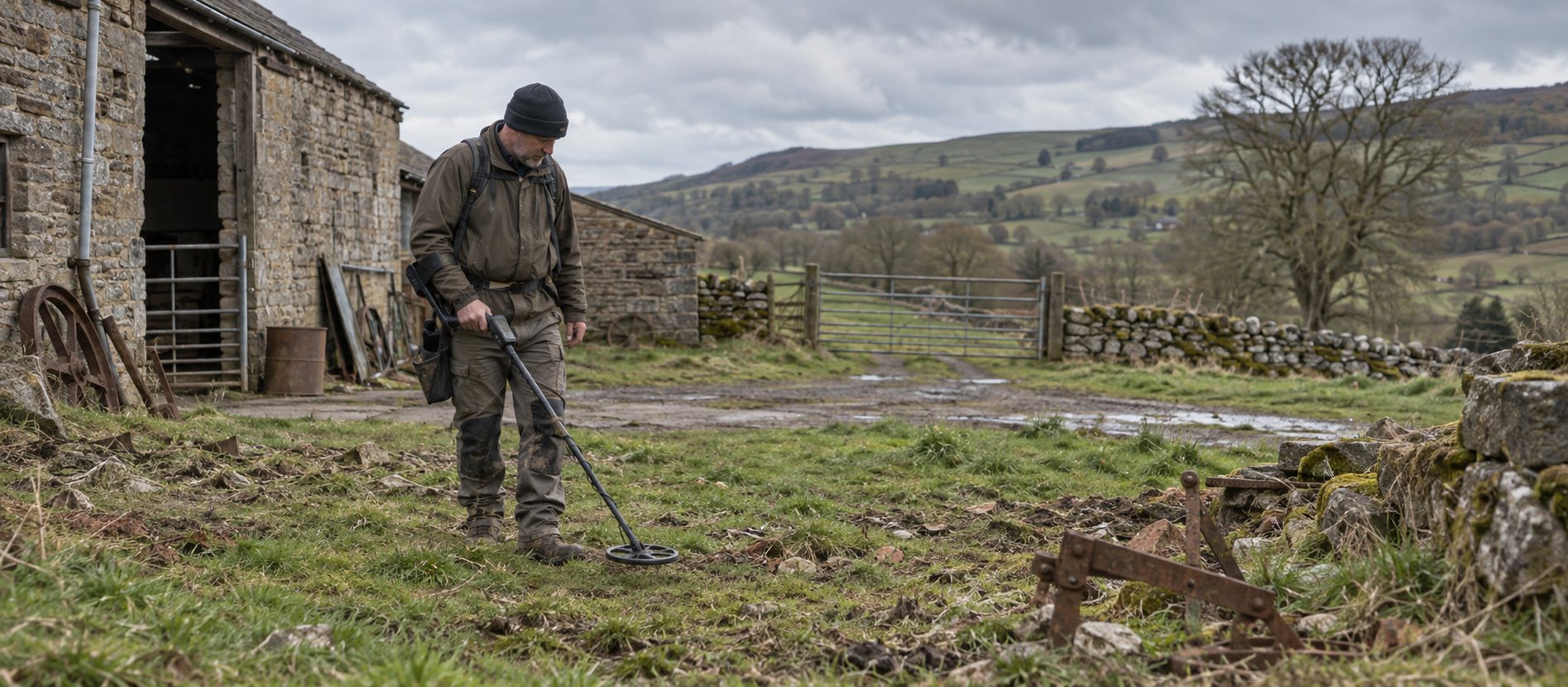
An iron-contaminated site might be an old permitted field gate, a working farmyard margin or a patch of cultivated ground with generations of nails and machinery fragments. It is not permission to search an archaeological site, a scheduled monument or any farm structure without explicit consent. The practical equipment challenge is that the coil receives several objects at once. A strong nail may mask a smaller non-ferrous object nearby.
The buying features that matter are a manageable coil footprint, useful audio, stable ground handling and recovery controls you can test. High discrimination alone makes a site quieter but can also hide desirable targets close to iron.
Most adaptable: Minelab X-TERRA ELITE
The X-TERRA ELITE pairs simultaneous Multi-IQ with Field and Park profiles, adjustable recovery speed, iron bias from -1 to 2 and ferrous-volume control. These are useful tools for working out whether a brief high note is tied to a compact position between iron responses. Its target-ID display is helpful but does not identify an object conclusively.
The supplied V12X 12-by-9-inch elliptical coil covers ground efficiently. On a dense nail patch, its footprint may include too many objects at once. Check the manufacturer's smaller compatible V8X option and bundle details if iron separation will be the main use. A different coil is a material change in geometry, not a magic setting.
Full 5 m waterproofing and Multi-IQ also make the ELITE versatile outside the iron patch. Those advantages may justify it for mixed field and beach use; do not buy it solely for one difficult gate where access may be restricted.
Settings-led single-frequency alternative: X-TERRA PRO
The X-TERRA PRO offers Park and Field profiles, selectable single frequencies, three recovery-speed levels, automatic/manual/tracking ground balance, detailed tone choices and a broad target-ID scale. A committed operator can tune it for the actual soil and target density while learning what each change does.
Its supplied 12-inch elliptical coil is good for general coverage but wide for closely spaced nails. A compatible smaller coil is likely to be more valuable on a concentrated iron patch than repeatedly changing frequency. Selectable frequencies are one at a time, not simultaneous Multi-IQ; that matters if wet salt sand is also a regular destination.
Lighter adjustable option: SIMPLEX Ultra
The SIMPLEX Ultra runs a fixed 15 kHz frequency and provides recovery-speed control, tone break, tone frequency and tone volume. Its 1.2 kg listed weight and carbon-fibre shaft make a practical long-session package. It offers enough audio adjustment to keep iron audible at a manageable level while testing short non-ferrous responses.
The supplied 11-inch round coil is not particularly small for a busy patch. Check compatible Nokta coil options and the actual package before expecting tight separation straight from the box. It remains a single-frequency detector even though its Beach mode and waterproofing can handle some coastal use.
Why the base SCORE is not in this shortlist
The base Nokta SCORE is a capable and simple simultaneous multi-frequency detector for mixed ground, but Nokta's current model comparison does not list user recovery-speed, iron-filter or ground-balance adjustment for that base version. Those controls belong to higher SCORE variants. For an iron-specific buying intent, we prioritised exact models with the relevant controls rather than borrowing features from a related product name.
Likewise, the VANQUISH 360 has useful Multi-IQ and a compact 10-by-7-inch coil, but its iron bias is fixed high and recovery is not adjustable. It can still be a very sensible first detector; this shortlist is for buyers deliberately working difficult iron.
Coil size and geometry
A smaller coil detects a narrower slice of ground, which may allow you to hear two close objects separately. A large coil offers coverage and often stronger responses to larger isolated targets but combines more nearby iron into each sweep. Coil shape and orientation also matter. An elliptical coil can slip between stubble or fragments more easily in one direction than another.
Read search coils explained and verify electrical and software compatibility with the precise detector. Matching connector shape is not enough.
The settings order on a new iron patch
Begin with a stable factory Field or Park profile. Run noise cancel and ground balance where the model requires it. Keep sensitivity below the point of constant chatter. Sweep a short line at a controlled pace and listen to the iron rather than immediately silencing it.
If close targets merge, test one step faster recovery speed over the same spot. If bent iron creates repeated high edges, test a modest iron-bias change. Open discrimination briefly when a promising response breaks. Change one variable at a time, or you will not know what helped.
A field exercise before buying another coil
Place a modern coin and nail on permitted clean ground. Begin a coil width apart and move them closer in small steps. Cross from two directions and compare with the current factory settings. Then shorten the sweep; next try one recovery change. Only after those checks should you judge whether a smaller coil is worth the expense.
This exercise cannot simulate every buried target. Soil minerals, depth and corrosion alter the result. It does show whether the controls you plan to pay for improve your ability to hear two separate responses.
Legal and archaeological limits
Old iron concentrations can signal former structures or activity, not simply rubbish. Stop if you encounter compact layers, associated objects, building material or human remains. Photograph and record the findspot before cleaning, and seek advice from the landowner and an appropriate Finds Liaison Officer. Do not widen a hole to pursue a weak signal beyond the agreed recovery depth.
Before the first search
Confirm the landowner's authority, precise boundaries, access route and permitted recovery method. Check protected-site restrictions independently. On a working farm, ask about buried services, livestock and machinery. Take all safe recovered scrap away, restore every permitted hole and record unusual finds. A more capable detector should lead to more careful decisions, not more disturbance.
Before deciding whether an adjustable detector is worth buying, use our iron-site search method with your current machine. It shows where a shorter sweep and second-angle check help, and where a smaller coil or recovery control may make a genuine difference.
Common questions
Frequently asked questions
What detector feature helps most among old nails?
A manageable coil footprint and clear repeatable audio are often more useful than extreme discrimination. Adjustable recovery and iron behaviour can help when tested methodically.
Will a faster recovery setting find a coin beside iron?
It may help separate nearby responses, but no setting guarantees a coin beneath or against large iron. Coil geometry, target position and soil remain important.
Is a smaller coil better on iron-contaminated ground?
Often, because it detects a narrower slice of ground and fewer neighbouring objects at once. It covers less area and may give a weaker response to some isolated larger targets.
Why is the base Nokta SCORE not on this shortlist?
It is a capable multi-frequency detector, but the base model does not offer the user recovery-speed and iron-filter controls listed for higher SCORE variants. This shortlist focuses on deliberate iron-site adjustment.