
FIELD KIT · FINDS BOXES 91
Best metal detecting finds boxes
Compare three field finds boxes for cushioned carrying, small compartments and compact separation, with clear limits on fragile finds and long-term storage.
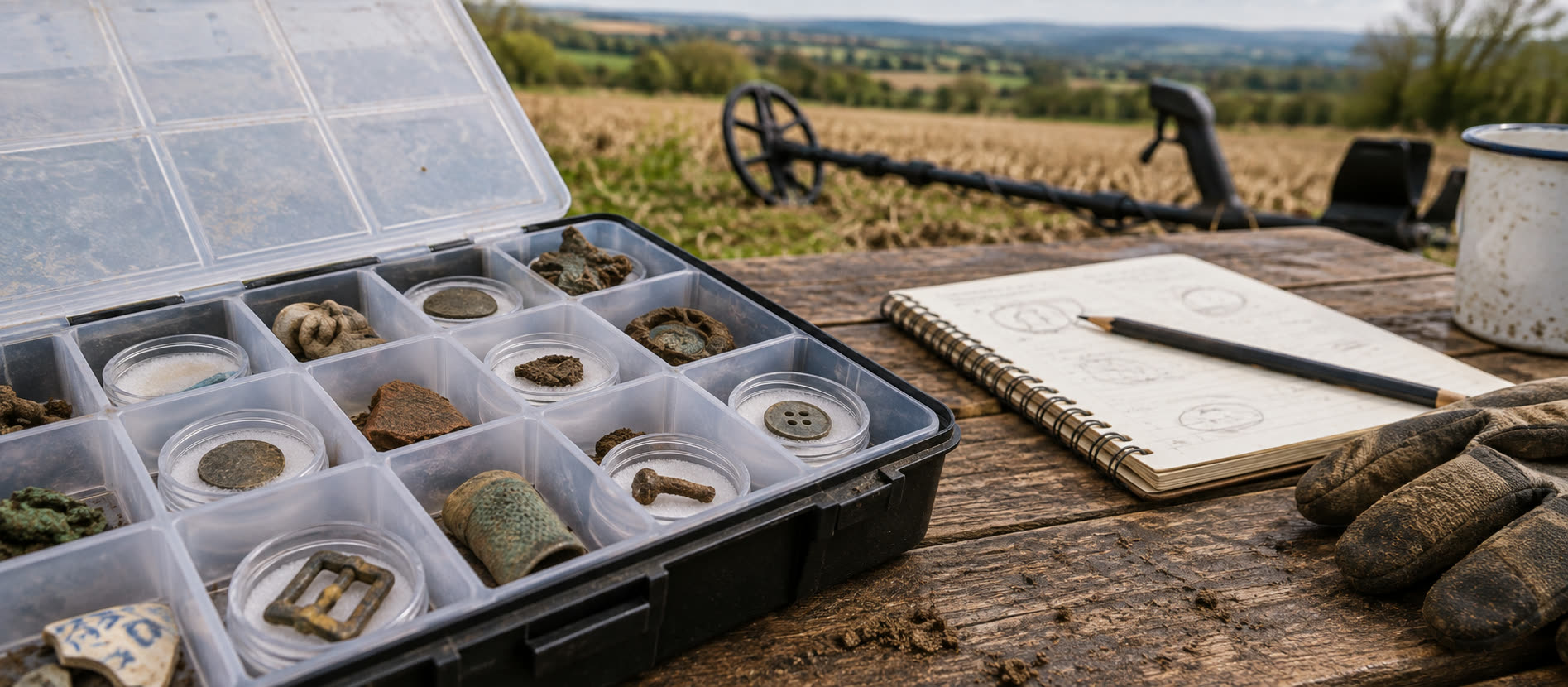
Our recommendations
Three distinct field carrying options
Compare compartment layout, dimensions and intended use. Storage and archaeological recording are separate decisions.

Larger cushioned field case
CMD Large Finds Box
Best for: Detectorists who need one larger cushioned transit case inside a pouch or bag.
- Foam-lined rigid case
- Four closing clips
- Large field format
A rigid field case with a foam-lined interior, four closing clips and a supplied lanyard for carrying ordinary small finds between the field and home.
Know before buying: Foam contact and a closed case are not automatically suitable for damp, unstable or archaeologically significant objects in long-term storage.

Compact compartment case
Detecting Innovations Mini Finds Box
Best for: Short sessions where separation matters more than generous padding or capacity.
- Ten lidded compartments
- 95 × 70 × 32 mm claimed closed size
- Lightweight folding plastic
A small folding plastic case with ten separate lidded compartments for keeping several ordinary field finds apart.
Know before buying: The small compartments do not replace individual field numbers and may not suit fragile, damp or larger archaeological objects.

Two compact finds pods
Searcher Finds Pod Two Pack
Best for: A minimal field kit that needs a pair of separate small-find containers.
- Two pods
- Small-find separation
- Compact field carry
A two-pack of small finds pods for keeping separate small ordinary finds from loose debris during a session.
Know before buying: The product listing says contents are not included; check the current listing for exactly what is supplied and do not presume archival suitability.
| Option | Field format | Separation | Main limitation | Best fit |
|---|---|---|---|---|
| CMD Large Finds Box | Rigid foam-lined case with four clips | One cushioned interior | Foam contact is not universal conservation storage | A few robust finds in one larger case |
| Detecting Innovations Mini Finds Box | Small folding plastic case | Ten lidded compartments | Limited space and padding | Several small everyday finds kept apart |
| Searcher Finds Pod two-pack | Two compact pods | Two independent containers | No archival or waterproof claim | Minimal pocket or pouch kit |
What a field box must do
It should stop ordinary small finds escaping or scraping against sharp rubbish, while allowing you to keep each item associated with its exact findspot. That is a field transport requirement. Long-term storage of a corroding coin, damp iron, lead or an object with attached organic material can demand a different container and professional advice. Our finds pouch comparison covers the outer carry system; this guide is about the inner containers.
Best cushioned case: CMD Large Finds Box
The listed large CMD case has a rigid plastic shell, foam interior, four clips and a lanyard. It is the most practical all-purpose cushioned option here when a detectorist wants to bring a handful of robust, individually logged objects back from a session without letting them knock together. Check that the closed case fits the protected pocket of your pouch and that the clips can be operated with gloves. The foam is a cushion, not proof that its material or contact surface suits every archaeological find.
This option is less efficient for ten tiny objects that each need a separate compartment. A field-number slip beside a coin must not drift to another object when the lid opens. If an item is damp, flaking or otherwise vulnerable, ask a recording professional or conservator how to package it instead of pressing it into foam.
Best divided mini case: Detecting Innovations Mini Finds Box
The Amazon UK listing describes ten separate lidded compartments and claims a closed size of 95 × 70 × 32 mm. That is compact enough to plan around a pouch pocket, though you should check current listing details and your own equipment. The attraction is separation: a robust button, modern coin and little fitting can each have their own numbered slot rather than sharing a loose pocket.
Tiny compartments are not a reason to collect fragile material without context. Labels must be small but legible, and large or irregular finds will not fit. The plastic construction alone does not establish archival material, moisture control or suitability for valuable archaeological objects.
Best minimal pair: Searcher Finds Pod two-pack
Two separate compact pods can be easier to carry than one large organiser on a short session. Keep one for an ordinary small find and the other for a second object; put rubbish elsewhere. The listing explicitly says the photographed contents are not included. It gives no dependable conservation or watertight specification, so do not treat either claim as established.
If you regularly recover more than two items worth keeping separate, a divided box or individually labelled containers will scale better. Use the field-log method to connect each pod to a find number before moving the contents.
Record first, box second
At the hole, photograph the object in place if safe, take a precise private location and assign a number. Then choose the container. Never infer that all objects in one case came from one deposit, and do not group two discs to save space if their findspots differ. How to record a find details the essentials; cataloguing a collection carries those identifiers into home storage.
Keep any possible Treasure, concentrated group or archaeological deposit in the correct reporting process rather than continuing to fill a box. Do not transport suspected ordnance; follow the dangerous-finds guidance. Written finds ownership terms also matter before anyone takes the box home.
What the listings do not prove
The exact Amazon UK listings provide product photographs, dimensions and stated features. None of those details establishes drop resistance, water sealing, foam chemistry or long-term preservation. A seller's “protective” language is not a conservation standard. Avoid a box whose lid lets contents move freely, whose inserts can shed fibres onto delicate surfaces or whose form encourages you to mix numbered finds.
For long-term care, follow object-specific advice in storing coins and storing iron. If the surface changes after storage, isolate the object, photograph it and seek specialist advice rather than coating or cleaning it.
Before you buy
Lay out your pouch, a sample label and the kind of ordinary stable object you usually recover. Choose the smallest box that keeps each piece secure and separately identifiable. A reusable numbering routine and a few suitable containers are more useful than a large unlabelled case. For rare, fragile or unstable material, the correct response is documentation and professional guidance—not a more expensive generic box.
Common questions
Frequently asked questions
Which finds box is best for several small items?
A divided case such as the ten-compartment mini can keep ordinary robust finds separate, but each still needs a number and precise findspot.
Is a waterproof-looking finds box safe for wet iron?
Do not assume so. Trapped moisture can worsen corrosion, and the listed cases are not independently verified conservation environments. Seek object-specific advice.
Can I keep a possible archaeological coin in foam?
A foam-lined field case may cushion transport but does not establish long-term suitability. Keep its number and context and ask a recording professional about fragile or unstable material.
What can a finds-box listing establish?
A listing can describe dimensions, compartments and materials, but it cannot establish long-term conservation suitability. Keep location notes with finds and seek object-specific advice for fragile material.