
PLACES · DRY GROUND
Metal detecting on hard summer ground
Learn how to approach hard dry UK ground without damaging pasture, overworking a detector or forcing unsafe recovery in drought-stressed turf.
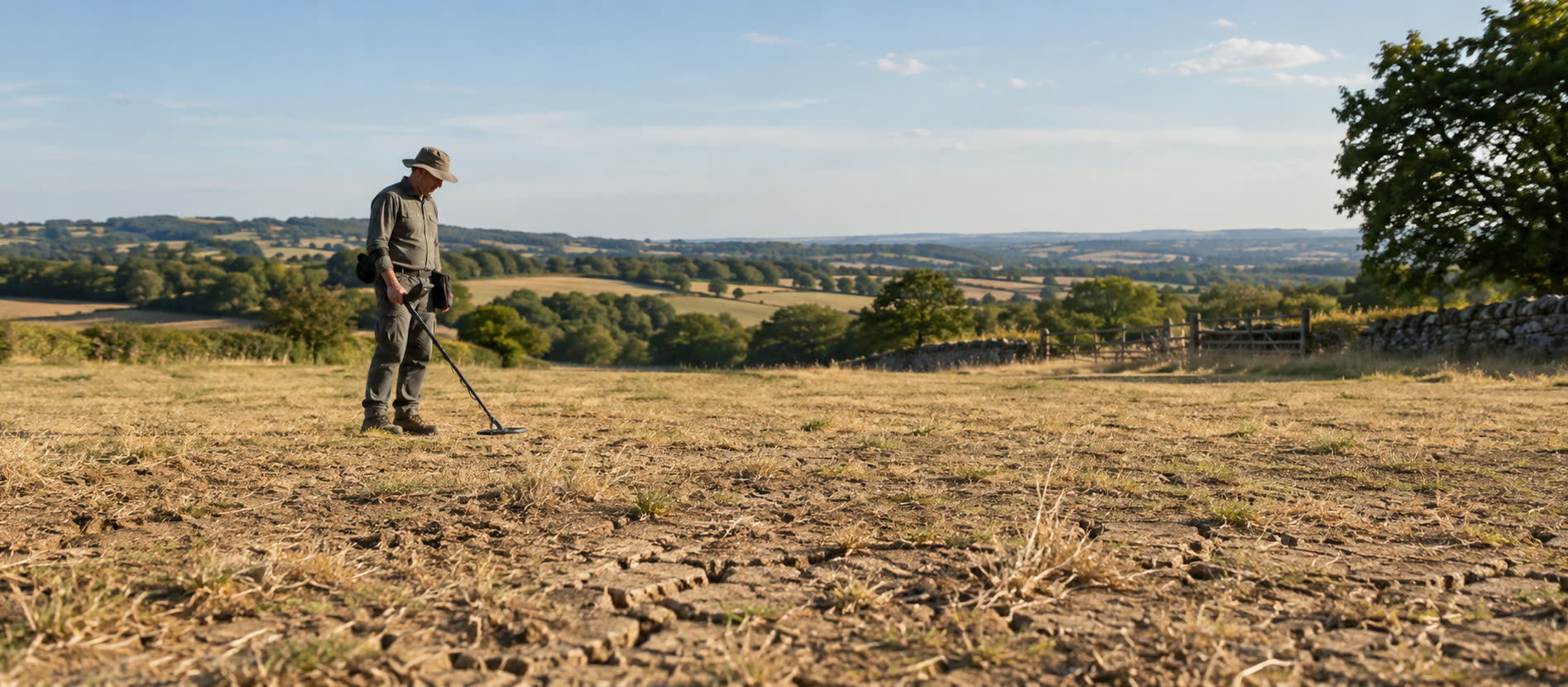
Do not cut dry, brittle turf simply because permission was granted months ago.
Separate poor coil control from a genuinely weak soil response.
Record signals for a return visit only if the landholder agrees and locations stay private.
Why a dry field changes the decision
Grass can look intact while its roots and underlying soil are under stress. A plug cut from hard, dry turf may fracture, leave a gap or die even when pressed back. The landholder must decide whether access and recovery are appropriate now, not just whether your written agreement covered the field generally. If a clean reinstatement is doubtful, do not cut. Our pasture guide explains the normal recovery standard and the permission agreement can record seasonal restrictions.
Heat also changes the human side of the search. Plan water, shade, a charged phone and a short exit route. Avoid the hottest hours and stop when concentration or footing worsens. Check the Met Office weather forecast and any relevant heat advice, but judge the actual patch underfoot. A brief shower over a long dry spell does not necessarily soften the soil below.
What hard ground does—and does not—prove about signals
Dryness can change soil conductivity and target response, but there is no fixed centimetre loss or reliable rule that one brand 'beats' summer ground. Coil height often matters more: clods, stubble and hard ruts can make the search head rise. Shorten the arc, keep the coil level without scraping and compare a repeatable target from two directions. The depth explainer covers target size, orientation, coil height and soil together.
Use the manufacturer's baseline field profile. Noise cancel where available, ground-balance as instructed and set sensitivity for a calm sweep, not a headline maximum. If signals are weak, do not compensate by swinging faster or raising gain until the machine chatters. Write down the setting and site condition so a later damp-ground visit can be compared fairly. Sensitivity settings provides a stepwise method.
Alternatives to forcing a plug
Ask the occupier whether a recently cultivated field is available and suitable; do not move there without specific permission. A pre-agreed surface-only survey may be possible, but a detector tone without lawful recovery is not a licence to return at will. You can also use known targets at home to practise the sweep in a test garden, or clean and check equipment for the next session.
The VANQUISH 360 is one uncomplicated multi-frequency field option for a buyer who also wants mixed-ground use. Its automatic operation does not overcome unsafe recovery, and its target ID cannot identify whether a buried item is worth damaging turf. See detectors for pasture for the full trade-offs.
If the ground becomes workable again
After sustained rain, ask the farmer before returning. Check that a plug lifts whole, soil stays together and the grass closes flush. Stop again if the first authorised recovery crumbles. Where a concentration or unusual object appears, record the location and context rather than widening the hole; grouped finds may need specialist advice. Restraint in a hard spell protects both the permission and the evidence under it.
Common questions
Frequently asked questions
Should I dig metal detector signals in drought-stressed pasture?
No if the turf and soil cannot be restored. Ask the landholder, and postpone recovery or move to another specifically permitted suitable site.
Does dry soil always reduce detector depth?
No fixed depth rule applies. Soil composition, target, coil height and settings interact; compare repeatable signals on the actual ground.
Will one light shower make hard ground safe to dig?
Not necessarily. Surface moisture may not soften the soil below or revive stressed roots. Check whether an authorised plug lifts whole and closes flush.
Can a stronger spade solve hard summer ground?
No. A sharper or heavier tool can damage turf and roots more quickly. The right response may be to stop digging.
Helpful products
A detector for a later suitable session
A straightforward multi-frequency machine can be useful across ordinary field conditions, but no detector turns drought-stressed pasture into recoverable ground.

Mid-range
Minelab VANQUISH 360
Best for: Parks, fields and beaches for a beginner who wants simple controls and one detector for varied ground.
- Multi-IQ simultaneous multi-frequency
- Whole detector to 5 m (IP68)
- 1.16 kg
Automatic simultaneous multi-frequency operation, a low 1.16 kg weight and full 5 m waterproofing make this the least complicated route into mixed UK ground.
Know before buying: The deliberately simple control set offers less room to tune audio and recovery behaviour than the X-TERRA PRO.