
TECHNIQUE · CONTROLLED PRACTICE
Build a metal detector test garden
Create a small, documented metal detector test garden with safe modern targets, repeatable measurements, labelled positions and realistic limits.
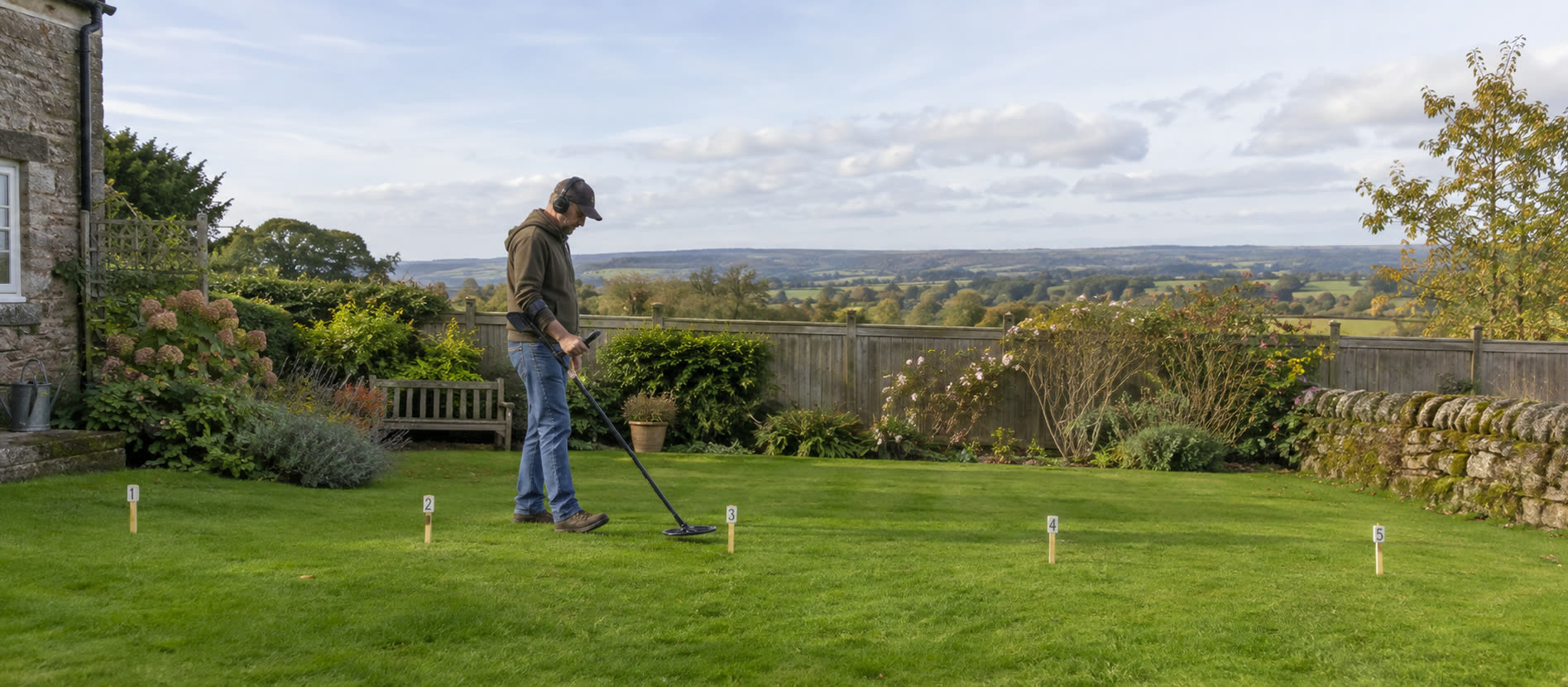
Use only your own ground or explicit permission, away from services and archaeology.
Measure target type, depth, orientation and spacing before any burial.
Change one detector setting at a time and log repeatability, not just a beep.
Decide whether you need to bury anything
Surface targets on a clean mat can teach most first-day controls without cutting a garden at all. Begin there with a modern coin, iron nail and pull tab held or placed at known orientations. Practise a level sweep and compare sound and target ID. The air-tests-versus-ground guide explains why this is a controls lesson, not a buried-depth claim.
If you want a buried lane, use only land you own or a patch where the owner explicitly agrees to it. Check for utilities before digging; avoid roots, drains, protected land and any area with suspected archaeological remains. Do not leave sharp iron exposed where children or pets can encounter it. The exercise is about safe, modern test objects, not planting finds that could later be mistaken for genuine archaeology.
Design a small measured layout
Choose a few different targets rather than a deep collection: a current coin, a small foil piece and one nail. Use non-metallic markers and a written sketch with fixed distances from permanent features. Record each object's material, approximate size, orientation, depth, date and exact location. Keep enough separation that neighbouring targets do not interfere with a baseline pass; then, if useful, create a deliberately close coin-and-nail pair to hear masking. Label this as a special case in the log.
Do not bury hazardous materials, old coins, unknown finds, batteries or anything you would not be content to retrieve. Use the shallowest depth needed for the question and recover every target when the exercise ends. Restore turf fully and keep the map private. Recording a find uses a similar discipline, but a test target is not an archaeological find.
Test one variable at a time
Set the shaft length and use the same coil, pass direction, height and speed for each run. Begin with the manufacturer's default field mode. Record whether the response is repeatable from two directions, its tone and ID range, and whether the machine remains stable between passes. Now change one setting—perhaps sensitivity, discrimination or ground balance—and repeat. A loud one-way chirp is not the same as a usable field signal.
Compare a clean coin with the coin beside a nail, and note whether a shorter sweep exposes the separate response. The iron-masking guide explains why a blanked or clipped signal is still information. Do not interpret a planted target's apparent depth as what the detector will find in compact, mineralised or salt-wet real ground.
The VANQUISH 360 is one approachable practice machine because its programmes and automatic Multi-IQ leave fewer setup choices. It is not a standard against which every other detector must be judged, and a different coil or programme changes the comparison.
Use the results in a real permission
Take the audio lesson, not a promised centimetre figure, into the field. Use stable settings, keep coil height consistent and investigate repeatable real signals. If the garden develops new metal contamination or the turf fails to recover, remove the test targets and stop. The beginner practice plan gives a progression from known objects to a short permitted search.
Common questions
Frequently asked questions
Do I have to bury targets for a test garden?
No. Known objects on a clean surface teach controls, tones and coil centre without disturbing the ground.
How far apart should buried test targets be?
Space baseline targets far enough that responses do not overlap, record the exact layout, then make a separately labelled close-target exercise if you want to study masking.
Will a test garden show my detector's maximum real depth?
No. Freshly disturbed soil and planted target orientation differ from compact natural ground; use the lane for repeatable settings comparisons, not universal depth claims.
Can I leave old coins buried as test targets?
Use clearly documented modern objects instead, and recover them when the exercise ends. Do not create a false archaeological context or leave sharp material behind.
Helpful products
A simple machine for learning the method
An accessible detector with a small number of modes is enough for controlled practice; the test design matters more than owning a premium model.

Mid-range
Minelab VANQUISH 360
Best for: Parks, fields and beaches for a beginner who wants simple controls and one detector for varied ground.
- Multi-IQ simultaneous multi-frequency
- Whole detector to 5 m (IP68)
- 1.16 kg
Automatic simultaneous multi-frequency operation, a low 1.16 kg weight and full 5 m waterproofing make this the least complicated route into mixed UK ground.
Know before buying: The deliberately simple control set offers less room to tune audio and recovery behaviour than the X-TERRA PRO.