
Places · STUBBLE GROUND
Metal detecting on stubble fields
Search short harvested stubble safely and effectively with level coil technique, suitable settings, permission checks, measured coverage and careful recovery.
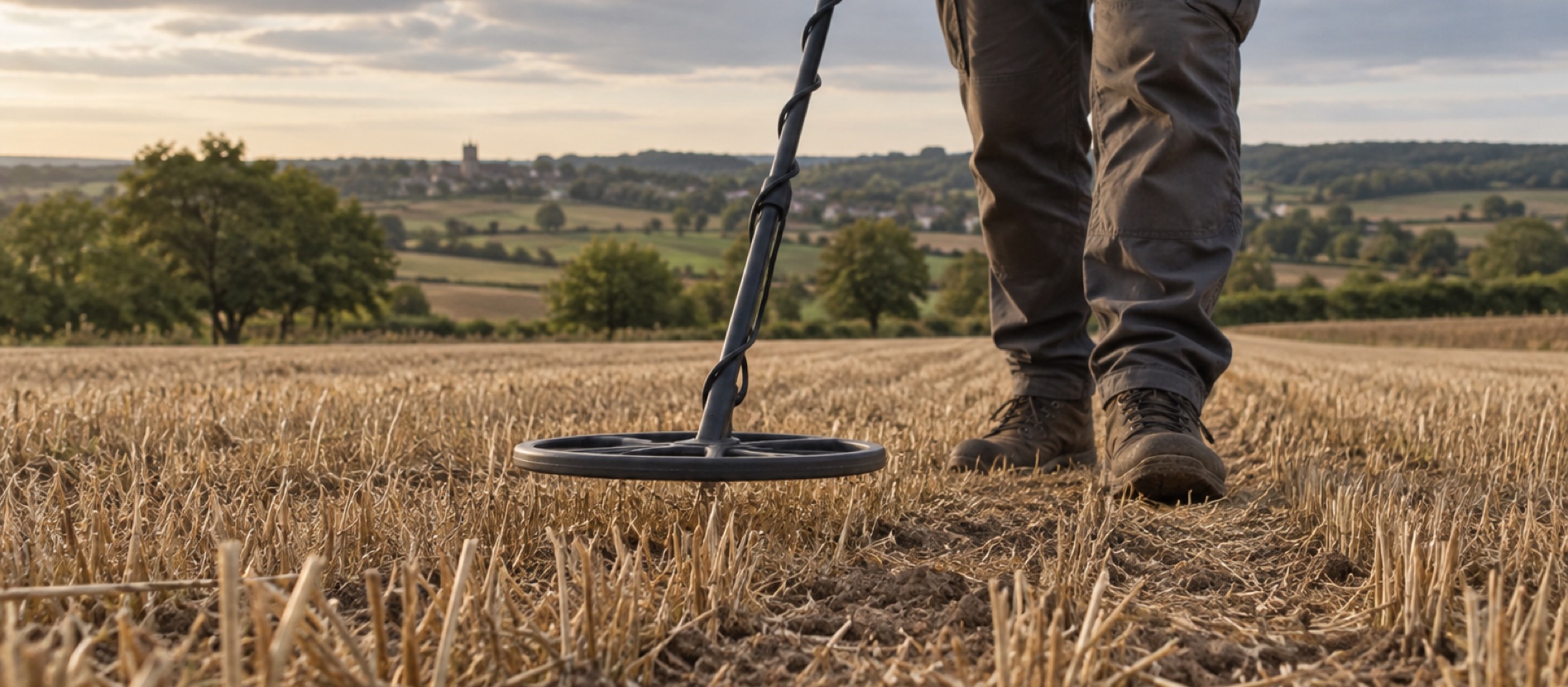
Check cut height, baling, re-sowing and machinery movement before entering.
Shorten the sweep or choose a smaller coil where stems obstruct a level pass.
Keep every recovery safe for the next operation and record its position.
Stubble is not one consistent surface
After a cereal crop is cut, the field may have a low, even mat of stems or tall, rigid rows mixed with loose straw. The first is easier to sweep; the second can hold the coil well above the soil, snag the cable and obscure small recovery holes. A wet mat can hide soft ground, while dry stalks can scrape the coil and sound like knocks. Walk a short trial strip before planning the whole permission.
This page is about working the stubble surface. For the farm-calendar question—when a cut field is actually available—read metal detecting after harvest. Neither a cut crop nor a visible public footpath grants detecting rights. Confirm the exact field, access dates and any no-go areas with the landowner or authorised manager.
Stay clear of farm operations
Ask whether straw will be baled or chopped, whether cultivation or drilling is planned, and where machinery will travel. Do not detect in the same field as moving plant. Leave turning areas, stacks, gateways and active vehicle routes clear. If a tractor appears unexpectedly, stop, make yourself visible from a safe location and follow the manager's instructions. Do not assume the driver can see a person behind a straw bale or fold in the field.
Check stewardship and heritage constraints as part of the permission. Historic England's agri-environment advice makes clear that an agreement holder may have restricted areas. Short stubble does not change the status of a scheduled monument or known archaeological site.
Keep the coil close without striking stems
Adjust shaft length while wearing the boots you will use. Keep the coil parallel to the soil and avoid a pendulum arc that rises at each end. A repeated thump against a stem can create a false response or simply hide a weak target in handling noise. In tall rows, sweep the open strip between stems where possible, then make a second pass from a different direction rather than raising the coil over every obstacle.
An 11-inch coil covers clean, short stubble efficiently; a smaller compatible coil may move more easily between taller stems and iron contamination. The gain in manoeuvrability costs coverage, so plan tighter lanes. Read search coils explained before treating a larger coil as an automatic depth upgrade. The SIMPLEX Ultra's Field mode, adjustable recovery and standard 11-inch coil are useful features to compare, though its fixed 15 kHz single-frequency system has different trade-offs from multi-frequency detectors.
Set the detector for the actual ground
Start with the manufacturer's Field profile. Check a known surface coin, run frequency shift or noise cancellation if nearby equipment causes interference, balance as the manual directs and bring sensitivity down from a noisy maximum. Check whether stem strikes, mineralised soil or nearby iron cause the chatter before changing multiple controls. Ground balance and sensitivity solve different problems.
Stubble can hide nails, fencing pieces and broken machinery. Use cautious iron rejection until you know the field. Cross a doubtful response from two directions and listen for a compact centre; a one-way high chirp at the coil's edge is not proof of a coin. On an iron-rich patch, detecting around iron explains how a shorter sweep and sensible recovery setting help.
Search lanes you can repeat
Use visible headlands or hedge features as lane references and divide a large field into blocks. Overlap sweeps more generously when stems interrupt the arc. If the coil is repeatedly forced high, mark that strip as incomplete rather than counting it as searched. A second pass across the crop rows may expose missed gaps when conditions permit.
Keep a brief block record, including mode, coil, date and soil condition. The field-gridding guide gives a complete pattern and explains why a phone GPS line is not proof of coil-width coverage.
Recover and leave no hazard
Pinpoint a repeatable target before moving soil. A pinpointer can narrow its position in a clod or loose straw, reducing unnecessary disturbance. Keep blades away from the estimated target, work only to the agreed depth and return soil and stems so the next farm operation is not obstructed. Sweep the recovery area again for sharp iron and remove it safely.
Stop if several objects appear together, if you reach an undisturbed layer, or if an unusual deposit or possible human remains are exposed. Photograph the situation before moving more material, mark the position and seek appropriate advice. The finds-recording guide helps preserve location and context. A tidy field and clear report to the farmer matter as much as the objects you take home.
Common questions
Frequently asked questions
What detector setting works best on stubble?
Start with the manufacturer's Field mode, check ground balance or noise cancel as needed and use a stable sensitivity. Coil height and stem strikes often matter more than a special setting.
Does tall stubble reduce metal detector depth?
It can. Stems hold the coil farther from buried objects, increasing coil-to-target distance. Search open strips or return after conditions improve rather than forcing the coil through tall stalks.
Should I use a smaller coil on stubble?
A smaller compatible coil may fit between rows and iron better, but needs tighter lanes. An 11-inch coil covers short even stubble efficiently when it stays level.
Is a harvested stubble field automatically open to detecting?
No. You still need permission for the field and date, plus checks for farm operations, heritage restrictions and agri-environment conditions.
Helpful products
Tools for a controlled stubble search
A detector with a Field mode and a pinpointer can help locate targets without widening holes. Use them only where the exact recovery method is agreed.

Settings-led beginner
Nokta SIMPLEX Ultra
Best for: Inland permissions and freshwater use for a beginner who wants settings to learn rather than automatic multi-frequency operation.
- 15 kHz single frequency
- Whole detector to 5 m (IP68)
- 1.2 kg
A fully waterproof 15 kHz detector with six search modes, manual or automatic ground balance and unusually detailed tone and recovery controls for the price.
Know before buying: Beach mode helps with salt response, but the single 15 kHz platform can still need lower sensitivity and careful ground setup on wet salt sand.

Premium pinpointer
Garrett PRO-Pointer AT
Best for: Regular inland, beach and shallow-water detecting where simple controls and a robust waterproof body matter.
- 11.5 kHz
- Whole pinpointer to 6 m (IP68)
- 200 g with battery
A highly visible waterproof probe with three sensitivity levels, proportional audio and vibration, fast retune and a 360-degree detection area.
Know before buying: One button handles power, retune, sensitivity and silent mode, so the control sequence takes a little practice. It uses a replaceable 9V battery.