
Places · FARM TIMING
Metal detecting after harvest in the UK
Plan a responsible post-harvest detecting visit with explicit farm permission, safe timing, crop and soil checks, measured coverage and careful finds recording.
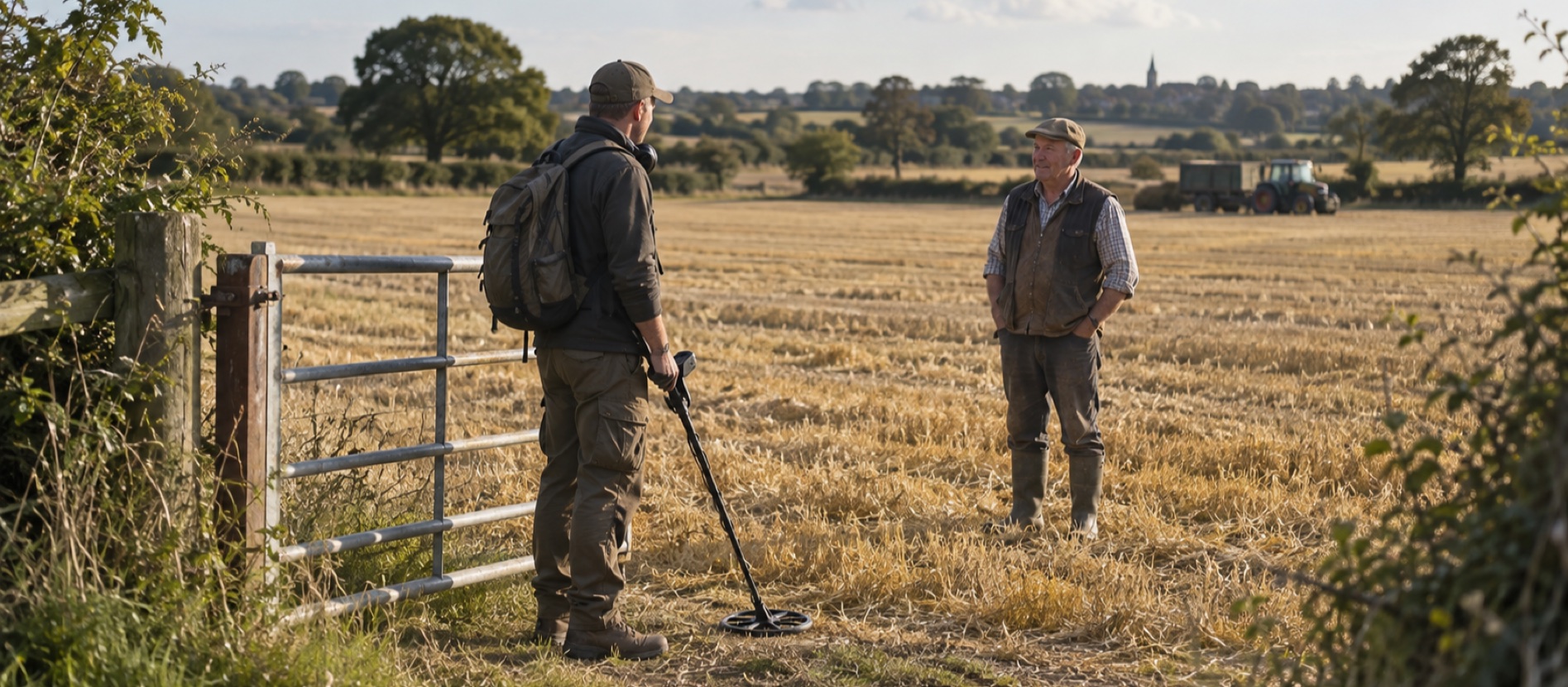
Confirm permission for the exact field and current post-harvest window.
Avoid crop residues, machinery routes, environmental margins and sensitive features.
Record locations before cleaning or separating associated finds.
The window depends on the farmer's plan
After harvest, a field may look empty while still being in active agricultural use. Straw can be baled, spread or incorporated; the soil may be cultivated and drilled again quickly. Ask the landowner or authorised occupier for the exact field, dates, access route, parking, working hours and a contact number. Confirm whether the field is due to receive machinery, livestock, spraying or an environmental operation. An old permission is not necessarily permission for this year's harvest window.
Agree who owns finds, what should be reported, how any valuable object will be handled and the maximum recovery depth. In England and Wales, follow the responsible detecting code and the relevant permission checks. Do not treat a footpath or public right of way as permission to search adjacent land.
Check protected and agreement land
Scheduled monuments, known archaeological sites, Sites of Special Scientific Interest and agri-environment agreement land may carry restrictions beyond the farmer's general permission. Historic England's agri-environment guidance explains why the agreement holder must check current conditions. Ask them to identify any excluded zones before you arrive. Do not infer that harvested appearance removes a protected designation.
Field edges, earthworks and unusual concentrations of objects can be sensitive. If a place appears archaeological, step back and seek advice; a detectorist's grid is not an archaeological excavation plan. The ploughed-fields guide covers the special issue of remaining within previously disturbed cultivation soil.
Choose the right surface to search
Short stubble may permit a level coil and measured lanes. Tall cut stems hold the coil up, hide holes and catch the cable. Newly cultivated ground can expose fresh soil but be uneven and slippery. A field soaked after harvest may not reinstate well; dry clods may make a neat recovery difficult. Postpone rather than force an unsuitable day.
If the farmer has baled straw, keep clear of stacks and machinery. Never enter a field with an active combine, baler, tractor or sprayer. Do not cross standing crops, crush a newly drilled row or park where a farm vehicle must turn. The stubble-fields guide deals with coil height, straw and sharp debris in detail.
Plan an efficient first pass
Divide the permitted area into named blocks and walk parallel lanes between stable landmarks. Overlap coil arcs and lane strips; do not assume a single brisk walk covers the ground. Search slowly around a repeatable response, then return to the original lane. Record which blocks were completed so a second visit can focus on missed ground rather than the easiest route again.
The field-gridding guide gives a repeatable method. A light detector such as the VANQUISH 360 can make long lanes less tiring, but its simple controls are not a substitute for stable settings and careful overlap. Use a Field or suitable general mode and check a known surface coin before starting.
Recover within the agreed layer
Pinpoint before cutting or moving soil. Keep the smallest practical recovery area, contain loose earth and return it as the land manager expects. In cultivated ground, avoid going below the previously disturbed layer. If you meet compact deposits, several associated objects, structural material or possible human remains, stop and record the context. Suffolk's metal detecting guidance stresses systematic searching and protecting the archaeology beneath plough soil.
Separate modern sharp rubbish from potentially recordable finds. Keep the field, block and precise location with each object; a pouch with divided compartments can help prevent abrasion but does not replace a written label or photo. Record a find explains what to note before cleaning changes the surface.
Finish in a way that protects future access
Check that every hole is safe, carry sharp scrap away, close gates exactly as found and clean soil from boots and tools before entering another holding. Tell the farmer which blocks were searched and whether you saw broken wire, damaged fencing or anything that affects farm operations. Share ordinary finds as agreed, and do not delay reporting possible Treasure or seeking a Finds Liaison Officer's advice for potentially significant objects.
The best post-harvest visit fits the farm's timetable. If the available window closes, leave the remaining blocks for another agreed date.
Common questions
Frequently asked questions
Can I metal detect in a field as soon as it is harvested?
Only with permission for that exact field and current window. The farmer may still need to bale, cultivate, graze, spray or re-sow it, and protected or agreement areas may be excluded.
What should I agree with the farmer before a post-harvest search?
Confirm boundaries, dates, access, parking, recovery method and depth, no-go areas, finds ownership and how significant objects will be reported.
Is post-harvest stubble always easy to search?
No. Tall stems raise the coil and conceal holes; wet straw and uneven cultivated ground can make safe recovery difficult. Inspect the surface before committing to a full search.
Can I dig below the plough soil for a deep signal?
Not merely because a detector sounds on it. Follow the agreed recovery depth and avoid disturbing intact archaeology beneath the cultivated layer. Record and seek advice if the context looks significant.
Helpful products
A light, orderly post-harvest kit
A manageable all-round detector and a divided pouch help with long lanes and separate finds. Neither justifies entering a field until the manager has confirmed the window.

Mid-range
Minelab VANQUISH 360
Best for: Parks, fields and beaches for a beginner who wants simple controls and one detector for varied ground.
- Multi-IQ simultaneous multi-frequency
- Whole detector to 5 m (IP68)
- 1.16 kg
Automatic simultaneous multi-frequency operation, a low 1.16 kg weight and full 5 m waterproofing make this the least complicated route into mixed UK ground.
Know before buying: The deliberately simple control set offers less room to tune audio and recovery behaviour than the X-TERRA PRO.

Compact starter pouch
Garrett Finds Pouch
Best for: Beginners who want a compact branded pouch for parks, fields and dry beach searches without a bulky belt system.
- Simple waist-mounted storage
- Wipe-clean fabric
- Lightweight shell pouch
A straightforward lightweight waist pouch that keeps recovered rubbish out of clothing pockets and gives a beginner a dedicated place for ordinary finds.
Know before buying: Its simpler layout offers less protection and organisation than larger multi-pocket pouches; add a rigid finds box for anything old, thin or fragile.