
FINDS CARE · OBJECT IDENTIFICATION
Tokens, jettons or coins? A first identification guide
Distinguish possible tokens, jettons and coins using both faces, legends, size and context, with PAS comparisons and appropriate reporting steps.
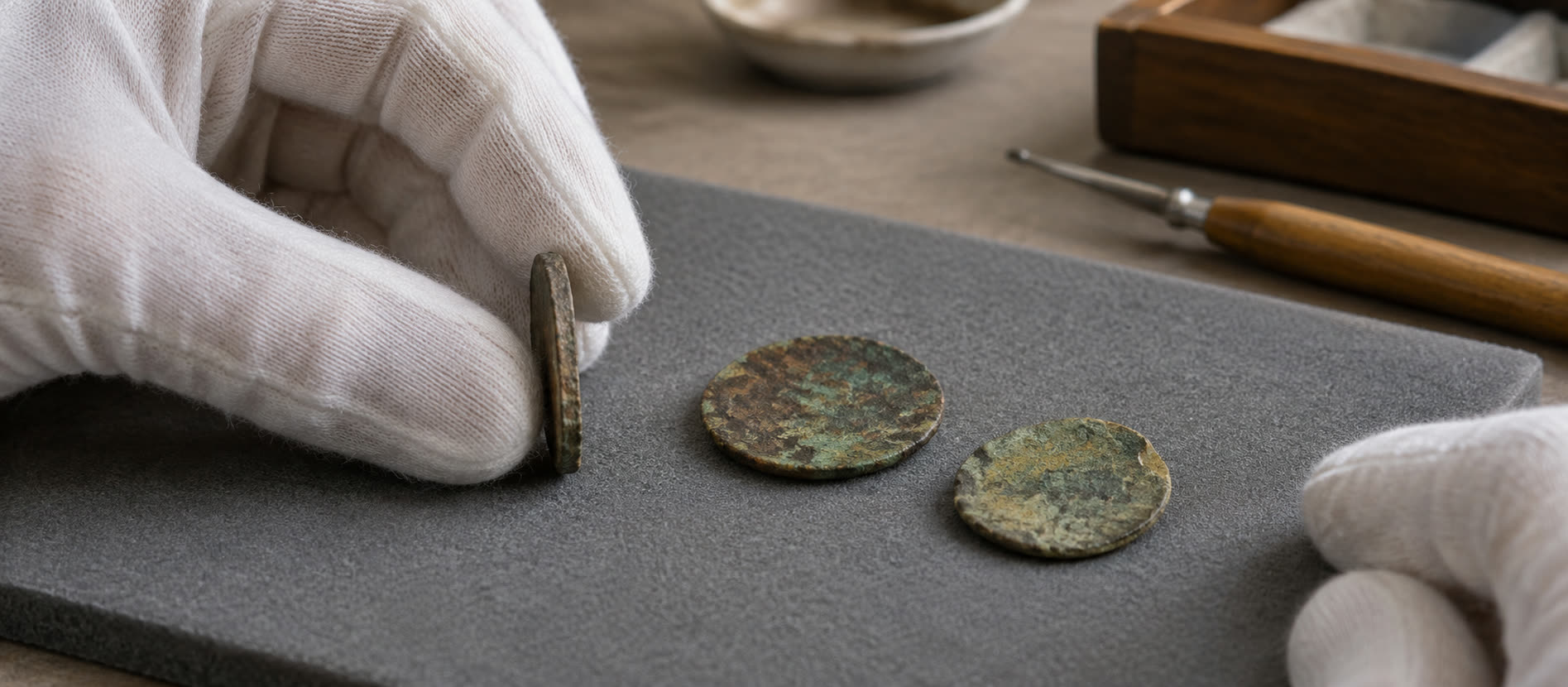
Do not clean a worn surface just to reveal a legend.
Compare both sides and physical details, not a single motif.
Keep provisional categories until a specialist confirms them.
Why the first label should be provisional
A small metal disc might be official coinage, a privately issued token, a counting jetton or a later commemorative object. Burial can remove lettering and edges; a convincing portrait can appear on a non-coin. The safest first log entry is “disc, possible token or jetton” plus observable features. It leaves room for a better identification without changing the findspot record.
Jettons were used as counters in reckoning and account-keeping, and some have coin-like designs. Tokens served other purposes and are not one historical series. Neither category can be defined by colour or a target-ID number. The PAS database includes both jetton and token records, with broad periods, measurements and sometimes named issuers or mints; it is a comparison resource, not an image-matching guarantee.
Examine two faces and an edge
Photograph the disc in place, then each face and the edge with a scale. Note its diameter, thickness, weight if safely measurable, any hole, clipping, bend or casting seam. Transcribe lettering exactly as visible and put uncertain characters in brackets or leave a gap; do not fill them from a similar web image. Look for a denomination, issuer, place name, repeated motif or a cross-reference between the two sides, but remember wear and overstriking can confuse each clue.
Avoid wetting, rubbing, pencilling over or applying a chemical to reveal detail. A bright newly exposed patch may remove surface information permanently. Old coin first steps and whether to clean finds explain the safer pause-and-record approach.
Compare records without cherry-picking
Start with shape and dimensions, then the same design on both sides and any surviving legend. Search PAS for the broad object type and filter by material and period only if you have evidence for them. Read the complete description and the certainty or caveats, not just the title. A design shared by one side of two discs is weak evidence when their reverse types differ.
For example, the PAS record of a medieval French jetton demonstrates that an identifiable specimen can be catalogued as a jetton with a named type, but a featureless disc from your permission does not inherit that ID. If several discs appear together in one feature, do not sort them into “keepers” before recording their relationship; follow grouped-finds context and seek advice.
Your field-to-desk workflow
- Give the disc a unique find number and note the precise coordinate or grid reference, field, approximate depth and recovery context.
- Keep the uncleaned object separate from other metal. Photograph both faces, edge and scale in diffuse light; retain originals.
- Record visible legends and motifs as observations, plus uncertainties. Do not use a detector's numerical target ID as an alloy test.
- Compare more than one complete PAS record and note their IDs, measurements and distinguishing features.
- Ask your FLO or relevant local recording service if it may be archaeological, and check the separate possible-Treasure process promptly where applicable.
Separate compartments are a practical transit aid for everyday stable finds. Put a field-number slip with each item rather than trusting which slot it occupied. Do not confine a damp or unstable archaeological disc against unknown plastic without advice; the coin-storage guide covers the difference between field carrying and longer-term storage.
What an identification can and cannot say
Even a good type match does not prove where a token was originally used or why it ended up in that field. A ploughed find has lost some context. Preserve the exact findspot privately for the relevant professional and landowner arrangements, and use a broad location in public posts. A careful “likely jetton, type unconfirmed” is valuable; an invented issuer or exact date is not.
Common questions
Frequently asked questions
Is a jetton a coin?
A jetton can look coin-like but was commonly used as a counting counter. Identification depends on the complete design, legend, material and context, not its round shape alone.
Can target ID distinguish a token from a coin?
No. Detector readings vary with size, shape, alloy, depth and ground conditions. They cannot establish a historical object type.
Should I rub a disc to reveal its lettering?
No. Rubbing can remove fragile surface. Take clear images in diffuse or raking light and seek identification advice without altering the object.
Could a token or jetton be reportable?
An archaeological example may merit recording through the appropriate local service. A possible Treasure question has a separate statutory route and should be checked promptly.
Helpful products
Prevent small discs rubbing together
Separate ordinary robust finds for transport, while fragile or potentially significant discs need individual labelled packaging and conservation advice.

Compact compartment case
Detecting Innovations Mini Finds Box
Best for: Short sessions where separation matters more than generous padding or capacity.
- Ten lidded compartments
- 95 × 70 × 32 mm claimed closed size
- Lightweight folding plastic
A small folding plastic case with ten separate lidded compartments for keeping several ordinary field finds apart.
Know before buying: The small compartments do not replace individual field numbers and may not suit fragile, damp or larger archaeological objects.