
FINDS CARE · MATERIAL ID
Identifying lead metal detecting finds
Identify possible lead finds from shape, context and photographs without risky home tests; learn safe handling, common misidentifications and reporting steps.
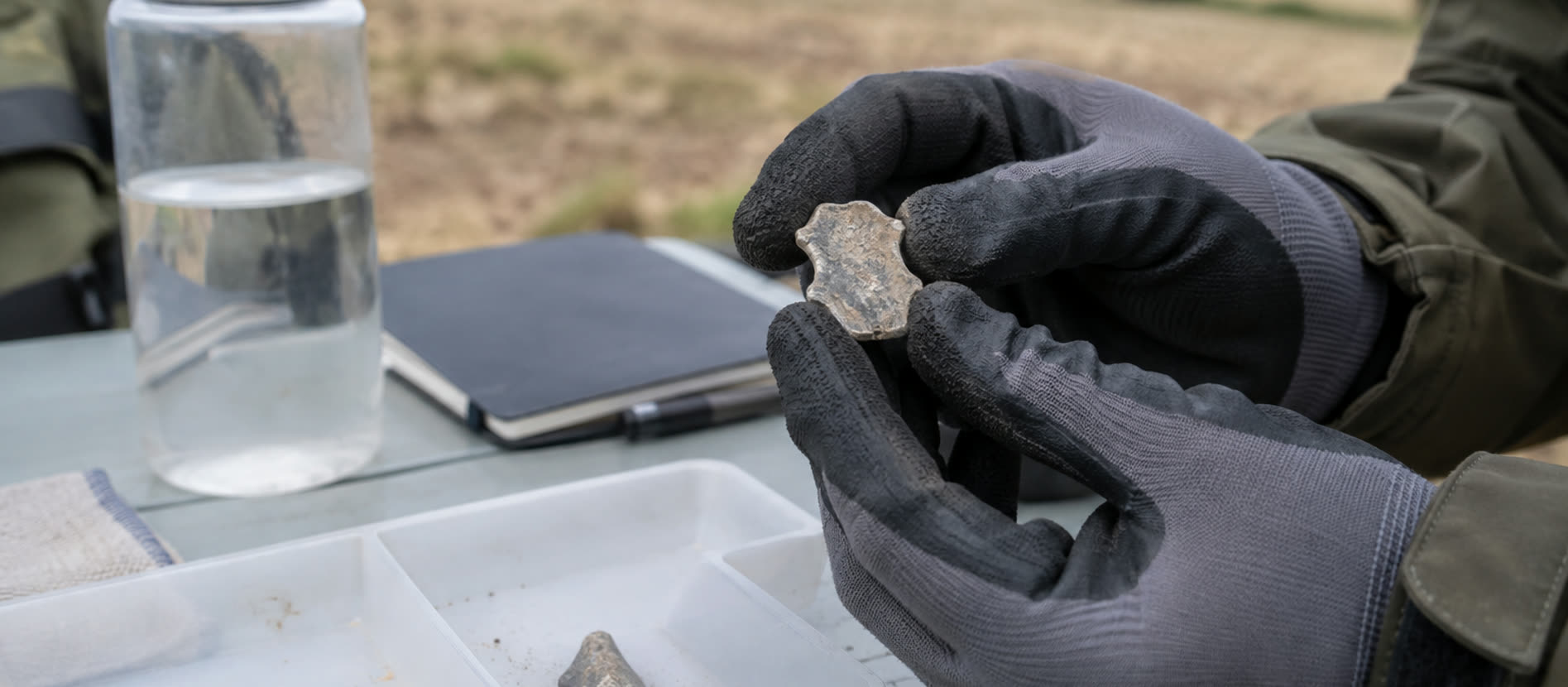
Lead identification by appearance alone is provisional.
Wash hands after handling and do not eat during sorting.
Refer possible archaeological objects to the right reporting route.
Is the grey object really lead?
Colour and detector target ID cannot establish metal composition. Lead often appears dull grey and feels heavy for its size, but soil staining, corrosion and alloying change appearance. Pewter, zinc, aluminium, solder and plated metal can fool a quick glance. A detector's number is a response to size, shape, orientation and ground as well as conductivity; it is not a laboratory result.
Start with a neutral description: “dense grey disc, 23 mm across, hole near one edge” is more useful than “Roman spindle whorl” when the attribution is uncertain. Photograph front, back and edge with a scale and record the exact findspot before sorting it into a type.
Common forms—and why context matters
Detectorists encounter possible weights, seals, tokens, shot, scrap, fittings and other grey-metal pieces. Similar shapes can come from very different periods or uses. A pierced disc may be a reused piece rather than a purpose-made weight; a rounded pellet may be modern ammunition or industrial waste. The object alone may not settle the answer.
Look for manufacturing details without picking away soil: a cast seam, stamped marks, suspension hole, wear or attachment point. Compare the object with reliable museum or PAS records, but filter by material and object type carefully and do not treat a visual match as proof. A reliable field record gives an FLO the context needed to judge it.
Handle it as a potential contaminant
Lead exposure is a health concern, especially when dust or residues are transferred to the mouth. HSE guidance stresses hygiene after lead handling and before eating or drinking. Avoid rubbing, grinding, filing, melting, heating, licking or acid-testing a find. Handle as little as practical, use a suitable barrier such as clean disposable gloves when sorting, wash hands and keep objects away from food, children and pets. Do not dry-brush unknown residues into the air.
If an object may be ammunition or ordnance, stop this identification workflow and follow the dangerous-finds guidance. Do not put it in a pouch or bring it home for a closer look.
For ordinary, already assessed field finds, a pouch can carry an individually enclosed, labelled object separately from other scrap. It is not an exposure control, laboratory container or safe method for moving suspicious ammunition.
When to seek an expert view
Ask a Finds Liaison Officer about a possibly archaeological lead object found in England or Wales. Send clear images, dimensions, findspot and permission context; do not post an object uninvited. The PAS guide explains the process. Scotland and Northern Ireland have distinct reporting routes, and a clustered group may require stop-and-record handling.
Avoid “cleaning until identifiable”. Loss of a seal impression, surface mark or attached residue cannot be undone. Preserve the object and the uncertainty until a qualified assessment.
Common questions
Frequently asked questions
Can a metal detector identify lead from target ID?
No. The reading changes with size, shape, orientation, nearby metal and soil. Colour and weight are clues, not proof of composition.
Is it safe to file or acid-test a lead find?
No. Avoid making dust, using chemicals or heating an unknown object. Record its observable features and ask an appropriate specialist if identification matters.
Should I wash my hands after handling a possible lead find?
Yes. Keep hands away from food and wash them after handling. HSE warns that lead dust and residues can be swallowed through hand-to-mouth transfer.
What if the object might be ammunition?
Stop handling it and follow dangerous-finds guidance. Do not put suspected ammunition or ordnance in a pouch or take it home for identification.
Helpful products
Keep ordinary finds separated in the field
Use separate protective containers inside a pouch. It is not a reason to handle unidentified or potentially hazardous material.

Compact starter pouch
Garrett Finds Pouch
Best for: Beginners who want a compact branded pouch for parks, fields and dry beach searches without a bulky belt system.
- Simple waist-mounted storage
- Wipe-clean fabric
- Lightweight shell pouch
A straightforward lightweight waist pouch that keeps recovered rubbish out of clothing pockets and gives a beginner a dedicated place for ordinary finds.
Know before buying: Its simpler layout offers less protection and organisation than larger multi-pocket pouches; add a rigid finds box for anything old, thin or fragile.