
FINDS CARE · OBJECT IDENTIFICATION
How to identify a metal detecting buckle find
Identify the useful features of a recovered buckle without guessing its age. Photograph the frame, pin and plate, record the findspot and compare PAS examples.
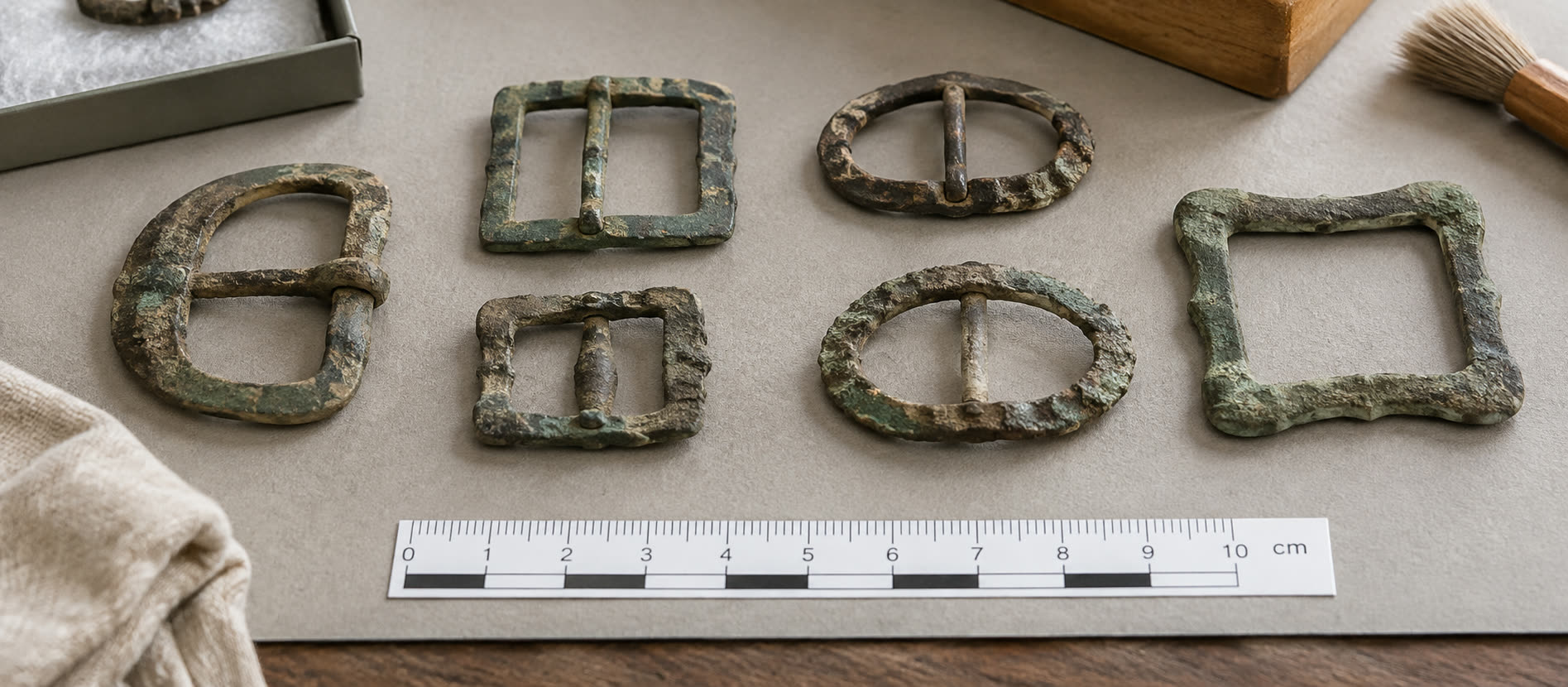
Photograph both faces, side profile and the pin attachment.
Note the frame shape, cross-section, plate and decoration separately.
Compare complete PAS records, not a single similar-looking image.
Is it actually a buckle?
Begin by asking whether the object could fasten a strap. A buckle normally has a frame through which the strap passed and a bar or hinge area to hold a pin. The pin may survive, be broken or have disappeared completely. A plate can fold around the strap and attach to the frame, sometimes with rivets; not every buckle had a plate. A bare rectangular or oval frame might also be another kind of fitting. Do not turn a resemblance into an identification.
Before lifting an unusual object, photograph it in place and note whether another component lies beside it. Two pieces in the same hole may belong together, but do not force them together or assume they are a set. Our grouped-finds guide explains when to pause recovery and preserve an association.
Read the frame, bar and pin
Describe the outline—oval, D-shaped, rectangular or double-looped—then the metal, width, thickness and cross-section. Is the bar integral to the frame? Is there a groove, pin rest or evidence of a missing central bar? Does a separate pin wrap around it? Record what is visible, rather than silently reconstructing missing parts. Copper-alloy corrosion can hide an iron pin; a magnetic test against the object may risk contact damage and is not a substitute for specialist examination.
Photograph the reverse as carefully as the decorated face. Wear on the bar or surviving plate rivets may help distinguish a strap buckle from a mount or harness fitting. Take a side view showing curvature and thickness. The PAS finds database is most useful when you compare several well-described records with similar construction and read their caveats and dating evidence. Its records themselves distinguish frame, bar, pin and plate and sometimes state that only a broad date is possible.
Decoration is a clue, not a clock
An ornate frame is not automatically ancient, and a plain frame is not automatically modern. Styles recur, fittings can be repaired and components can be reused. Even an apparently diagnostic decorative motif should be checked against material, manufacture, attachment and archaeological context. Avoid confident social-history claims such as “a knight’s belt buckle” from shape alone.
Use tentative descriptions in your log: “copper-alloy buckle frame, probably double-looped; date uncertain” is more useful than an unsupported exact century. If it is a fragment, say which edge is broken and what would have been needed for a firmer ID. Record the detector response only as a field observation; target ID cannot establish alloy or period.
The recording sequence
- Give the find a unique field number and note the precise position, permission, depth and soil context. A field name alone is not a precise findspot.
- Photograph its original position before moving it, then front, back and edge with a metric scale. Keep original images.
- Measure maximum length, width and thickness without scraping the surface. Describe intact and broken parts separately.
- Place it in an individually labelled container. Do not polish, oil or straighten the pin to reveal a pattern.
- Compare multiple PAS examples, recording their database IDs and why they are similar; then ask a Finds Liaison Officer about an archaeological candidate.
The record-a-find guide gives a reusable minimum dataset; photographing finds shows views that make a specialist's remote assessment easier.
Separate closed compartments are convenient for ordinary robust field finds. They are not a conservation treatment: unstable metal, damp soil attachments or a possible archaeological deposit call for individual packaging and advice, not a closed box full of mixed objects. Keep the field number with the container and never tape a label to the buckle.
When to stop trying to self-identify
Seek advice if the object has gilding, enamel, attached textile or leather, fragile surfaces, an unusual association or an uncertain protected-site context. In England and Wales the Portable Antiquities Scheme can record archaeological objects; possible Treasure has a separate statutory route. Outside England and Wales, follow the relevant national reporting rules. A good provisional description and exact context matter more than winning an identification debate online.
Common questions
Frequently asked questions
Does a square buckle frame prove it is medieval?
No. Frame shape alone is not enough to date a fitting. Record the bar, pin, plate, manufacture, dimensions and findspot, then compare multiple well-described examples.
What if the buckle pin is missing?
Photograph the bar and any wear or break where the pin might have attached. Describe the part as missing rather than reconstructing an unsupported shape.
Should I clean a buckle to reveal decoration?
Not by default. Cleaning may remove original surface or attached evidence. Photograph it as found and ask a specialist for advice if fragile or potentially archaeological.
Can the PAS database identify my buckle exactly?
It can provide useful comparisons, but a visual match is provisional. Compare construction and measurements as well as photos, and ask a local FLO where appropriate.
Helpful products
Keep small buckle parts separate
A compartment box can stop robust loose pieces mixing with scrap on the walk home; label each compartment and seek specialist advice for fragile or damp material.

Compact compartment case
Detecting Innovations Mini Finds Box
Best for: Short sessions where separation matters more than generous padding or capacity.
- Ten lidded compartments
- 95 × 70 × 32 mm claimed closed size
- Lightweight folding plastic
A small folding plastic case with ten separate lidded compartments for keeping several ordinary field finds apart.
Know before buying: The small compartments do not replace individual field numbers and may not suit fragile, damp or larger archaeological objects.