
PLACES · WATER EDGES
Metal detecting by rivers and streams
A UK guide to metal detecting near rivers and streams, covering bank ownership, flood risk, protected habitats, stable footing and detector water limits.
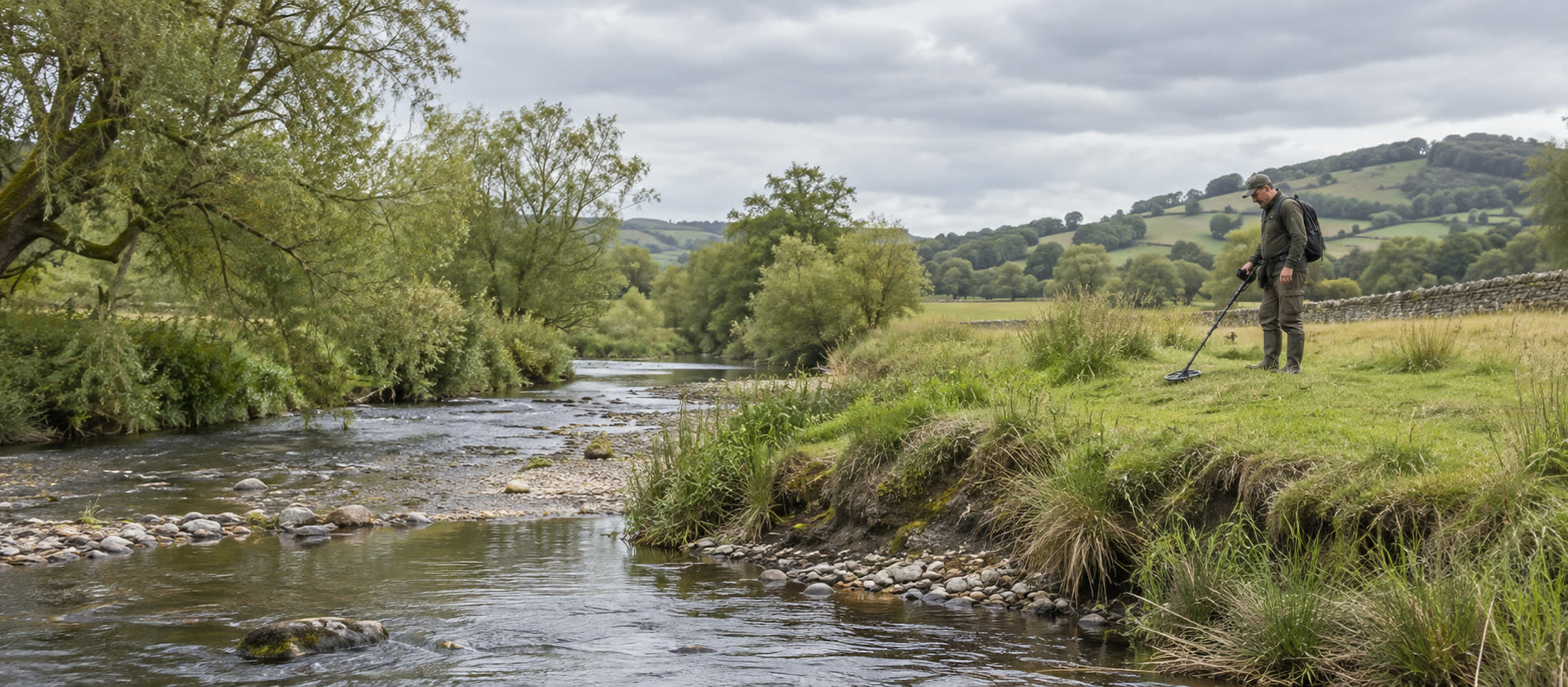
Identify the landowner, the permitted bank and any separate watercourse rules.
Check upstream weather and flood warnings; never chase a signal into the current.
Keep excavation away from eroding edges, flood defences, roots and habitat.
Bank, bed and path may have different rights
Start by identifying the owner or authorised manager of the exact bank. A public riverside route permits passage, not detecting or digging. Do not assume the person who farms the adjacent field also controls the riverbed, a towpath or flood defence. The South Downs National Park Authority's metal-detecting FAQs note that some rivers are privately owned and protected designations can cover banks and watercourses. Ask for the searchable boundary, recovery depth and finds agreement in writing. Our permission-agreement checklist helps make that conversation specific.
Scheduled monuments, SSSIs and sensitive habitats can bring further restrictions. Banks may also conceal archaeological deposits that erosion has exposed. A landholder's ordinary permission does not settle those questions. Avoid digging in a flood bank or defence: regulated work near main rivers and flood-defence structures can require additional authorisation under Environment Agency flood-risk activity guidance. If the proposed work touches these structures, ask the authority rather than guessing which exemption applies.
Check water conditions before leaving home
Rain upstream can alter a stream that looks calm where you stand. Check the relevant national flood and river-level service; in England, GOV.UK's flood checker shows warnings and levels. If the bank is undercut, slippery, recently overtopped or the exit is doubtful, choose another site. Keep a companion informed, carry a charged phone and do not step into water to retrieve a target. Waterproof electronics are not personal safety equipment.
Even on a dry day, keep back from the lip and avoid steep cut banks, exposed roots and loose stones. Leave fishing lines, livestock watering points and wildlife habitat undisturbed. If an object looks like a weapon or munition, do not handle it; follow dangerous-finds advice.
Why river-edge signals are difficult
Gravel, clay, iron-rich stones and scattered modern litter can change over a few steps. A coil may move across uneven tufts and air gaps, making target ID less steady. Start with the manufacturer's general or field mode, ground-balance as instructed and lower sensitivity until the machine is quiet enough to hear repeatable signals. Check a response at two angles before considering recovery. The mineralised-soil guide explains when ground noise can be mistaken for a target.
A waterproof machine such as the X-TERRA ELITE has a published whole-detector rating, but confirm seals, connections and manual limits before wet use. It does not authorise in-stream detecting, and a coil-only rating on another machine is not the same thing. Our waterproof-detector guide separates those boundaries.
Recover only where the bank can be restored
If the agreement allows shallow recovery on dry stable ground, pinpoint carefully and work in the smallest area that can be put back. Do not cut into a natural bank section, exposed archaeology, roots or compact layers. Keep soil from falling into the channel. Photograph and record unusual or associated material in place before moving it; erosion can reveal useful context that will otherwise vanish. The record-a-find guide sets out a simple location note.
When the water rises, footing worsens or the bank starts shedding soil, stop. No target is worth entering a river or weakening its edge. Finish by removing safe litter and leaving access exactly as agreed with the owner.
Common questions
Frequently asked questions
Can I detect a riverbank from a public footpath?
The footpath grants passage, not a right to search or excavate the bank. Establish the landowner and any protected or watercourse restrictions first.
Does a waterproof detector make stream detecting safe?
No. Its rating concerns the equipment, not current, unstable banks or your exit. Stay on stable permitted ground and never chase a signal into moving water.
Should I detect by a river after heavy rain?
Check upstream rainfall, flood warnings and actual levels. If the bank is wet, undercut or the route is doubtful, postpone the visit.
Can I dig into a riverbank or flood defence?
Do not assume so. Ownership, habitat, archaeology and flood-risk activity controls may apply. Ask the relevant land manager and authority before any work affecting these features.
Helpful products
Wet-weather-capable equipment, with a firm safety limit
A manufacturer-rated waterproof detector may tolerate wet conditions, but it cannot make moving water or an unstable bank safe. Only use one where access and recovery are authorised.

Upper mid-range
Minelab X-TERRA ELITE
Best for: Regular field, park and beach use where stable mixed-ground performance and detailed controls justify a higher budget.
- Multi-IQ; 15 kHz inland option
- Whole detector to 5 m (IP68)
- 1.3 kg
Multi-IQ simultaneous multi-frequency operation, six search profiles and a 5 m waterproof build make this a capable step-up detector for varied UK ground.
Know before buying: Its larger coil and deeper menu demand more concentration than a simple starter model, and wireless audio uses Minelab's compatible low-latency system rather than ordinary Bluetooth.