
PLACES · WINTER CONDITIONS
Metal detecting in cold weather
Plan a safer UK winter detecting session with checks for frozen ground, short daylight, battery behaviour, wet kit, permissions and careful recovery.
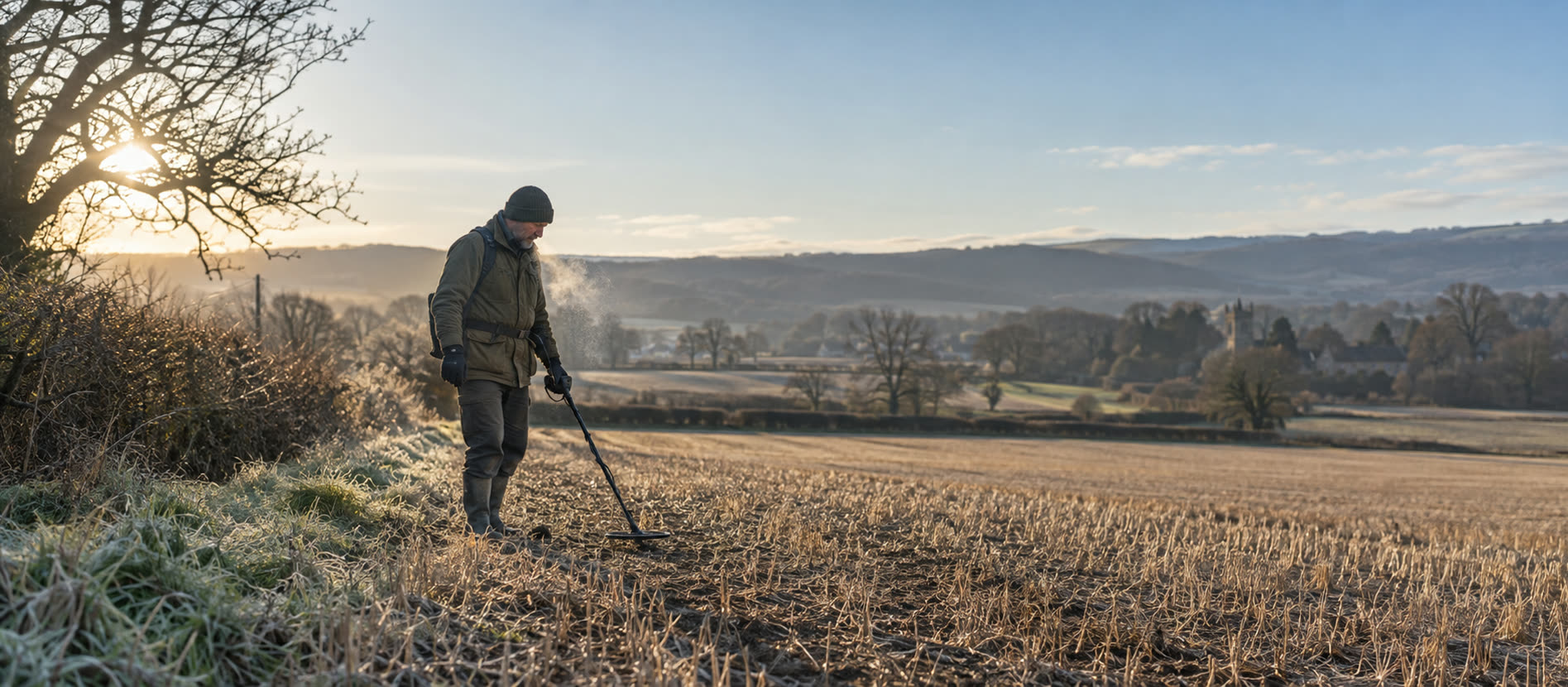
Confirm the field is open and check weather, access and daylight before leaving.
Test whether the surface will reinstate; do not cut frozen or saturated turf.
Keep power, phone and essential layers warm and dry within their instructions.
Choose a winter permission that can withstand a visit
Short pasture or worked ground may look inviting when summer growth has died back, but the occupier still decides when access is allowed. Ask about grazing, shooting days, forestry work, waterlogged gateways and field operations. Agree parking that will not churn a verge. Our pasture and stubble-field guides give surface-specific plans; winter does not waive any protected-site condition.
Check the forecast for wind, rain, ice and daylight. Choose a smaller search block than you would in summer and set a firm return time. Give a contact the access point and expected check-in if alone; solo detecting safety covers the plan. Do not enter a remote wood or waterside bank because cold weather has reduced crowds.
Frozen ground and sodden ground are stop signs
Turf cut while frozen can break instead of hinge and may not sit back level when it thaws. Waterlogged plugs can smear, collapse or leave ruts under boots. If a small permitted test recovery will not restore immediately, stop digging. A surface-only session may still teach signals, but only if the manager allows scanning. Avoid levering a tool through frost or roots; it risks both injury and land damage.
On cultivated land, a hard crust can conceal soft ruts. Walk slowly, keep away from steep edges and do not disturb an exposed archaeological feature. Summer hard ground has a different cause but the same central rule: no clean reinstatement, no routine recovery.
Expect equipment to behave differently
Battery performance can decline in cold conditions. Start with a charged detector and phone, keep a safe spare power source within the maker's temperature guidance and avoid charging a very cold lithium battery until it has warmed as instructed. Check the detector manual for its operating and charging limits rather than assuming one rule applies to every model. Moisture and condensation can affect connectors; wipe kit dry and let it reach room temperature before sealing it in storage.
Thick gloves may make small controls awkward. Set a familiar programme before walking, use a stable sensitivity setting and secure the coil cable so cold-stiffened loops do not tap the shaft. Wind can hide a quiet tone. Headphones may help, but verify compatibility and keep one ear aware of other users, livestock or machinery as appropriate.
Use a compact search and exit early
Work short lanes with a level sweep rather than striding to keep warm. Cold fingers encourage rushed target recovery; pinpoint twice, lay soil on a cloth and stop when dexterity or visibility falls. Bring a warm layer for standing still during find recording, water and food for the planned duration, and a way to navigate without relying only on mobile signal.
Photograph unusual objects before moving them and keep finds in separate labelled containers. The record-a-find guide gives a quick field record. Clean mud from kit, inspect cable and seals, and tell the occupier if a gate or route has become unsafe. A short winter session that leaves no trace is a successful one.
Common questions
Frequently asked questions
Can I metal detect on frozen ground?
Scanning may be possible where authorised, but do not force a plug through frozen turf that will fracture or fail to reinstate.
Do detector batteries run down faster in cold weather?
Cold conditions can reduce available battery performance. Start charged and follow the exact maker's operating and charging temperature instructions.
What is the main winter field safety check?
Confirm daylight, weather, access and a return plan. Avoid waterlogged routes, remote hazards and a last-minute recovery as visibility fades.
Are headphones useful in winter wind?
Compatible headphones can help you hear quiet signals, but keep awareness of people, livestock, machinery and the route out.
Helpful products
Hear subtle audio without running loud
Compatible headphones can make signals easier to hear in winter wind; check the detector's exact wireless protocol and keep your awareness of people and machinery.

Premium wireless headphones
Minelab ML85 Headphones
Best for: X-TERRA PRO, X-TERRA ELITE, EQUINOX 700/900 and MANTICORE owners who want the intended wireless connection.
- Low-latency 2.4 GHz wireless
- Not submersible
- 221 g
Low-latency wireless audio, a detachable 3.5 mm cable and long rechargeable runtime make the ML85 a flexible match for supported newer Minelab detectors.
Know before buying: Minelab's wireless system is proprietary and model-specific; these are not submersible and do not wirelessly pair with older models such as the EQUINOX 800.