
Head-to-head · TWO ADJUSTABLE STARTERS
Nokta SIMPLEX Ultra vs Minelab X-TERRA PRO
Compare Nokta SIMPLEX Ultra and Minelab X-TERRA PRO for UK fields and beaches, including frequency, recovery, ground balance, coils, audio and waterproofing.
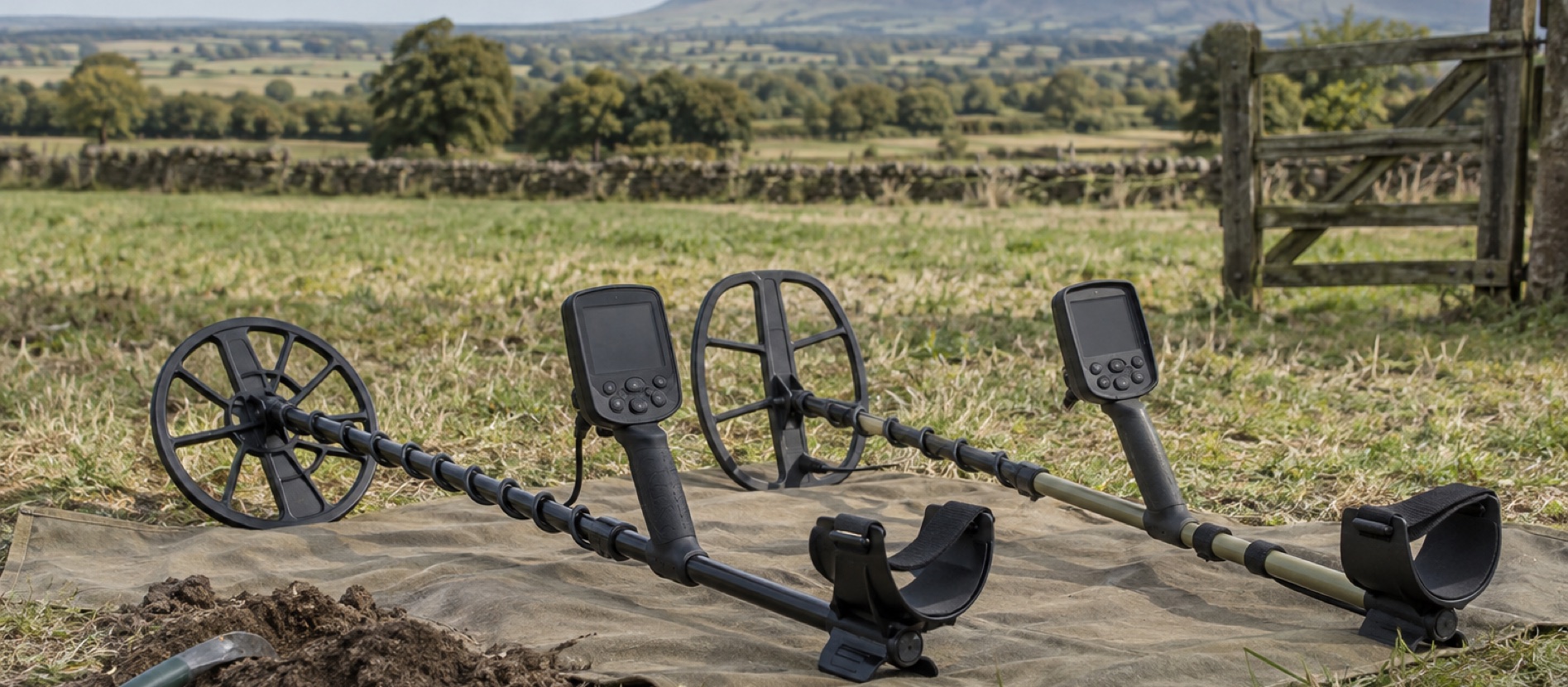
Our recommendations
Two capable but different field machines
These picks appeal to someone who wants more control than a basic starter without assuming a higher number of settings guarantees more finds.

Settings-led beginner
Nokta SIMPLEX Ultra
Best for: Inland permissions and freshwater use for a beginner who wants settings to learn rather than automatic multi-frequency operation.
- 15 kHz single frequency
- Whole detector to 5 m (IP68)
- 1.2 kg
A fully waterproof 15 kHz detector with six search modes, manual or automatic ground balance and unusually detailed tone and recovery controls for the price.
Know before buying: Beach mode helps with salt response, but the single 15 kHz platform can still need lower sensitivity and careful ground setup on wet salt sand.

Upper mid-range
Minelab X-TERRA PRO
Best for: A committed inland beginner who wants to learn how frequency, ground balance and audio choices change detector behaviour.
- Selectable 5 / 8 / 10 / 15 kHz
- Whole detector to 5 m (IP68)
- 1.3 kg
Selectable 5, 8, 10 and 15 kHz operation, six search profiles and detailed tone and discrimination controls give a keen beginner more room to progress.
Know before buying: Selectable frequencies are not simultaneous multi-frequency, and the extra controls create a steeper first-week learning curve.
| Feature | SIMPLEX Ultra | X-TERRA PRO | Why it matters |
|---|---|---|---|
| Frequency | Fixed 15 kHz single frequency | Selectable single frequencies by mode | PRO offers a frequency choice but neither runs simultaneous multi-frequency |
| Modes | Field Park 4 Tone 99 Tone Beach All Metal | Park 1/2 Field 1/2 Beach 1/2 | Both have useful inland and beach starting profiles |
| Recovery | Adjustable 1 to 5 | Adjustable 1 to 3 | Both can trade close-target separation against marginal response |
| Ground balance | Automatic or manual | Automatic manual or tracking | PRO can follow gradual changes while Ultra requires a deliberate rebalance |
| Standard coil | 11-inch round DD | 12 by 9-inch elliptical DD | PRO covers open ground broadly; Ultra is a little narrower |
| Target IDs | 01 to 99 | Ferrous -19 to 0 and non-ferrous 1 to 99 | Numbers do not translate directly between brands |
| Waterproofing | Whole detector to 5 m | Whole detector to 5 m | Audio and open ports have separate limits |
| Weight | Listed 1.2 kg | Listed 1.3 kg | Fit and balance matter as much as the small figure difference |
The key difference is frequency choice versus tone flexibility
Nokta's SIMPLEX Ultra specification lists fixed 15 kHz operation, Field and Beach modes, adjustable recovery, tone break, tone frequency and tone volume. Minelab's X-TERRA PRO specification lists selectable single frequencies: 5, 10 or 15 kHz in Park and Field, and 8 kHz in Beach. The PRO also provides tracking ground balance. Those are meaningful differences for a learner who intends to keep notes and change one control at a time.
Do not confuse the PRO's selectable frequencies with simultaneous multi-frequency. Only one is active at a time. Nor should you assume the Ultra's larger number of recovery steps means greater depth; a setting scale is not a performance test. On mild ordinary soil, coil control and a stable starting mode may matter more than either feature.
SIMPLEX Ultra: strong audio and recovery control
The Ultra's Field, Park, 4 Tone, 99 Tone, Beach and All Metal modes give different ways to hear the same ground. Its 1–5 recovery-speed setting can make close targets clearer among iron, while its tone break and tone-frequency controls let you alter what information is prominent. The five-step scale is especially easy to demonstrate with a coin beside a nail. Nokta's manual says faster recovery can help nearby targets but can reduce depth response; do not set it high everywhere.
The whole detector is rated IP68 to 5 m, its supplied SX28 coil is 11 inches and the listed weight is 1.2 kg. The carbon-fibre shaft may appeal to someone walking long lanes. Its fixed 15 kHz frequency is a limitation when you want to experiment with frequency response, and its single-frequency Beach mode can need compromises on difficult wet salt. A quiet inland field is its clearest use case.
X-TERRA PRO: broader frequency and ground choices
The PRO has two profiles each for Park, Field and Beach. Park and Field allow 5, 10 or 15 kHz; Beach uses 8 kHz. This gives a methodical user a way to compare stability and response on the same ground without buying a different detector. It also offers automatic, manual and tracking ground balance, a 1–3 recovery scale, a range of tone options and a supplied 12-by-9-inch elliptical V12X coil.
For an open, lightly contaminated field, that coil covers ground efficiently. Around a tight iron patch, a smaller compatible coil or shorter sweep may be preferable. The listed 1.3 kg weight is close to the Ultra's, but balance in your own hand and the retailer bundle matter. The PRO's control depth also means more opportunity to create a noisy programme by changing frequency, ground balance and sensitivity at once.
Which is easier around iron?
Both allow recovery-speed changes; neither guarantees a coin will be heard beneath a nail. The Ultra offers finer recovery steps and detailed tone shaping. The PRO offers a larger stock coil that may cover several nearby objects at once, but supports a smaller compatible option. Start with the factory Field profile, only mild rejection and a surface coin-and-nail check. Raise recovery by one step if the coin disappears beside the nail, then listen again from two directions.
The detecting-around-iron guide separates masking from misleading iron chirps. If the field is mostly open, do not select either machine solely on an iron feature you rarely need.
Ground balance and mineralisation
Both have automatic and manual balance. The PRO adds tracking, which can adapt as ground gradually changes. Tracking is not a button to leave on without thought: test a known target when moving into a different soil patch and understand the manual's behaviour around weak responses. The Ultra's manual balance is sufficient for many permissions if you stop and repeat it as the ground changes.
Electrical interference is a separate problem from soil. Run frequency shift or noise cancel as directed before blaming mineralisation. The mineralised-soil guide gives an orderly diagnostic sequence.
Beach and water use
Both complete detectors are rated to 5 m, but water protection does not automatically make wet salt sand quiet. Each has a Beach mode; the PRO provides Beach 1 and Beach 2, while the Ultra has a single Beach profile. For an occasional damp-sand outing, either may be workable after appropriate setup and lower sensitivity. For frequent tide-line searches, consider simultaneous multi-frequency options in the wet-sand shortlist.
Check the exact cap, connector and compatible waterproof audio before entering water. Above water, wireless audio support differs by accessories and bundle; ordinary Bluetooth headphones should not be assumed to work with every low-latency system. Rinse only as the manufacturer's manual permits after salt exposure.
A decision by actual use
Choose SIMPLEX Ultra if you mostly search inland, want flexible tones and fine recovery adjustment, and prefer its 11-inch stock coil and light listed weight. Choose X-TERRA PRO if you want to compare selectable frequencies, use tracking ground balance and value its six distinct starting profiles. If wet salt will dominate, compare a simultaneous multi-frequency detector rather than treating either waterproof rating as a salt-processing claim.
Neither offers a guaranteed depth advantage. Try the grip, menu and supplied coil if a dealer demonstration is available, then use the same simple practice targets at home. A comfortable machine you understand will serve a new permission better than a complex one left unstable.
Before the first field
Confirm permission, set the shaft for your boots, secure the coil cable and practise with a coin, foil and a nail on a permitted surface. Note one stable Field profile and change one setting at a time. That record makes the first actual signals much easier to interpret.
Common questions
Frequently asked questions
Is X-TERRA PRO simultaneous multi-frequency?
No. It lets you select one frequency at a time according to mode. SIMPLEX Ultra uses a fixed 15 kHz; neither runs simultaneous multi-frequency.
Which has more recovery-speed control?
SIMPLEX Ultra provides settings 1–5 and X-TERRA PRO settings 1–3. The scales are not directly comparable performance measurements; test each model's response on the same close-target situation.
Which is better for wet salt sand?
Both have Beach modes and can be adjusted, but both use single-frequency operation. For frequent wet tide-line searching, compare a suitable simultaneous multi-frequency model as well.
Are both detectors waterproof?
Both complete detectors are rated IP68 to 5 m, subject to properly fitted caps and manufacturer instructions. Headphones and connectors have their own water limits.