
STARTING OUT · FAMILY FIELD DAY
Metal detecting with children in the UK
Plan a short, supervised metal detecting outing with children: permission, child-sized equipment, safe targets, gentle recovery and realistic expectations.
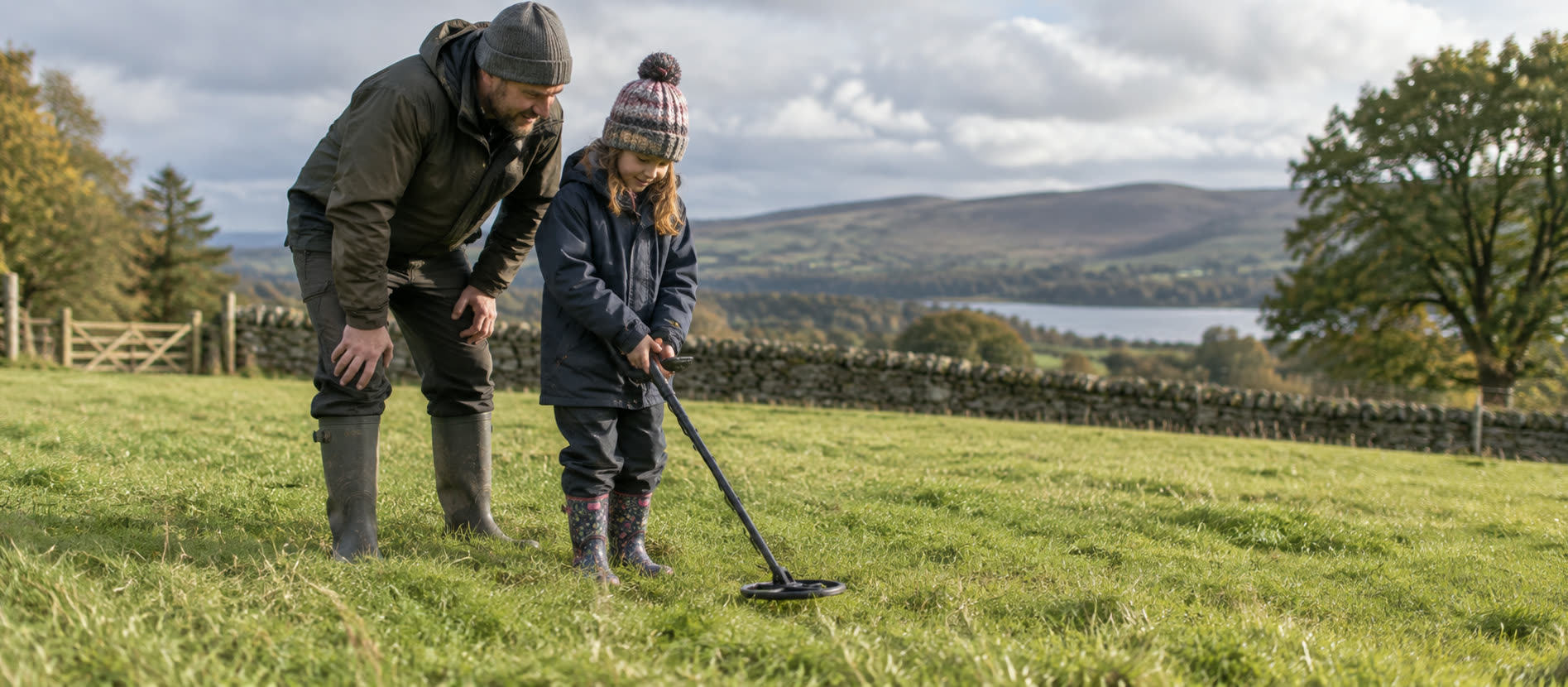
Ask for permission that explicitly includes the child and recovery.
Fit the shaft and keep the session short.
Let the adult assess holes and any unknown metal.
Start with the right place
A garden you control can be useful for simple surface tests, provided you know what is buried there. For a real outing, get the authorised landowner or occupier's permission for both detecting and any digging. Do not assume a public park, footpath or open beach is automatically available. The UK permissions guide explains why land access, detecting and recovery are separate questions. Avoid scheduled sites, livestock, crops, steep banks, littered ground and places where a child could wander beyond your agreed area.
Tell the child what a detector does and does not do: it responds to metal, not to “treasure”. Begin with a few familiar safe objects placed on a mat or on the surface of permitted ground, then move to ordinary signals. Set a small search patch and an easy finish point. A 20-minute successful session is better than hours of tired swinging and holes. Bring water, suitable layers, hand wipes, gloves and a way to collect ordinary rubbish.
Fit matters more than the age printed on the box
The child should be able to hold the detector with a relaxed arm and move the coil low over the ground without dragging it. If the shaft remains too long or the coil feels heavy after a few minutes, the machine is not a good fit however attractive its screen looks. Nokta describes the Midi Hoard as an 880 g, 83–109 cm adjustable detector for roughly ages 8–12+; that is a manufacturer's guide, not a universal size rule. An older or taller child may be more comfortable with a simple adult machine. See our children's detector guide and teenager guide for those different needs.
Teach the sequence, then supervise recovery
Demonstrate a slow overlapping sweep, a second pass from another direction, and how to stop the coil without hitting a person or animal. Praise a careful check even when the target is a bottle cap. A number on the screen cannot identify an object with certainty; the first signals guide explains what the audio and repeatability can tell you.
An adult should decide whether recovery is permitted, safe and sensible. Check for glass, sharp scrap and unknown objects before a child reaches into soil or sand. Keep the recovery tool in adult hands unless the child is old enough, trained and directly supervised for that particular tool and ground. Restore any authorised plug neatly and remove safe litter. Never let a child pick up suspected ammunition, an unexplained container or a possible hazardous find; stop and follow our dangerous-finds guidance.
If a potentially archaeological object appears, photograph and record the exact private findspot before moving it. Do not scrub it to make the pattern visible. The finds-care starting point shows a simple record. Be clear with the child that ownership and reporting do not change because they found it; the finds ownership guide covers that conversation.
Finish with a small win
Let the child choose one ordinary safe object to sketch or photograph, and note which sound led to it. Count recovered rubbish as useful ground care. Check clothing for ticks after grassy or scrubby ground and follow NHS advice if one is attached. At home, clean hands before eating and compare the day's signals with the beginner practice plan. A good first trip ends with curiosity intact.
Common questions
Frequently asked questions
Can children metal detect in a public park?
Not automatically. Public access is not permission to detect or dig. Check with the authorised owner or manager and follow any exclusions.
How long should a child's first detecting session be?
Keep it short enough to end while they are still interested. A small patch and a few repeatable signals teach more than an exhausting search.
Should a child dig their own signals?
An adult should first decide whether recovery is permitted and safe, inspect for sharp or unknown material, and directly supervise any suitable tool use.
What if a child finds something that looks old?
Record the precise private findspot and photograph it before moving it. Do not clean it; check reporting and ownership with the landholder and relevant service.
Helpful products
A detector sized for a younger learner
A lighter, shorter shaft can make the first sweep much easier. Check the child's actual fit and attention span before buying.

Child-sized
Nokta Midi Hoard
Best for: A supervised child around the maker's suggested 8–12+ age range who needs a shorter, lighter machine than an adult model.
- 15 kHz single frequency
- Whole detector to 1 m (IP68)
- 880 g
A purpose-sized 880 g detector with an adjustable 83–109 cm shaft, pinpoint control, three tones and a fully waterproof 1 m build.
Know before buying: It takes two AA batteries and its shorter shaft may be outgrown; age guidance does not replace an individual fit check or adult supervision.