
FIELD KIT · BUYING GUIDE
Best metal detector bags for UK field travel
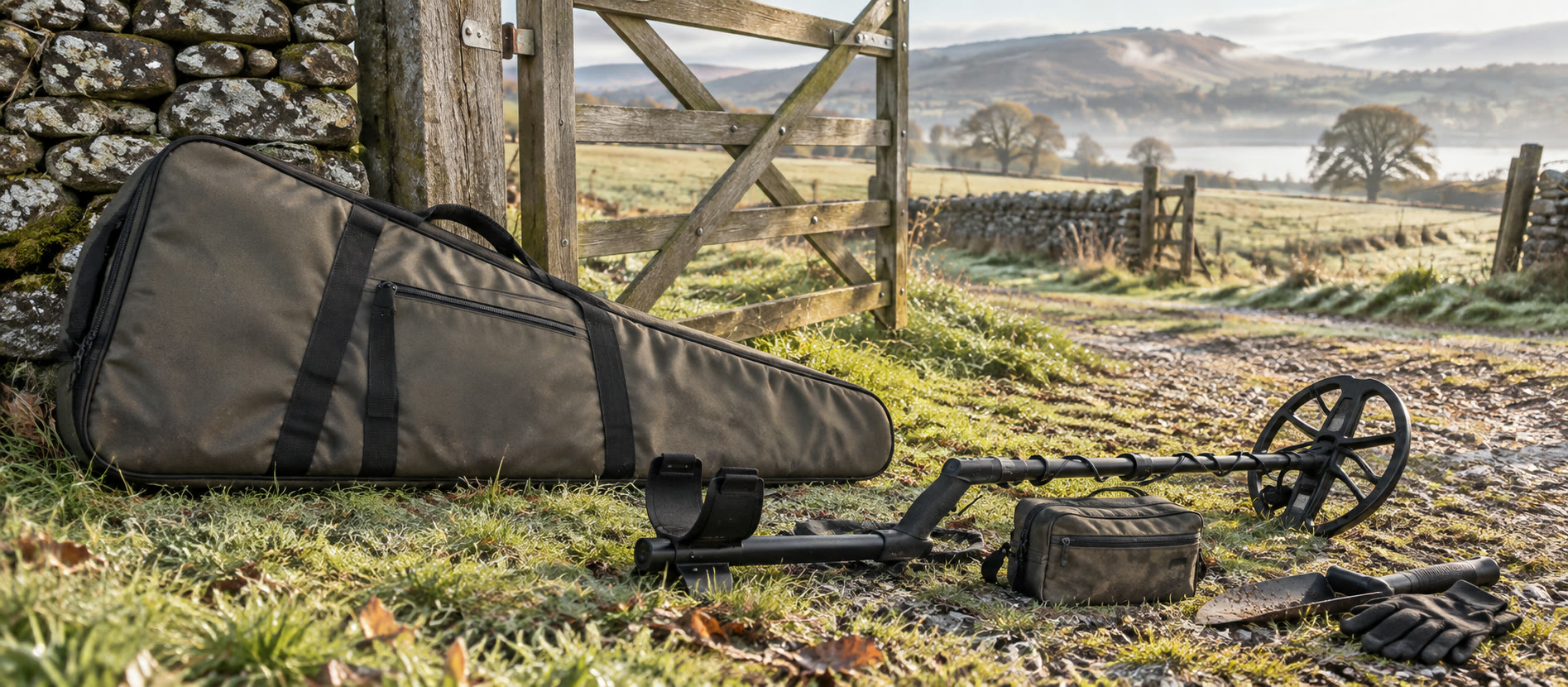
Find the right metal detector carry bag for UK car or public-transport trips. Check assembled length, coil clearance, wet-kit separation and padding.
Our recommendations
Relevant verified products
The Minelab Universal Carry Bag is a verified retailer example. “Universal” in its name is not a fit guarantee for every modern detector or coil.

Soft carry bag
Minelab Universal Carry Bag
Best for: Owners who transport a detector regularly and want one dedicated outer bag.
- Full-length bag
- Measure detector first
- Dry transport
A full-length soft carry bag sold for metal detector transport; check internal length and coil clearance against the exact assembled machine.
Know before buying: Universal does not prove every coil, shaft setting or accessory fits; do not pack a wet detector away long term.

Compact branded pouch
Minelab Finds Pouch
Best for: Detectorists who prefer a small, uncomplicated pouch and already carry a separate finds box for delicate objects.
- Hip-mounted finds storage
- Lightweight shell construction
- Compact field format
A compact waist pouch intended to keep ordinary finds and small tools at the hip, with a lightweight format that is easy to add to a basic field kit.
Know before buying: The shell pouch is not a substitute for individual bags, labels or a rigid box when precise findspots and fragile surfaces need protecting.
| Format | Best use | Advantage | Main caution |
|---|---|---|---|
| Full-length detector bag | Frequent car or train travel | Fewer assembly steps | Measure internal length and coil width |
| Detector broken down | Small storage space | Smaller case possible | More handling of connectors and cable |
| Small finds pouch | On-body field carry | Separates rubbish and finds | Not detector transport protection |
Measure before choosing a bag
Record the detector's packed length, widest fitted coil, control housing depth and any projecting armrest. Then compare those measurements with the current bag listing's internal dimensions, not an outside photograph. A zipper should close without pressing on the screen or cable. If you routinely swap coils, plan for the largest one you carry. The coil-cable problem guide explains why tight packing can strain connections.
A full-length option: Minelab Universal Carry Bag
Minelab's named carry bag is a straightforward soft carrier for trips where a detector stays largely assembled. The listing alone does not establish a protective impact rating or exact fit across the whole catalogue. If your model is a VANQUISH 360, X-TERRA PRO or another machine, check the packed measurements and strap arrangement against the live listing before ordering. A soft bag prevents snagging and keeps parts together; it is not a hard flight case.
Keep the field pouch separate
A finds pouch is for the search, not for cushioning a screen in a car boot. The Minelab finds pouch shown below illustrates the separate role: carry ordinary stable finds and sharp scrap in designated sections while the detector bag remains clean. Label significant finds independently and follow the field-log method.
Padding, straps and wet kit
Inspect padding where the control housing rests, not just at the ends. A shoulder strap should distribute weight without letting the coil swing against a gate or vehicle. Do not put an exposed spade blade against the coil. After a beach session, rinse and dry the detector according to its exact manual, then leave the bag open until both are dry. Sealing salt and moisture into fabric encourages corrosion and odour; see cleaning after the beach.
Before ordering a detector bag
Mock up the packed kit on the floor. Include headphones, batteries or charging cable, pinpointer, water and a separately sheathed digging tool. If the bag needs to hold all of them, verify pockets and weight rather than relying on a “universal” title. If your machine already came with a backpack—as the X-TERRA Voyager bundle does—try that first before adding another carrier.
Common questions
Frequently asked questions
Will a universal detector bag fit my machine?
Not necessarily. Measure the packed length and widest fitted coil, then compare the bag's internal dimensions.
Can I store a wet detector in a carry bag?
Not for long. Clean and dry the detector as its manual directs, then leave the bag open until dry.
Should a spade go in the detector bag?
Only in a protected compartment that cannot put its blade against the coil or control housing.
Is a finds pouch the same as a detector bag?
No. A pouch carries separately organised field finds and scrap; a detector bag transports the machine.