
Detector fundamentals · FIELD NOTE 18
VLF vs pulse induction metal detectors
Compare VLF and pulse induction metal detectors for UK fields, beaches and mineralised ground, including target ID, weight and practical trade-offs.
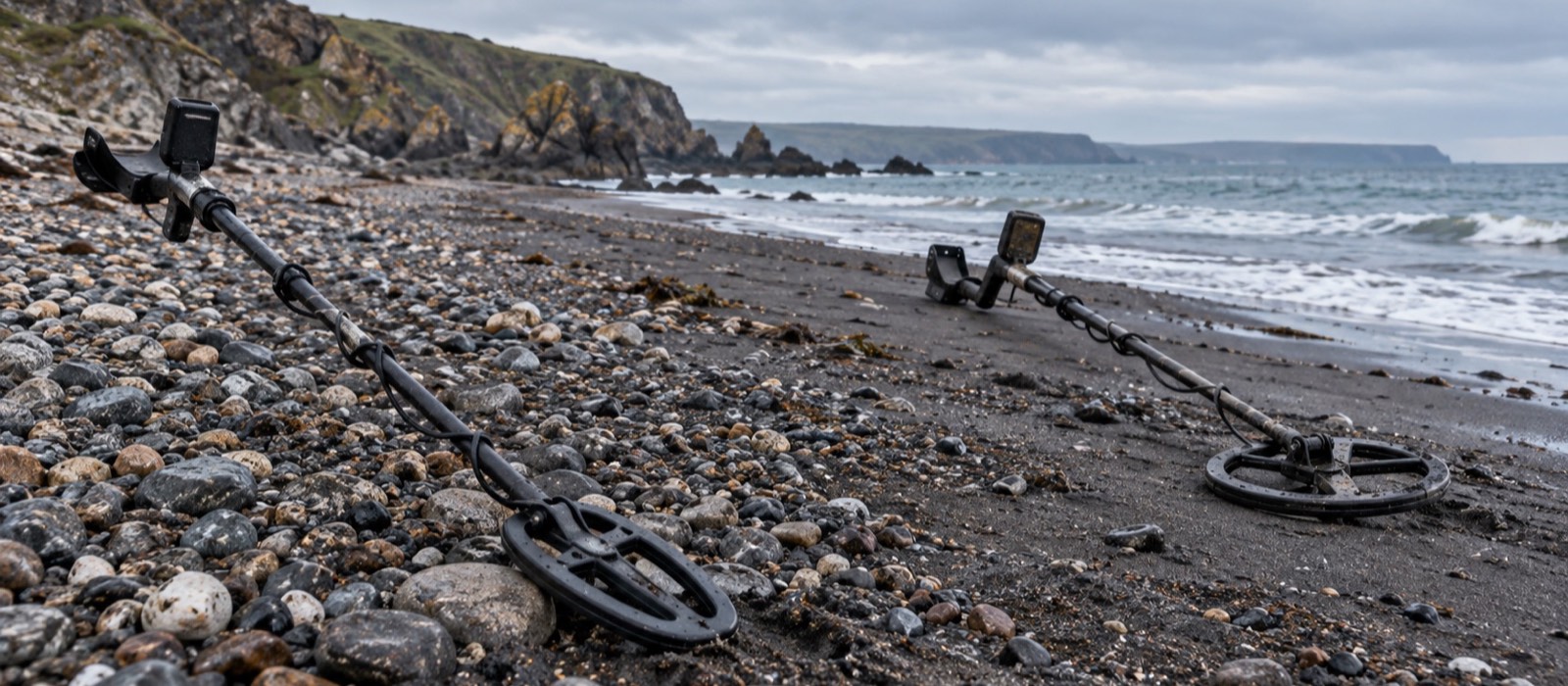
VLF describes a continuous-wave detection approach; it is not another name for single frequency.
Pulse induction handles difficult ground well but can make iron and non-ferrous targets harder to separate before digging.
Choose for the ground and target mix you can legally search, not for a depth claim in isolation.
The difference is how the detector transmits and listens
A VLF detector transmits a continuous alternating signal and evaluates the response returned through the search coil. Modern VLF machines may use one fixed frequency, a selectable frequency or several frequencies simultaneously. This family includes most familiar coin, relic and general-purpose detectors.
A pulse induction detector sends short, strong pulses and measures the decay after each pulse. Its timing can reduce the effect of mineralised ground that would dominate a conventional VLF response. Minelab's technical explanation of detector operation describes the common electromagnetic principle, while its ground-balance comparison shows why PI is valuable in difficult goldfield ground.
That engineering distinction matters, but it does not make one technology universally deeper or better. Coil design, power, processing, target size, orientation, ground conditions and the operator's sweep all change the result.
Where VLF detectors make more sense
VLF is the strong general choice for UK pasture, cultivated fields, permissioned parks and most recreational beaches. It can provide target ID, multiple tones, iron rejection and notch discrimination, helping a user decide which uncertain signals deserve recovery. A broad market also means lighter machines, more coil choices and simpler entry-level controls.
Wet salt sand is the important caveat. A fixed single-frequency VLF may become noisy or require a noticeable sensitivity reduction. A well-designed simultaneous multi-frequency VLF detector is normally the more practical all-round beach answer; see our multi-frequency versus single-frequency guide and beach detector shortlist.
The X-TERRA PRO is a useful example of selectable-frequency VLF. It lets the operator choose among inland frequencies and provides a separate beach frequency, but it uses one selected frequency at a time. That flexibility can help with interference and target emphasis without turning the detector into a simultaneous-frequency machine.
Where pulse induction earns its place
PI is most attractive when severe ground mineralisation overwhelms ordinary VLF operation, or when a specialist detectorist accepts more digging in exchange for stable detection in difficult conditions. Dedicated PI beach machines can work in salt and black sand, and gold prospecting models are built around ground that is far removed from an average British pasture.
The trade-off is target information. Many PI detectors are effectively all-metal machines with limited discrimination compared with a modern VLF coin detector. On a beach full of hairpins, bottle caps and fishing debris, that can mean recovering far more iron. PI machines may also be heavier, more expensive and less intuitive for a first detector.
Do not buy PI simply because a listing says “maximum depth”. A large iron object may respond deeply while a thin coin at an awkward angle does not. Useful depth is the depth at which the detector still gives a stable, interpretable response in the ground you actually search.
VLF, PI and simultaneous multi-frequency are not one scale
Simultaneous multi-frequency is normally implemented within the continuous-wave/VLF family. It combines information from more than one frequency during detection; it is not pulse induction. Likewise, a detector that can switch between 5 kHz and 15 kHz remains selectable single-frequency when it operates only one choice at a time.
This prevents a common buying error: treating fixed-frequency VLF, selectable VLF, simultaneous multi-frequency and PI as four price tiers. They solve different problems. A simple fixed-frequency detector can be excellent on clean inland ground, while an expensive PI machine can be frustrating on an iron-filled permission.
Which should you choose?
Choose VLF or simultaneous multi-frequency when you want one detector for ordinary UK fields, parks and beaches, especially if target ID and iron information matter. Choose PI only when difficult mineralisation or specialist work is the central problem and you understand the extra digging it can bring.
Before spending more, test whether better coil control, a correct ground balance, a quieter sensitivity setting or a more suitable search profile solves the instability. If electrical noise rather than soil is the problem, follow the interference checklist instead of changing detector technology.
A simple field comparison
On known clean ground, bury no historical material and use ordinary test targets you can remove. Compare a small foil piece, an iron nail and several modern coins at shallow, controlled depths. Listen from two directions and note how repeatability changes near iron. The exercise teaches more than an air-test depth number because it exposes the practical difference between hearing a target and interpreting it.
Common questions
Frequently asked questions
Is VLF or pulse induction better for beginners?
VLF is usually easier for a first detector because it offers more target information and discrimination. Pulse induction suits specialised difficult ground but often provides less help separating iron from desirable targets.
Which technology is better on wet salt beaches?
Pulse induction can remain stable in severe mineralisation, while a capable simultaneous multi-frequency VLF detector offers stronger target identification. The better choice depends on ground severity and how much iron is present.
Does pulse induction detect deeper than VLF?
It can have an advantage in highly mineralised ground where some VLF detectors lose stability or depth. On mild ground, coil size, target size, settings and technique can matter more than the technology label.